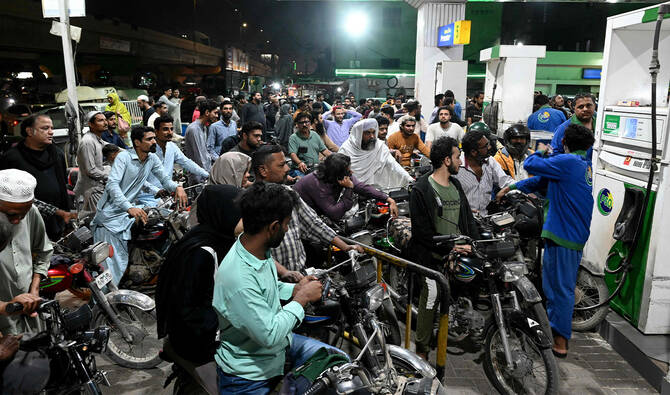

KARACHI: Pakistan’s economy is bound to bear the brunt of a recent hike in fuel prices by more than 20 percent, economists and industry leaders warned this week, fearing the move is expected to slow economic growth, increase inflation and hurt already declining exports.
Pakistan’s government on Friday increased petrol and diesel prices by Rs55 ($0.20) per liter each as the ongoing conflict in the Middle East, involving Iran, Israel and the US, sent global oil prices sharply higher and disrupted energy supply routes.
The price of petrol was revised up by 21 percent to Rs321.17 per liter while diesel was increased by 20 percent to Rs335.86 per liter. International oil prices have surged by 37 percent to around $106.8 per barrel from $78 on Mar. 1, while diesel prices have increased to about $150 per barrel since the conflict began on Feb. 28.
“The economy was picking up sluggishly, so I think that pace will slow down a bit,” Muhammad Saad Ali, head of research at Lucky Investments Ltd., told Arab News.
“Next year, it is expected that there will be more than 4 percent GDP growth, so potentially that might not happen,” he added.
Pakistan’s central bank said in February that the country’s growth outlook for the current fiscal year has improved to 3.75-4.75 percent due to improved economic activity. The growth will further improve in FY27, the State Bank of Pakistan (SBP) said in its bi-annual Monetary Policy Report.
Ali said the surge in fuel prices would also weigh on consumer price inflation, which rose to 7 percent last month to mark a 16-month high.
“It’s obvious that inflation will increase by 0.7 percent to 1 percent in the future,” Ali said.
He said it was expected that inflation would increase to 8-9 percent by May or June due to the base effect.
“Potentially, it will increase by 0.5 percent to 1 percent,” he said, adding that inflation projections would jump “a lot” in the months ahead.
“The State Bank talks about it a lot. People will cut back on their expenses,” he warned.
Pakistan’s finance adviser Khurram Schehzad and finance ministry spokesperson Qamar Sarwar Abbasi did not respond to Arab News’ questions on the issue.
‘HUGE BURDEN’
Pakistan’s SBP surprised investors in January by keeping the policy rate unchanged at 10.5 percent. The International Monetary Fund (IMF) has asked Islamabad to maintain an “appropriately tight” monetary policy to anchor inflation.
“If oil prices remain elevated, it would upset our inflation and interest rate outlook,” Ali said, adding that the IMF too was likely to be “strict” in its dealings with Pakistan now.
Ali expects the SBP to maintain its borrowing rate at 10.5 percent or increase it by 50 basis points next week. The central bank is scheduled to announce its monetary policy on Monday.
Meanwhile, Karachi Chamber of Commerce & Industry (KCCI) President Rehan Hanif lamented that the oil price hike was “unjustified.”
“This is a huge burden that the government has put on the middle class at a time when people are already coping with Ramadan and Eid-related inflation,” he said.
“This burden could have been avoided without any loss because the reserves of petroleum that you have now came at an old price.”
Hanif noted that while oil supplies can be maintained by importing Saudi oil via a different shipping route, Pakistani industries may suffer due to gas shortages.
“Qatar has stopped gas production,” Hanif warned. “This will lead to a huge gas crisis.”
Pakistan’s trade deficit widened by 25 percent to $25 billion in the July-February period of FY26, as per official data, with exports declining by 7.3 percent to $20.5 billion and imports rising by 8.1 percent to $45.5 billion.
“I see a shortage of gas and because of that, there will be a shortage in our industry. And our exports will be affected,” the KCCI president said.
Textiles comprise the largest chunk of Pakistan’s exports, earning around $18 billion in FY25.
Textile manufacturers, however, fear a surge in inland freight by 30 percent due to increased fuel prices.
“Your inland freight, that is Karachi to Central Punjab and Central Punjab to Karachi, will increase 25-30 percent,” Kamran Arshad, chairman of the All Pakistan Textile Mills Association (APTMA), told Arab News.
Pakistan Railways notified a 9 percent increase in its goods transportation freight and a 5 to 10 percent increase in passenger fares on Saturday.
Last year Pakistan imported petroleum products worth $16 billion, accounting for the most on Islamabad’s $58.4 billion import bill, as per official data.
Arshad explained that increasing oil prices will also increase the country’s import bill.
“The problem at the governmental level is that for every $5 increase in international oil prices, there is a $1 billion increase in Pakistan’s import bill, because your biggest import is oil,” he said.