Malnutrition treatments halted in Ethiopia due to underfunding

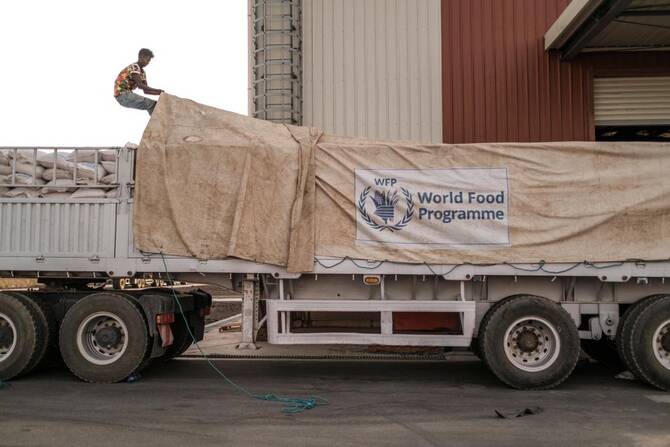
A worker covers a truck full of sacks of grain in a warehouse of the World Food Programme (WFP) in the city of Abala, Ethiopia, on June 09, 2022. (AFP)
Short Url
Updated 22 April 2025
Follow

Malnutrition treatments halted in Ethiopia due to underfunding

  • WFP says it had reduced rations in recent months and that its operations were now at breaking point

ADDIS ABABA: The World Food Programme suspended malnutrition treatment for 650,000 malnourished women and children in Ethiopia this week due to severe funding shortages, the UN agency said, with millions more at risk of losing access to aid.

WFP gets financing from 15-20 donors including the US but many of them have cut funding this year, said Zlatan Milisic, WFP Country Director in Ethiopia. The agency has received exemptions from US President Donald Trump’s aid freeze that has disrupted humanitarian work around the world, he added, but little for 2025 so far.

More than 10 million people in Ethiopia are gravely short of food, including 3 million displaced by conflict and extreme weather conditions as well as refugees from war-torn neighboring Sudan, according to WFP.

Milisic said WFP had already reduced rations in recent months but that its operations were now at “breaking point” due to severe underfunding, forcing more drastic measures.

“We’ve been left no choice but to this week suspend treatment for 650,000 malnourished women and children — simply because we’ve run out of commodities and funding,” he told a Geneva press briefing by video from Addis Ababa.

A WFP spokesperson later added that those cut off were in various locations including the northern regions of Tigray and Afar, and that the UN agency is actively seeking funding to purchase more supplies to resume treatments.

Around 3.6 million people could lose access to assistance, including some being treated for malnutrition, if more funding is not received by June, Milisic added.

“I would hope that we will get the resources and put in place measures to really do our best to assist them. But if they don’t receive assistance, we will have serious consequences.”

Ethiopia’s food crisis has worsened in recent years as a result of a 2020-22 civil war in Tigray. The country also faced the Horn of Africa’s worst drought in decades in 2022.



WHO appeals for $1 bn for world’s worst health crises in 2026

Updated 58 min 6 sec ago
Follow

WHO appeals for $1 bn for world’s worst health crises in 2026

  • The UN health agency estimated 239 million people would need urgent humanitarian assistance this year and the money would keep essential health services going

GENEVA: The World Health Organization on Tuesday appealed for $1 billion to tackle health crises this year across the world’s 36 most severe emergencies, including in Gaza, Sudan, Haiti and the Democratic Republic of Congo.
The UN health agency estimated 239 million people would need urgent humanitarian assistance this year and the money would keep essential health services going.
WHO health emergencies chief Chikwe Ihekweazu told reporters in Geneva: “A quarter of a billion people are living through humanitarian crises that strip away the most basic protections: safety, shelter and access to health care.
“In these settings, health needs are surging, whether due to injuries, disease outbreaks, malnutrition or untreated chronic diseases,” he warned.
“Yet access to care is shrinking.”
The agency’s emergency request was significantly lower than in recent years, given the global funding crunch for aid operations.
Washington, traditionally the UN health agency’s biggest donor, has slashed foreign aid spending under President Donald Trump, who on his first day back in office in January 2025 handed the WHO his country’s one-year withdrawal notice.
Last year, WHO had appealed for $1.5 billion but Ihekweazu said that only $900 million was ultimately made available.
Unfortunately, he said, the agency had been “recognizing ... that the appetite for resource mobilization is much smaller than it was in previous years.”
“That’s one of the reasons that we’ve calibrated our ask a little bit more toward what is available realistically, understanding the situation around the world, the constraints that many countries have,” he said.
The WHO said in 2026 it was “hyper-prioritising the highest-impact services and scaling back lower?impact activities to maximize lives saved.”
Last year, global funding cuts forced 6,700 health facilities across 22 humanitarian settings to either close or reduce services, “cutting 53 million people off from health care.” Ihekweazu said.
“Families living on the edge face impossible decisions, such as whether to buy food or medicine,” he added, stressing that “people should never have to make these choices.”
“This is why today we are appealing to the better sense of countries, and of people, and asking them to invest in a healthier, safer world.”