Oil Updates — prices rise on short-covering, but tariff worries linger 

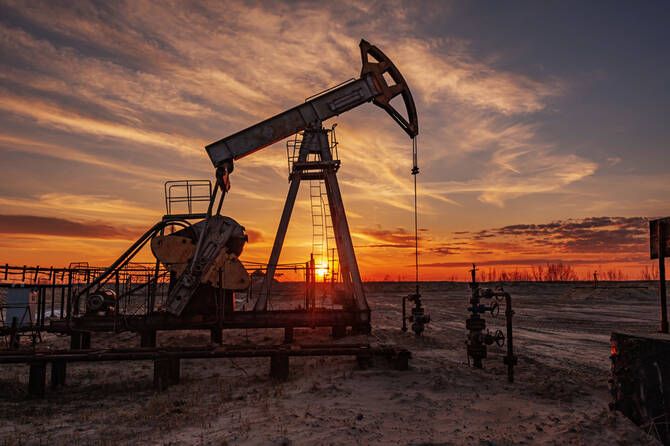
Brent crude futures rose 42 cents, or 0.6 percent, to $66.68 a barrel at 09:20 a.m. Saudi time. Shutterstock
Short Url
Updated 22 April 2025
Follow

Oil Updates — prices rise on short-covering, but tariff worries linger 

SINGAPORE: Oil prices climbed on Tuesday as investors took advantage of the previous day’s losses to cover short positions, although concerns persisted over economic headwinds from tariffs and US monetary policy that could dampen fuel demand, according to Reuters. 

Brent crude futures rose 42 cents, or 0.6 percent, to $66.68 a barrel at 09:20 a.m. Saudi time. The US West Texas Intermediate crude contract for May, which expires on Tuesday, was at $63.53 a barrel, up 45 cents, or 0.7 percent. 

The more actively traded WTI June contract was up 0.7 percent, or 45 cents, at $62.86 a barrel. 

Both benchmarks dropped more than 2 percent on Monday, as signs of progress in nuclear deal talks between the US and Iran helped ease supply concerns. 

“Some short-covering emerged after Monday’s sharp sell-off,” said Hiroyuki Kikukawa, chief strategist of Nissan Securities Investment, a unit of Nissan Securities. 

“However, concerns about a potential recession driven by the tariff war persist,” he said, predicting that WTI will likely trade in the $55–$65 range for the time being given ongoing uncertainty related to tariffs. 

On Monday, US President Donald Trump repeated his criticism of Federal Reserve Chair Jerome Powell and said the US economy could slow unless interest rates were lowered immediately. 

His comments about Powell fuelled worries about the Fed’s independence in setting monetary policy and the outlook for US assets. Major US stock indexes dropped and the dollar index slid to a three-year low on Monday. 

“The growing uncertainty surrounding US monetary policy is expected to negatively impact financial markets and the broader economy, raising fears that it could lead to a decline in crude oil demand,” Kikukawa said. 

A Reuters poll on April 17 showed investors believe the tariff policy will trigger a significant slowdown in the US economy this year and next, with the median probability of recession in the next 12 months approaching 50 percent. 

The US is the world’s biggest oil consumer. 

Progress in talks between the US and Iran, which on Saturday agreed to begin drawing up a framework for a potential nuclear deal, could also weigh on oil prices and reduce supply concerns as the Middle Eastern country is a major producer. 

“Our view that Iran’s oil exports face imminent downside risks due to the enforcement of US sanctions has eased given ongoing talks between US and Iran,” Vivek Dhar, an analyst at Commonwealth Bank of Australia, said in a note, adding that US sanctions relief was potentially on the table. 

Meanwhile, Russia’s economy ministry has cut its forecast for the average price of Brent crude in 2025 by nearly 17 percent from what it saw in its September calculations, according to documents obtained by Reuters. 

US crude oil and gasoline stockpiles were expected to have fallen last week, while distillate inventories likely rose, a preliminary Reuters poll showed on Monday, ahead of weekly reports from the American Petroleum Institute and the Energy Information Administration. 


Sustainability Forum Middle East spotlights Saudi role in driving climate finance deployment

Updated 5 sec ago
Follow

Sustainability Forum Middle East spotlights Saudi role in driving climate finance deployment

MANAMA: Saudi Arabia’s growing influence over sustainable finance and climate-aligned investment was a central theme at the Sustainability Forum Middle East, as regional banks, investors, and policymakers signaled a shift from climate pledges to market execution.

The fourth edition of the forum, held in Bahrain under the theme “Advancing Alignment, Innovation, and Implementation for Energy and Climate Transformation,” brought together more than 500 participants and over 50 speakers from government, finance, energy, and industry. 

While the agenda covered climate diplomacy and national strategies, the dominant conversations this year centered on capital deployment, bankability, technology, and the commercial realities of the energy transition.

Saudi Arabia’s role in shaping that transition was repeatedly highlighted, particularly through its efforts to structure green finance instruments, integrate sustainability into Vision 2030 programs, and scale renewable energy ambitions. Global banks at the forum pointed to the kingdom as a key driver of demand for credible sustainable finance frameworks in the Gulf.

“Saudi Arabia has demonstrated clear leadership through Vision 2030 and its green financing frameworks,” Lina Osman, managing director and head of sustainable finance for the Middle East, Africa and Pakistan at Standard Chartered, told Arab News.

“The Public Investment Fund’s green bond issuance is a clear demonstration of the value of the opportunity that is available in Saudi Arabia and how Saudi Arabia is seizing that opportunity,” she added.

Osman also noted that Saudi Arabia’s target of sourcing 50 percent of its electricity from renewables represents a “true demonstration of leadership in sustainability,” adding that financing instruments will need to evolve to serve those ambitions. 

She said the bank has been customizing sustainable finance structures for Gulf Cooperation Council clients as the market becomes more sophisticated and sector-specific.

Organizations at the forum said the region has moved beyond ESG signaling and into discussions about return profiles, risk pricing, and revenue impact. 

“Financial institutions are now focused on how sustainability generates value — reducing costs, building resilience, and boosting revenue. Previously, it was mostly window dressing,” said Ian McCallum, chief sustainability officer at Bank ABC. 

Speaking to Arab News, he added that Saudi Arabia is playing a “significant role in shaping the direction of sustainable finance by continuing to strengthen ESG regulatory and disclosure requirements.”

Speakers from private markets and venture capital also pointed to Saudi Arabia as an emerging market for climate technologies that are moving from pilot phase to commercialization. 

Investors highlighted carbon removal, energy optimization, and AI-enabled climate solutions as areas where the Kingdom’s scaling capacity and demand for industrial decarbonization make deployment feasible.

Beyond finance, the forum examined how the GCC can accelerate industrial decarbonization through AI integration, carbon capture, supply chain reform, and the expansion of renewables. 

Panels explored how sovereign strategies and industrial policy are aligning across the region, with Saudi Arabia’s energy transition goals seen as an anchor for cross-border capital flows.

The event saw memorandums of understanding and multi-sector partnerships intended to translate national ambitions into deployable projects. 

Organizers said the agreements reflect a shift toward implementation, positioning the Gulf as a market where climate action is increasingly tied to competitiveness, industrial growth, and long-term economic resilience.