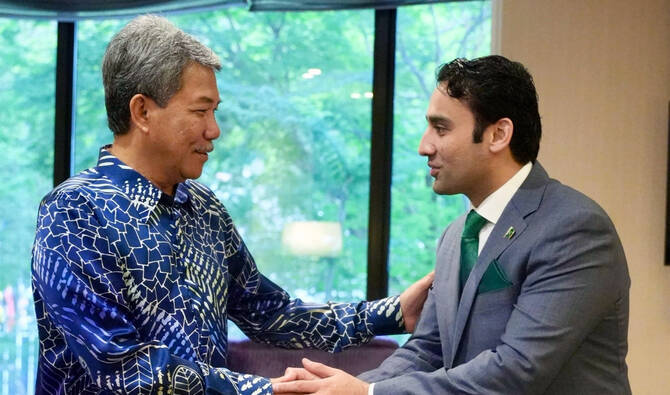
KARACHI: Malaysian Foreign Minister Mohamad bin Hajji Hasan has met with Bilal bin Saqib, head of the Pakistan Crypto Council (PCC), and discussed with him collaborative opportunities in blockchain technology, digital assets and Shariah-compliant finance, the Pakistani finance ministry said on Tuesday.
The development comes more than a week after Pakistan introduced its first-ever policy framework to regulate virtual assets and service providers, aligning with compliance and financial integrity guidelines of the global Financial Action Task Force (FATF).
The move followed the establishment of the Pakistan Crypto Council last month to create a legal framework to create a legal framework for cryptocurrency trading in a bid to lure international investment.
The meeting between the Malaysian FM and PCC chief in Kuala Lumpur focused on laying the groundwork for a Pakistan-Malaysia Digital Finance Partnership, aimed at co-developing FATF-compliant, Shariah-aligned digital asset frameworks.
“Malaysia’s leadership in Islamic finance and Pakistan’s momentum in crypto regulation form a natural alliance,” Saqib was quoted as saying by the Pakistani finance ministry.
“Together, we have a historic opportunity to set global standards for ethical innovation in digital finance — from halal stablecoins and tokenized sukuks to compliant regulatory sandboxes and youth empowerment.”
Cryptocurrencies including bitcoin are not officially regulated in Pakistan but are also not illegal or banned. As of Jan. 16, 2021, the State Bank of Pakistan has not authorized any individuals or organizations to carry out the sale, purchase, exchange, and investment of virtual currencies, coins, and tokens.
Pakistan’s new policy for virtual assets and service providers, created by a special government group under the Anti-Money Laundering (AML) and Counter Terrorism Financing (CTF) authority, is meant to set rules for how digital money like cryptocurrencies and the companies that deal in it should operate in Pakistan.
The finance ministry said the PCC is leading efforts to design a passportable crypto regulatory framework tailored to emerging markets that fosters innovation while ensuring full compliance with international standards.
During Saqib’s meeting with the Malaysian FM, both sides expressed strong alignment on key areas of cooperation, including regulatory coordination between financial authorities and cross-border talent development and education initiatives.
“This milestone engagement signals the beginning of a deeper economic and technological partnership between Pakistan and Malaysia — driven by a shared vision to build the future of finance through values-based innovation and strategic collaboration,” the Pakistani finance ministry said.


![]()

Pakistan, Malaysia join forces to develop Shariah-aligned digital assets framework
Short Url
https://arab.news/vwmh8
Pakistan, Malaysia join forces to develop Shariah-aligned digital assets framework
- The development comes more than a week after Pakistan introduced its first-ever policy framework to regulate virtual assets and service providers
- Pakistan Crypto Council chief says Malaysia’s leadership in Islamic finance and Pakistan’s momentum in crypto regulation form a ‘natural alliance’
Latest updates


© 2026 SAUDI RESEARCH & PUBLISHING COMPANY, All Rights Reserved And subject to Terms of Use Agreement.