Popularity of Himalayan salt grows in China as Pakistan exports reach $1.8 million in FQ25

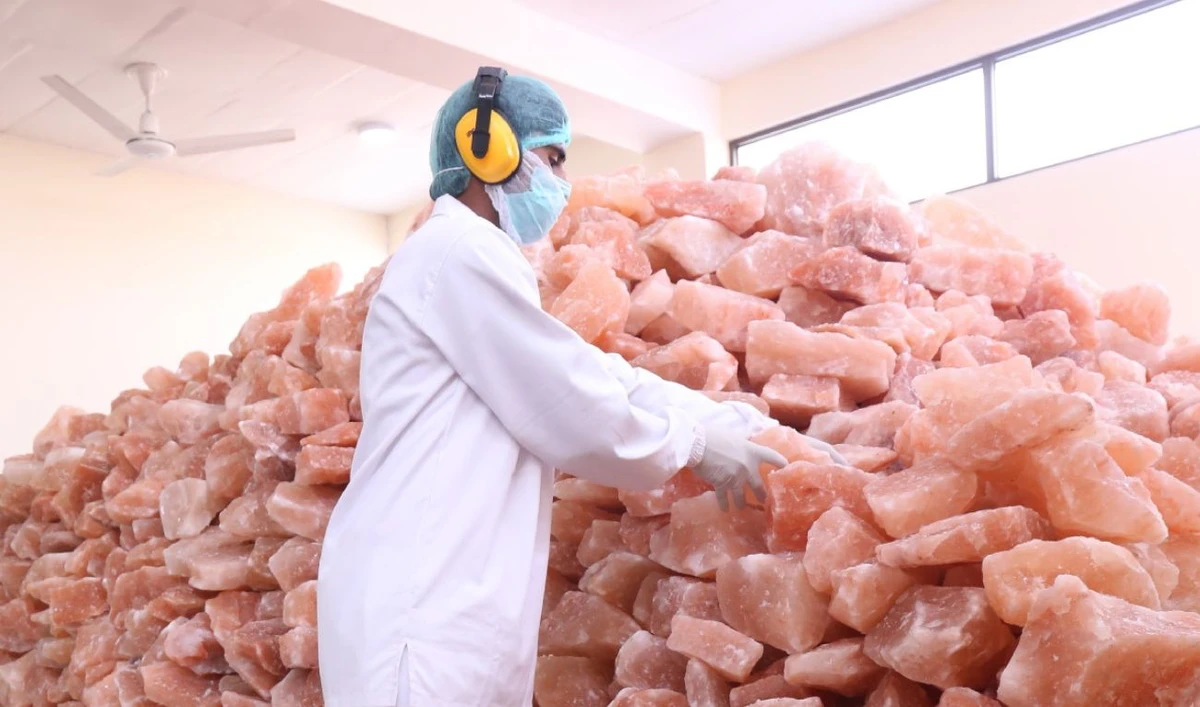
In this undated photo an employee checks stocks at Anthela Foods' Himalayan salt plant in Lahore, Pakistan. (Photo courtesy:China Daily/ website)
Short Url
Updated 21 April 2025
Follow

Popularity of Himalayan salt grows in China as Pakistan exports reach $1.8 million in FQ25

  • Pakistan sees 40 percent increase compared to exports in same period last year
  • Himalayan salt export driven by increasing Chinese interest in health-oriented products

ISLAMABAD: Pakistan exported $1.83 million (Rs512 million) worth of salt to China in the first three months of 2025, an increase of 40 percent compared to the same period last year, state-run media reported on Monday, showing the growing popularity of the product in the Chinese market. 

Pakistan primarily exports salt to the United States, Canada, China, the United Kingdom, and Japan. Other significant destinations include Afghanistan, the United Arab Emirates, and Vietnam. Pakistan’s salt exports are known to be mined at the Khewra Salt Mine and surrounding deposits. 

The Khewra Salt Mine is one of the world’s oldest and second largest, turning out 325,000 tons of salt a year. The mine is renowned for producing Himalayan pink salt, which is popular globally for its unique color and health benefits. The mine contributes significantly to Pakistan’s exports, especially to China, and is also a major tourist attraction due to its historical and geological significance.

“Pakistan exported over 13.64 million kilograms of salt to China worth $1.83 million (Rs512 million) in the first quarter of 2025 whereas last year in the same period it was $1.3 million (Rs364 million),” the Associated Press of Pakistan said in a report, quoting Ghulam Qadir, the Trade and Investment Counsellor of Pakistan in Beijing.

“Pakistan is exporting salt to China under three categories, edible salt, pure sodium chloride and other salt.”

The report attributed the increase to better trade ties between the two nations and China’s increasing appetite for premium-grade edible salt as well as for salt for industrial consumption, particularly for use in the chemical, pharmaceutical and food processing sectors. 

Industry experts attributed Pakistan’s salt export growth to “improved logistics, competitive pricing and enhanced quality standards” adopted by Pakistani exporters.

“This surge is a testament to Pakistan’s expanding capacity to meet international market demands, and a positive sign for diversifying our exports to China,” the report said, quoting a Trade Development Authority of Pakistan official.



Pakistan says 41 suspected militants killed in operations in restive Balochistan province

Updated 10 sec ago
Follow

Pakistan says 41 suspected militants killed in operations in restive Balochistan province

  • Military says intelligence-based raids carried out in Harnai and Panjgur districts
  • Islamabad repeats claim militants backed by New Delhi, an allegation India denies

ISLAMABAD: Pakistani security forces killed 41 suspected militants in two separate intelligence-based operations in the southwestern province of Balochistan, the military said on Thursday, alleging the fighters were linked to India. 

The operations were carried out in the districts of Harnai and Panjgur in Balochistan, Pakistan’s largest but least developed province and home to a long running separatist insurgency that frequently targets security personnel, government infrastructure and non-local residents.

“On 29 January 2026, 41 terrorists belonging to Indian proxy, Fitna al Khwarij and Fitna al Hindustan, were killed in two separate operations in Balochistan,” the military’s media wing, Inter-Services Public Relations (ISPR), said in a statement.

According to the ISPR, 30 militants were killed in Harnai district following a “heavy exchange of fire,” during which security forces also destroyed a cache of recovered weapons and explosives.

In a separate intelligence-based operation in Panjgur district, the military said 11 additional suspected militants were killed after security forces raided a hideout.

“Besides weapons and ammunition, looted money from bank robbery in Panjgur on 15 December 2025 were also recovered from the killed terrorists,” the statement said.
“The terrorists were involved in numerous terrorist activities in the past.”

Pakistan’s military and government frequently use the terms “Fitna al Khwarij” and “Fitna al Hindustan” to describe militant groups it associates with the Pakistani Taliban and alleged Indian support.

The ISPR said follow-up “sanitization operations” were underway to eliminate any remaining militants in the area, describing them as “Indian-sponsored terrorists.”

Islamabad has repeatedly accused India of backing separatist groups in Balochistan to destabilize Pakistan, an allegation New Delhi denies.

Earlier this month, Pakistan’s counterterrorism police said they killed five militants planning attacks on security forces and an attempt to block the Quetta–Sibi highway, a key transport route. On Jan. 25, the military also reported killing three militants, including a local commander, in an intelligence-based operation in Panjgur.

Balochistan is strategically important due to its vast mineral resources and its role as a transit corridor for the China-Pakistan Economic Corridor (CPEC), a multibillion-dollar infrastructure initiative linking Pakistan with China.

Separatist groups such as the Balochistan Liberation Army (BLA) accuse Islamabad of exploiting the province’s natural resources without fair local benefit, a claim the government rejects.