

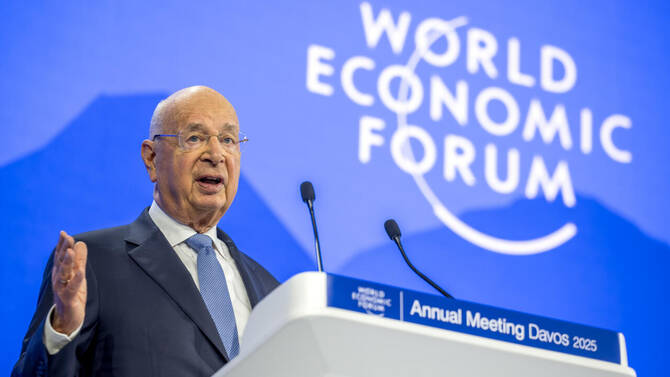
Davos meet founder Klaus Schwab quits as WEF chair

The German-born Schwab established the WEF in 1971 with the aim of creating a forum for policymakers and top corporate executives to tackle major global issues.
Short Url
Updated 21 April 2025
Follow

Davos meet founder Klaus Schwab quits as WEF chair

ZURICH: Klaus Schwab, founder of the World Economic Forum, whose annual gathering of business and political leaders in the Swiss mountain resort of Davos became a symbol of globalization, has resigned as chair of its trustees.

The Geneva-based WEF made the announcement on Monday after revealing earlier this month that the 87-year-old Schwab, who for decades has been the face of the Davos get-together, would be stepping down, without giving a firm timeline.

“Following my recent announcement, and as I enter my 88th year, I have decided to step down from the position of Chair and as a member of the Board of Trustees, with immediate effect,” Schwab said in a statement released by the WEF.

The forum did not say why he was quitting.

The WEF board said in the statement it had accepted Schwab’s resignation at an extraordinary meeting on April 20, with Vice Chairman Peter Brabeck-Letmathe serving as interim chairman while the search for a new chair began.

The German-born Schwab established the WEF in 1971 with the aim of creating a forum for policymakers and top corporate executives to tackle major global issues.

The village of Davos gradually became a fixture on the international calendar in January when political leaders, CEOs and celebrities got together in discreet, neutral Switzerland to discuss the agenda for the coming year.


Saudi economy grows 4.5% in 2025 as oil, non-oil sectors accelerate 

Updated 21 sec ago
Follow

Saudi economy grows 4.5% in 2025 as oil, non-oil sectors accelerate 

RIYADH: Saudi Arabia’s real gross domestic product expanded by 4.5 percent year on year in 2025, driven by strong growth in both oil and non-energy activities, official data showed. 

According to flash estimates released by Saudi Arabia’s General Authority for Statistics, oil activities in the Kingdom expanded by 5.6 percent in 2025 compared to the previous year, while non-oil operations and government activities rose by 4.9 percent and 0.9 percent, respectively, during the same period. 

The latest report aligns with an October outlook from the International Monetary Fund, which projected Saudi Arabia’s GDP would grow by 4 percent in both 2025 and 2026. 

Earlier this month, the World Bank forecast that the Kingdom’s GDP is projected to expand by 4.3 percent in 2026 and 4.4 percent in 2027, up from an expected 3.8 percent in 2025. 

“The main driver of real GDP growth in 2025 was non-oil activities, which contributed 2.7 percentage points, while oil activities with 1.4 pp, government activities at 0.1 pp and net taxes on products at 0.2 pp, also contributed positively,” said GASTAT.  

Momentum accelerated toward year-end. Real GDP expanded 4.9 percent in the fourth quarter from a year earlier, led by a 10.4 percent surge in oil activities, while non-oil sectors grew 4.1 percent. Government activities contracted 1.2 percent on an annual basis in the quarter. 

“The main driver of growth in real GDP of the fourth quarter of 2025 was oil activities, which contributed 2.5 pp, non-oil activities contributed 2.3 pp and net taxes on products contributed 0.2 pp, while government activities had a negative contribution of 0.2 pp,” added the authority.  

Saudi Arabia’s seasonally adjusted real GDP recorded growth of 1.1 percent in the fourth quarter of 2025 compared to the previous three months.  

In the fourth quarter, oil activities witnessed a quarter-on-quarter growth of 1.4 percent, while non-oil activities expanded by 1.3 percent during the same period.  

Government activities, however, recorded a decline of 0.2 percent in the fourth quarter compared to the previous three months.  

Earlier this month, a separate analysis by Standard Chartered said the Kingdom’s GDP is expected to expand by 4.5 percent in 2026, outperforming the global growth average of 3.4 percent, driven by sustained momentum in both hydrocarbon and non-oil sectors.