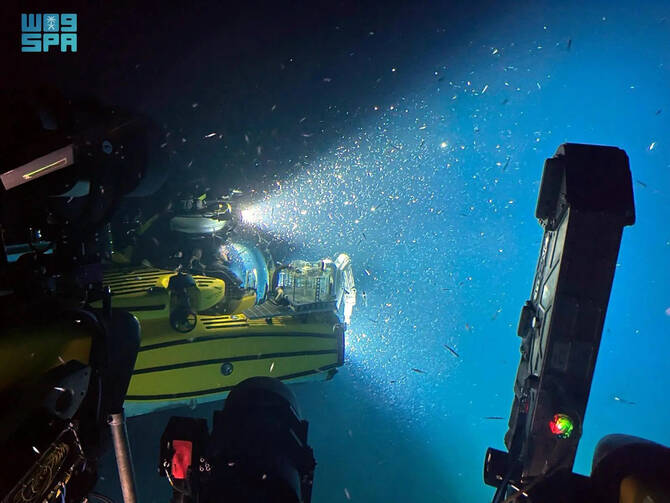

RIYADH: Marine scientists have found creatures thriving in deep waters of the Red Sea under seemingly unfavorable conditions of low oxygen levels and high acidity.
The unusual ecosystem was found in Difat Farasan near the border between Saudi Arabia and Yemen.
It was reported in the science journal PNAS Nexus by a team of scientists from the King Abdullah University of Science and Technology and the National Center for Wildlife, KAUST said in a press statement posted on its website.
Also known as the Farasan Bank, Difat Farasan is located below the third-largest coral reef system in the world and biggest in the Red Sea.
Despite the low oxygen and high acidity, corals, fish and other animals were found to be thriving.
“Several of the creatures showed unexpected coping strategies to the extreme environment. Fish swam slower, and corals were healthy in conditions that normally prevent the calcification of their skeletons,” said the statement.
The study explained that calcification was “necessary for coral growth and survival.”
KAUST research scientist Dr. Shannon Klein, who led the study, said: “The ability for these animals to live in warm, oxygen-depleted zones suggests they have an unusual ability to reduce how much oxygen they use to sustain life.
“This discovery highlights the need for greater marine exploration of deeper layers (of) tropical coastal areas, as they may hold unexpected ecosystems.”
The study also noted that while coral reefs usually exist in shallow waters, depressions of more than 200 meters deep were found throughout the Farasan Bank coral reef system.
“Considering that oxygen depletion in the sea is one consequence of rising temperatures, greater study of how these creatures exist there may help us understand how marine life can withstand the challenges of climate change,” the study stated.
Dr. Mohammad Qurban, CEO of the National Center for Wildlife, said: “This research highlights the significance of the Red Sea as a natural laboratory for studying marine resilience.
“Discovering ecosystems that thrive in extreme conditions expands our understanding of how marine life adapts and reinforces the need for continued exploration and conservation of these unique habitats.”
KAUST Assistant Prof. Froukje van der Zwan, Associate Prof. Francesca Benzoni and KAUST Ibn Sina Distinguished Prof. Carlos Duarte also contributed to the study.