


WASHINGTON: With Donald Trump back in the White House you never know what you’re going to get. Will he berate a foreign leader? Rock the global markets? Take vengeance against his foes?
But there has been one constant behind the chaos of his first 100 days — Trump is pushing US presidential power to almost imperial limits.
“I think the second term is just more powerful,” the 78-year-old Republican said during a recent event. “They do it — when I say do it, they do it, right?“
Trump has been driven by a sense of grievance left over from an undisciplined first term that ended in the shame of the 2021 US Capitol riots after his election defeat to Joe Biden.
And while Trump freed hundreds of those attackers from jail on his first day back in office, he is taking no prisoners when it comes to consolidating the power of the White House.
“Trump 2.0 is far more authoritarian-minded and authoritarian in its actions than Trump 1.0,” political historian Matt Dallek of George Washington University told AFP.
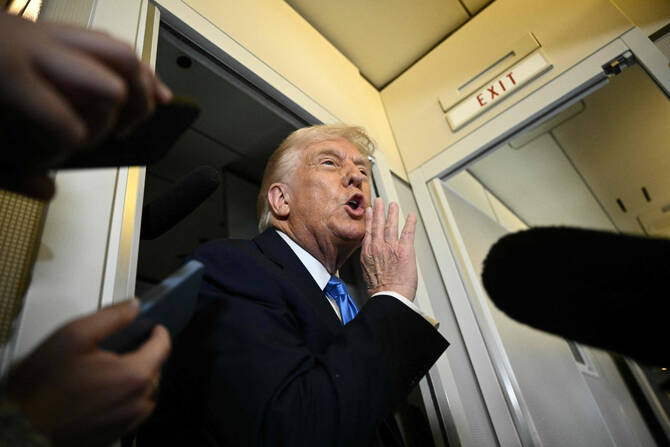
Trump has also stepped up the sense of an endless reality show in which he is the star, as he signs executive orders and takes questions from reporters in the Oval Office almost daily.
That slew of orders has unleashed an unprecedented assault on the cornerstones of American democracy — and on the world order.
“We have seen certainly not in modern times such a sustained attack to unwind constitutional safeguards,” added Dallek.
Controversially aided by Elon Musk, the world’s richest man, Trump has launched a drive to gut a federal government he regards as part of a liberal “deep state.”

Protesters demonstrate during a "Tesla Takedown" protest against CEO Elon Musk in New York City on March 22, 2025. As President Trump marks 100 days in office, much ink will be spilt on his divisive transformation of the US governmen. (AFP)
He has invoked a centuries-old wartime act to deport migrants to a mega prison in El Salvador — while warning that US citizens could be next.
He has dug in for a confrontation with judges, and forced a string of punishing deals on law firms involved in previous criminal or civil cases against him.
He has cracked down on the media — which he still dubs the “enemy of the people” — and limited access to news outlets covering him at the White House.
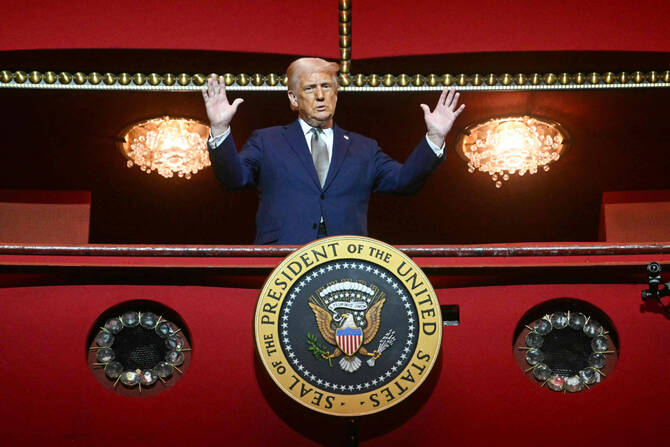
And he has launched an ideological purge, cutting diversity programs, targeting universities and even installing himself as head of a prestigious arts center.
The US Congress, which is meant to have ultimate control over the government’s purse strings, has been sidelined. Republicans have abetted his power grab while crushed Democrats have struggled to muster a response.
“We are all afraid,” Republican Senator Lisa Murkowski said recently.
“The president appears indifferent to formal — even constitutional — checks on his power,” added Barbara Trish, professor of political science at Grinnell College.
On the foreign stage Trump has made territorial claims over Greenland, Panama and Canada — asserting a sphere of influence that echoes Russian President Vladimir Putin’s expansionist bent.
Trump is meanwhile backed by a court of true believers. Aides with often fringe views, like vaccine-skeptic health secretary Robert Kennedy, take turns to praise him at cabinet meetings.
“Compared to the first term, the president has completely surrounded himself with aides who not only facilitate, but in some cases catalyze, his brazen power moves,” added Trish.

US President Donald Trump signs executive orders in the Oval Office of the White House in Washington on January 20, 2025. (AFP)
But Trump’s comeback has highlighted some familiar themes.
Trump is closing out his first three months with approval ratings well below all other post-World War II presidents — except for himself, in his first term, according to Gallup.
And there are signs of the same volatile leader the world saw from 2017 to 2021.
Trump’s wild televised meltdown in the Oval Office with Ukrainian President Volodymyr Zelensky — abetted by hawkish Vice President JD Vance — deeply alarmed allies who were already unnerved by his pivot to Russia.
Then there was his introduction of sweeping global tariffs — only to reverse many of them after tanking global markets proved to be the only real check on his power.
When asked how he had reached one of his tariff decisions Trump replied: “Just instinctively.”
The question now is whether Trump — who at one point referred to himself as “THE KING” on his Truth Social platform — will be willing to give up power.
Trump recently said that when he repeatedly mentioned a Constitution-defying third term he was “not joking.”


