

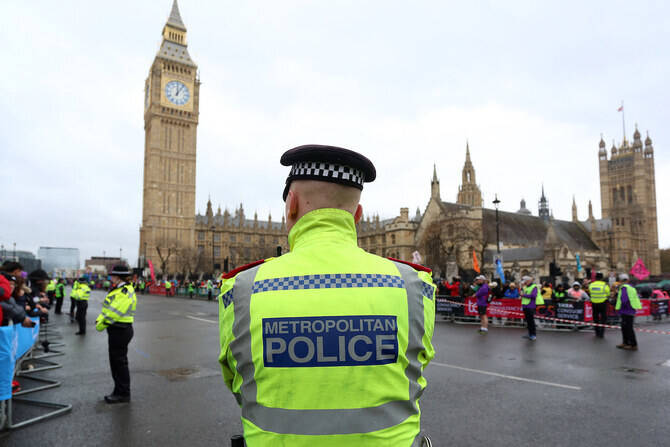

LONDON: A UK court on Tuesday denied a legal challenge brought by the Freemasons against a new London police policy requiring officers to declare membership of the historically secretive society.
In a 17-page judgment handed down at London’s High Court, judge Martin Chamberlain said the Metropolitan police’s policy “serves a legitimate aim, maintaining and enhancing public trust in policing, and is proportionate.”
He said the grounds of the challenge were not “reasonably arguable” and the policy was not discriminatory or “unduly stigmatising” against Freemasons.
He refused permission for the claimants to apply for a judicial review and as well as requests for an interim order suspending the disclosure requirement.
The Met, which said it had been prepared to “robustly defend” their policy through the courts, welcomed the decision.
“Both victims of crime and those reporting wrongdoing must have trust and confidence there is no risk that investigations are tainted by such issues,” Met Commander Simon Messinger said.
“We have prioritized this over any organization’s desire to maintain secrecy.”
The challenge had been brought by the United Grand Lodge of England, the Order of Women Freemasons, the Honourable Fraternity of Ancient Freemasons, and two serving Met police officers.
Under the new rule, introduced in December, all officers and staff must disclose whether they are, or have ever been, members of “confidential” societies, specifically naming Freemasonry.
Around 400 officers and staff have so far made declarations, the court was told.
The three Freemason groups among the claimants said they were “disappointed” by the ruling and were “considering further legal options.”
But they added they were “pleased” to have received assurances from the police about how declaration data would be gathered and held, with only a small number of select staff having access.
- ‘Blacklist’ -
At a hearing last week, lawyers for the claimants said the policy amounts to creating a discriminatory “blacklist.”
Claire Darwin, representing them, told the court the force was compiling a list that could later be cross-referenced in promotions, misconduct proceedings or vetting decisions.
“The aim of the Metropolitan Police is to create a blacklist of Freemasons that they will then use to assess risk,” she said.
Darwin noted that the Met’s own policy classifies Freemasonry membership as “low risk,” and questioned whether that was consistent with the sweeping nature of the new requirement.
She argued it had already had a “chilling effect,” with some members deterred from joining lodges.
James Berry, for the Met, said the legal challenge was “misconceived” and the suggestion of a blacklist was “plainly wrong.”
He added there was “no evidence” that those who had declared had suffered stigma or workplace discrimination.
Freemasonry is a centuries-old fraternal movement organized into local “lodges,” promoting principles such as charity, mutual support and moral self-improvement, using private rituals and a hierarchical structure.
Although Masonic groups say they are not secret but discreet, critics have long associated them with elite networks and influence within public institutions.
The declaration policy was brought in following recommendations from an independent panel, which in 2021 criticized the force’s culture and transparency after decades of failed inquiries into the 1987 murder of private investigator Daniel Morgan.
While the panel did not find systemic corruption linked to Freemasonry, it highlighted public concern about undisclosed Masonic membership within police forces.


