

India seeks to strengthen energy ties with Saudi Arabia during Modi’s visit

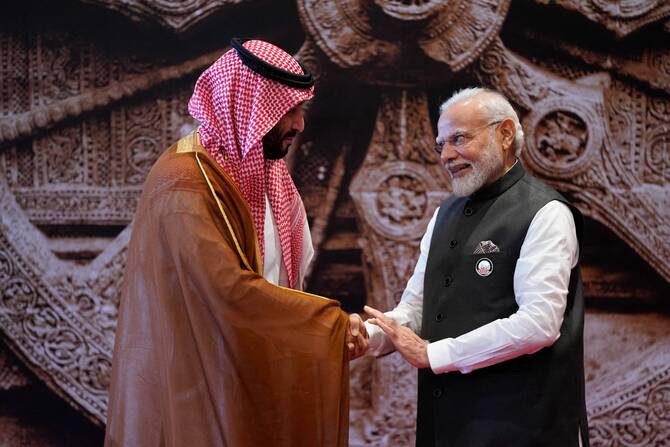
India's Prime Minister Narendra Modi, right, shakes hand with Saudi Arabia's Crown Prince and Prime Minister Mohammed bin Salman ahead of the G20 Leaders' Summit in New Delhi on Sept.9, 2023. (AFP)
Short Url
Updated 20 April 2025
Follow

India seeks to strengthen energy ties with Saudi Arabia during Modi’s visit

  • Saudi-India trade worth nearly $43bn in 2023-24; energy alone worth $25.7bn
  • Modi, crown prince to co-chair second meeting of Saudi-India Strategic Partnership Council 

NEW DELHI: Indian Prime Minister Narendra Modi will travel to Saudi Arabia on Tuesday for his third visit, as India seeks to strengthen strategic ties with the Kingdom, particularly in the energy sector.

During his two-day trip, Modi is scheduled to meet Crown Prince Mohammed bin Salman in Jeddah, where they will hold bilateral talks and co-chair the second meeting of the Saudi-India Strategic Partnership Council.

“The visit is important also on account of the obvious significance of Saudi Arabia as a strategic partner for India … Saudi Arabia is a leading voice in the Islamic world, and is increasingly playing an important role in regional developments,” Foreign Secretary Vikram Misri told a press briefing on Saturday.

As premier, Modi made his first trip to Saudi Arabia in 2016. Following the crown prince’s first visit to India in February 2019, the Indian leader made his second trip to the Kingdom that October, when the two countries established the Strategic Partnership Council.

In 2023-24, Saudi-India trade reached nearly $43 billion, making India Saudi Arabia’s second-largest trading partner, while the Kingdom stands as New Delhi’s fifth-largest.

Saudi Arabia is “a key player” in India’s energy scenario, Misri said.

“We are looking at infusing an even more strategic outlook in the energy partnership between the two countries. And we expect that the forthcoming visit will have some developments related to this as well,” he added.

Bilateral energy trade alone was worth $25.7 billion in 2023-24, with Saudi Arabia being the third-largest source of India’s LPG, crude and petroleum imports.

Modi’s upcoming visit is a follow-up to the crown prince’s trip to India in 2023, when he attended the summit of the Group of 20 biggest economies.

This was followed by the crown prince’s state visit, which saw the two leaders co-chairing the first meeting of the Strategic Partnership Council, and both countries signing around 50 initial pacts and agreeing to form a joint task force for a $100 billion Saudi investment in India.

“This is a very important visit as Saudi Arabia is one of the most important partners of India in the Gulf and Middle East region,” Muddassir Qamar, associate professor at the Center for West Asian Studies at Jawaharlal Nehru University, told Arab News on Sunday.

“It is also important as the visit to Saudi Arabia comes at a time of great regional turbulence and uncertainty in international politics, given that Saudi Arabia and India are two of the G20 members and have a similarity of views in regional and global issues.”

Two-way flow of investments, energy security, food security and defense cooperation are likely to be high on the agenda, he said, adding that discussions on the India-Middle East-Europe Economic Corridor Agreement are likely to be “top on the priority list,” referring to the trade connectivity plan.

As both countries are working on their respective development plans, namely the Saudi Vision 2030 and India’s Viksit Bharat 2047, they have “ample opportunities to collaborate among businesses and the private sector” across various sectors, including energy, logistics and infrastructure, he added.

Modi’s trip will also boost India’s role in geopolitics, according to Mohammed Soliman, senior fellow at the Middle East Institute in Washington D.C.

“Modi’s visit to Saudi Arabia marks a pivotal moment in the deepening of the India-Saudi strategic partnership — strengthening economic ties with $40 billion in trade, securing vital energy supplies, and elevating India’s voice in West Asian geopolitics,” he told Arab News. 

“The visit positions India as a key player in West Asia.” 


Trump administration labels 3 Muslim Brotherhood branches as terrorist organizations

Updated 5 sec ago
Follow

Trump administration labels 3 Muslim Brotherhood branches as terrorist organizations

  • The State Department designated the Lebanese branch a foreign terrorist organization
  • “These designations reflect the opening actions of an ongoing, sustained effort to thwart Muslim Brotherhood chapters’ violence,” Rubio said

WASHINGTON: President Donald Trump’s administration has made good on its pledge to label three Middle Eastern branches of the Muslim Brotherhood as terrorist organizations, imposing sanctions on them and their members in a decision that could have implications for US relationships with allies Qatar and Turkiye.
The Treasury and State departments announced the actions Tuesday against the Lebanese, Jordanian and Egyptian chapters of the Muslim Brotherhood, which they said pose a risk to the United States and American interests.
The State Department designated the Lebanese branch a foreign terrorist organization, the most severe of the labels, which makes it a criminal offense to provide material support to the group. The Jordanian and Egyptian branches were listed by Treasury as specially designated global terrorists for providing support to Hamas.
“These designations reflect the opening actions of an ongoing, sustained effort to thwart Muslim Brotherhood chapters’ violence and destabilization wherever it occurs,” Secretary of State Marco Rubio said in a statement. “The United States will use all available tools to deprive these Muslim Brotherhood chapters of the resources to engage in or support terrorism.”
Rubio and Treasury Secretary Scott Bessent were mandated last year under an executive order signed by Trump to determine the most appropriate way to impose sanctions on the groups, which US officials say engage in or support violence and destabilization campaigns that harm the United States and other regions.
Muslim Brotherhood leaders have said they renounce violence.
Trump’s executive order had singled out the chapters in Lebanon, Jordan and Egypt, noting that a wing of the Lebanese chapter had launched rockets on Israel after Hamas’ Oct. 7, 2023, attack in Israel that set off the war in Gaza. Leaders of the group in Jordan have provided support to Hamas, the order said.
The Muslim Brotherhood was founded in Egypt in 1928 but was banned in that country in 2013. Jordan announced a sweeping ban on the Muslim Brotherhood in April.
Nathan Brown, a professor of political science and international affairs at George Washington University, said some allies of the US, including the United Arab Emirates and Egypt, would likely be pleased with the designation.
“For other governments where the brotherhood is tolerated, it would be a thorn in bilateral relations,” including in Qatar and Turkiye, he said.
Brown also said a designation on the chapters may have effects on visa and asylum claims for people entering not just the US but also Western European countries and Canada.
“I think this would give immigration officials a stronger basis for suspicion, and it might make courts less likely to question any kind of official action against Brotherhood members who are seeking to stay in this country, seeking political asylum,” he said.
Trump, a Republican, weighed whether to designate the Muslim Brotherhood a terrorist organization in 2019 during his first term in office. Some prominent Trump supporters, including right-wing influencer Laura Loomer, have pushed his administration to take aggressive action against the group.
Two Republican-led state governments — Florida and Texas — designated the group as a terrorist organization this year.