

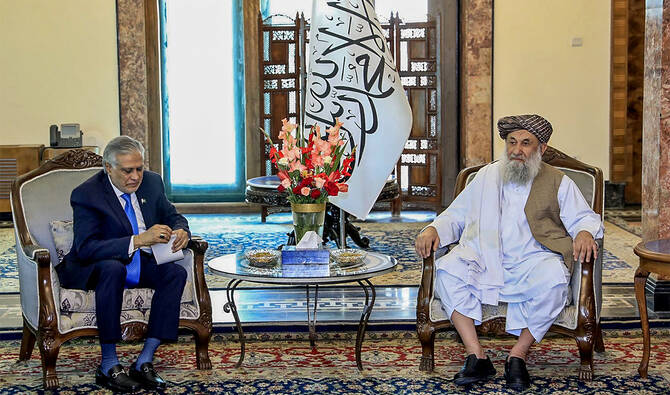

KABUL: Afghanistan’s prime minister condemned on Saturday the “unilateral measures” taken by Pakistan to forcibly deport tens of thousands of Afghans since the start of April.
Pakistan has launched a strict campaign to evict by the end of the month more than 800,000 Afghans who have had their residence permits canceled, including some who were born in Pakistan or lived there for decades.
Pakistan’s top diplomat Ishaq Dar flew to Kabul for a day-long visit on Saturday where he held discussions with Afghan Taliban officials, including Prime Minister Hasan Akhund and Foreign Minister Amir Khan Muttaqi.
“Rather than collaborating with the Islamic Emirate on the gradual repatriation process, Pakistan’s unilateral measures are intensifying the problem and hindering progress toward a solution,” Akhund said during his meeting with Dar.
He urged the Pakistani government to “facilitate the dignified return of Afghan refugees,” according to a statement on X.
Earlier, foreign minister Muttaqi “expressed his deep concern and disappointment over the situation and forced deportation of Afghan refugees in Pakistan,” the ministry’s deputy spokesperson Zia Ahmad said on X.
Ahmad added that Dar had reassured officials that Afghans “will not be mistreated.”
Afghans in Pakistan have reported weeks of arbitrary arrests, extortion and harassment by authorities.
Islamabad has said nearly 85,000 have already crossed into Afghanistan, with convoys of Afghan families heading to border crossings each day fearing raids, arrests or separation from family members.
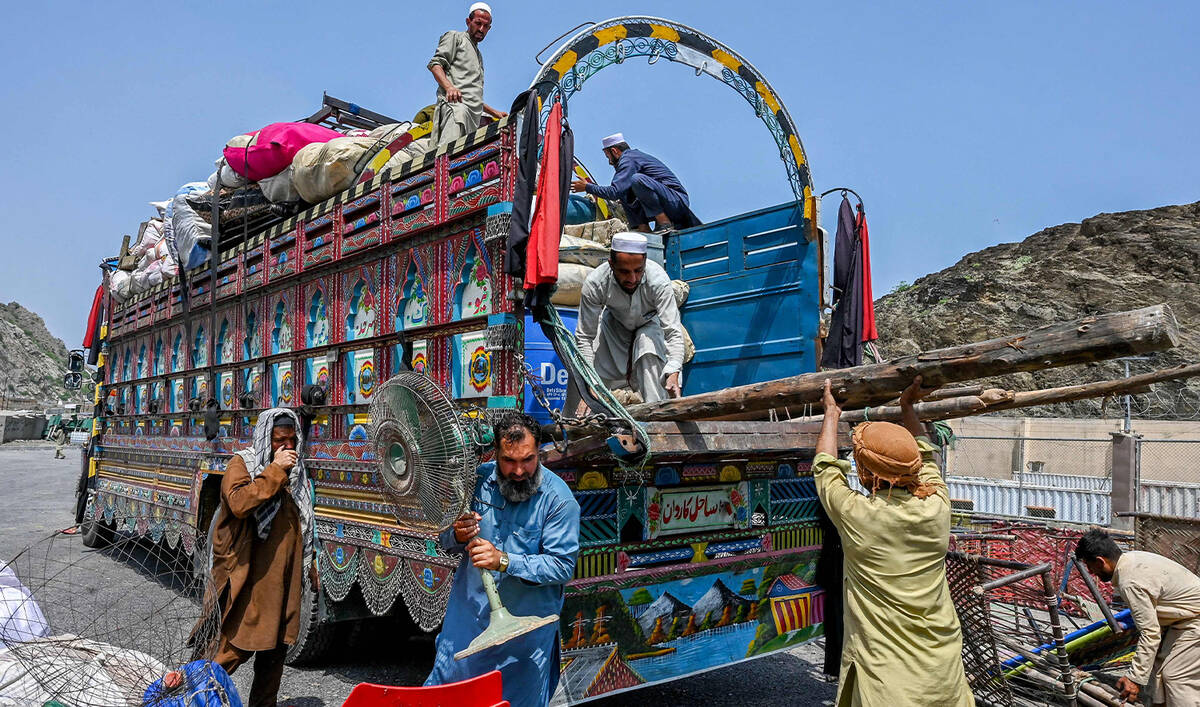
Afghan refugees load their belongings onto a truck as they prepare for their deportation to Afghanistan, at the Pakistan-Afghanistan border in Torkham on April 19, 2025. (AFP)
On Friday, Pakistan’s deputy interior minister Tallal Chaudhry told a news conference that “there will not be any sort of leniency and extension in the deadline.”
The relationship between the two neighbors has soured as attacks in Pakistan’s border regions have soared following the return of the Taliban government in Afghanistan in 2021.
Last year was the deadliest in Pakistan for a decade, with Islamabad accusing Kabul of allowing militants to take refuge in Afghanistan, from where they plan attacks.
The Taliban government denies the charge.
Chaudhry said on Friday that nearly 85,000 Afghans have crossed into Afghanistan since the start of April, the majority of them undocumented.
More than half of them were children, according to the United Nations refugee agency.
The women and girls among those crossing were entering a country where they are banned from education beyond secondary school and barred from many sectors of work.
Afghanistan’s refugees ministry spokesman told AFP on Saturday the Taliban authorities had recorded some 71,000 Afghan returnees through the two main border points with Pakistan between April 1 and 18.
In the first phase of returns in 2023, hundreds of thousands of undocumented Afghans were forced across the border in the space of a few weeks.
In the second phase announced in March, the Pakistan government canceled the residence permits of more than 800,000 Afghans and warned thousands more awaiting relocation to other countries to leave by the end of April.
The move to expel Afghans is widely supported by Pakistanis.
“They are totally disrespectful toward our country. They have abused us, they have used us. One can’t live in a country if they don’t respect it,” said Ahmad Waleed, standing in his shop on Friday in Rawalpindi, near the capital.


