Russian President Vladimir Putin announces an Easter ceasefire in Ukraine

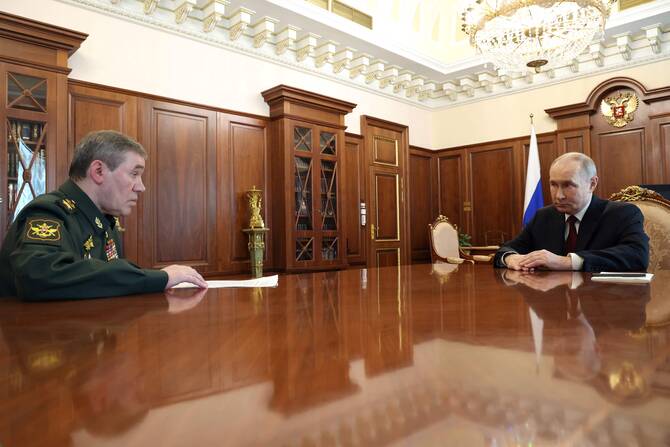
In this pool photograph distributed by the Russian state agency Sputnik, President Vladimir Putin meets with Chief of the General Staff of the Russian Armed Forces Valery Gerasimov in Moscow on April 19, 2025. Putin announced an Easter truce in the conflict in Ukraine. (AFP)
Short Url
Updated 19 April 2025
Follow

Russian President Vladimir Putin announces an Easter ceasefire in Ukraine

  • Ceasefire will last from 6 p.m. Moscow time on Saturday to midnight following Easter Sunday

MOSCOW: Russian President Vladimir Putin on Saturday announced an Easter truce in the conflict in Ukraine starting this evening and lasting till midnight on Sunday.
The short-term ceasefire proposal from Russia comes as President Donald Trump has been pressing both Moscow and Kyiv to agree a truce, but has failed to extract any major concessions from the Kremlin.
“Today from 1800 (1500 GMT) to midnight Sunday (2100 GMT Sunday), the Russian side announces an Easter truce,” Putin said in televised comments, while meeting Russian chief of staff Valery Gerasimov.
Easter, a major holiday for Christians, is celebrated on Sunday.
“I order for this period to stop all military action,” Putin said, calling the truce “based on humanitarian reasons.”
“We are going on the basis that the Ukrainian side will follow our example, while our troops must be ready to resist possible breaches of the truce and provocations by the enemy, any aggressive actions,” Putin said.
He said that Gerasimov had told him Ukraine “more than 100 times... breached an agreement on not striking energy infrastructure.”
Russia on Friday abandoned a moratorium on striking Ukrainian energy targets after each side accused the other of breaking a supposed deal without any formal agreement put in place.
The latest truce proposal will show “how sincere is the Kyiv’s regime’s readiness, its desire and ability to observe agreements and participate in a process of peace talks,” Putin said.
Previous attempts at holding ceasefires for Easter in April 2022 and Orthodox Christmas in January 2023 were not implemented after both sides failed to agree on them.


35 million Nigerians ‘risk hunger after global funding collapse’

Updated 5 sec ago
Follow

35 million Nigerians ‘risk hunger after global funding collapse’

  • The UN can only aim to ‌deliver $516 million to provide lifesaving aid to 2.5 million people this year, down from 3.6 million in 2025, which in turn was about half the previous year’s level

ABUJA: Nearly 35 million Nigerians are at risk of hunger this year, including 3 million children facing severe malnutrition, ​the UN said, following the collapse of global aid budgets.
Speaking at the launch of the 2026 humanitarian plan in Abuja, UN Resident and Humanitarian Coordinator Mohammed Malick Fall said the long-dominant, foreign-led aid model in Nigeria is no longer sustainable and ‌that Nigeria’s ‌needs have grown. 
Conditions in ‌the conflict-hit ​northeast ‌are dire, Fall said, with civilians in Borno, Adamawa, and Yobe states facing rising violence. 

BACKGROUND

UN Resident and Humanitarian Coordinator Mohammed Malick Fall said the foreign-led aid model in Nigeria is no longer sustainable and ‌that the country’s needs have grown.

A surge in terror attacks killed more than 4,000 people in the first eight months of 2025, matching the toll for all of 2023, he said.
The UN can only aim to ‌deliver $516 million to provide lifesaving aid to 2.5 million people this year, down from 3.6 million in 2025, which in turn was about half the previous year’s level.
“These are not statistics. These numbers represent lives, futures, and Nigerians,” Fall said.
He also said ​the UN had no choice but to focus on “the most lifesaving” interventions given the drop in available funding. 
Shortfalls last year led the World Food Programme to also warn that millions could go hungry in Nigeria as its resources ran out in December and it was forced to cut support for more than 300,000 children. 
Fall said Nigeria was showing growing national ownership of the crisis response in recent months through measures such as local funding for ‌lean-season food support and early-warning action on flooding.