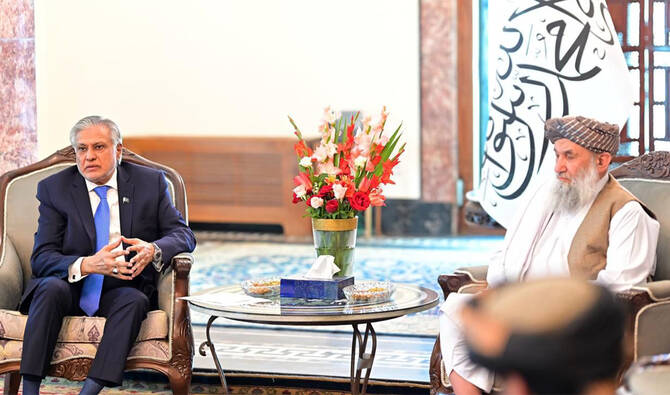

ISLAMABAD: Pakistan’s Deputy Prime Minister and Foreign Minister Ishaq Dar on Saturday met Afghanistan’s acting Prime Minister Mullah Muhammad Hassan Akhund during a day-long visit to Kabul, where the two sides discussed militancy, regional security, trade and efforts to boost bilateral cooperation.
His visit takes place amid surging militancy in Pakistan, which Islamabad blames on the Tehreek-e-Taliban Pakistan (TTP) militant outfit. Pakistan accuses the Afghan Taliban of providing them sanctuaries, allegations that Kabul has repeatedly denied.
Dar’s visit to Kabul also takes place as Pakistan intensifies its campaign to deport “illegal immigrants,” mostly Afghan nationals, which it has blamed without evidence for being involved in suicide attacks and militancy in the country.
Pakistan’s deportation drive has further soured ties between the two nations.
“Deputy Prime Minister / Foreign Minister, Senator Mohammad Ishaq Dar ... called on the acting Afghan Prime Minister, Mullah Muhammad Hassan Akhund,” the Pakistani foreign office said in a brief statement.
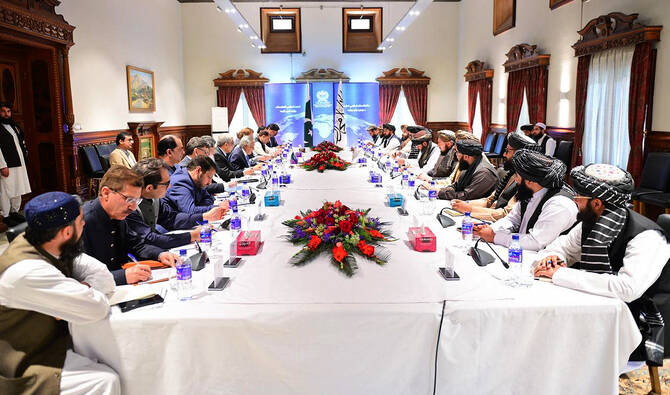
This handout photograph taken on April 19, 2025 and released by the Pakistan’s Ministry of Foreign Affairs shows the country’s Foreign Minister and Deputy Prime Minister Ishaq Dar (9L) speaks during a meeting with Acting Afghan Foreign Minister Amir Khan Muttaqi (8R) and other Taliban government officials in Kabul. Dar arrived in Afghanistan on April 19 for a one-day visit to meet senior Afghan Taliban officials, including Prime Minister Hasan Akhund, after Pakistan expelled more than 85,000 Afghans in just over two weeks. (Photo courtesy: Handout/MOFA)
“Both sides exchanged views on key issues of mutual interest, including security, trade and transit cooperation, and explored ways to enhance people-to-people contacts,” it added.
The foreign office informed the two leaders reaffirmed their commitment to continued engagement and agreed to maintain high-level exchanges to further strengthen relations between the two “brotherly countries.”
Dar arrived in Kabul earlier on Saturday to hold talks with Afghan leaders amid increasingly tense ties between the neighbors.

This handout photograph taken on April 19, 2025 and released by the Pakistan’s Ministry of Foreign Affairs shows the country’s Foreign Minister and Deputy Prime Minister Ishaq Dar (4R) shaking hands with Afghan government officials upon his arrival in Kabul. (Photo courtesy: Handout/MOFA)
Before departing for Kabul, Dar acknowledged recent “coldness” in ties between the two nations but said security remained a priority.
“I believe the security of Pakistan, its people, their lives and properties, is very important,” he told state-run Pakistan Television. “So one of our concerns is regarding terrorism, which we will discuss.”
Dar said Pakistan saw immense potential for trade and investment with Afghanistan and stressed the importance of regional connectivity.
“Our connection with Central Asian states can be established through rail links but that’s not possible unless Afghanistan becomes a partner in this,” he added.
Dar also met Afghan Deputy Prime Minister Mullah Abdul Salam Hanafi and Foreign Minister Amir Khan Muttaqi upon his arrival in Kabul to discuss security, border management and economic cooperation.
“Both parties reaffirmed their commitment to fostering mutually beneficial relations and agreed on the importance of maintaining high-level engagement,” the foreign office said after that meeting.
Dar’s trip is seen as part of Islamabad’s efforts to re-engage with the Afghan Taliban government despite ongoing tensions and to address its concerns over a surge in militant attacks in Pakistan.
A statement issued by the Afghan government said the Taliban foreign minister voiced “deep concern” over Pakistan’s deportation drive, urging Islamabad to “prevent the suppression of the rights of Afghans.”