Pakistan deputy PM meets Afghan premier in Kabul to discuss militancy, trade cooperation

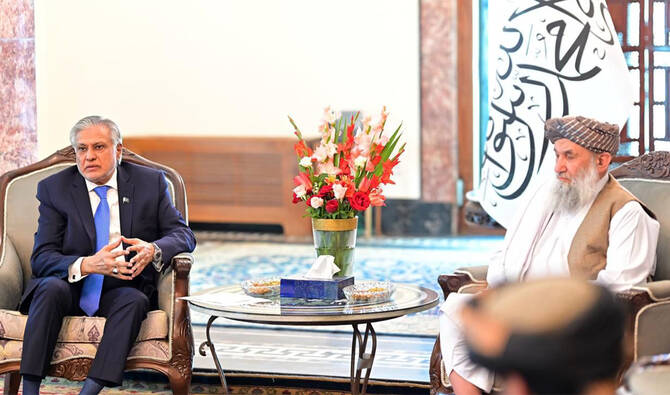
Afghanistan’s acting Prime Minister Mullah Muhammad Hassan Akhund meets Pakistan’s Deputy Prime Minister and Foreign Minister Ishaq Dar in Kabul, Afghanistan, on April 19, 2025. (MOFA)
Short Url
Updated 19 April 2025
Follow

Pakistan deputy PM meets Afghan premier in Kabul to discuss militancy, trade cooperation

  • Ishaq Dar acknowledges ‘coldness’ in ties before Kabul visit, says ‘terrorism’ will be discussed
  • Afghan foreign ministry also expresses concern over Pakistan’s deportation drive in a statement

ISLAMABAD: Pakistan’s Deputy Prime Minister and Foreign Minister Ishaq Dar on Saturday met Afghanistan’s acting Prime Minister Mullah Muhammad Hassan Akhund during a day-long visit to Kabul, where the two sides discussed militancy, regional security, trade and efforts to boost bilateral cooperation.
His visit takes place amid surging militancy in Pakistan, which Islamabad blames on the Tehreek-e-Taliban Pakistan (TTP) militant outfit. Pakistan accuses the Afghan Taliban of providing them sanctuaries, allegations that Kabul has repeatedly denied. 
Dar’s visit to Kabul also takes place as Pakistan intensifies its campaign to deport “illegal immigrants,” mostly Afghan nationals, which it has blamed without evidence for being involved in suicide attacks and militancy in the country.
Pakistan’s deportation drive has further soured ties between the two nations. 
“Deputy Prime Minister / Foreign Minister, Senator Mohammad Ishaq Dar ... called on the acting Afghan Prime Minister, Mullah Muhammad Hassan Akhund,” the Pakistani foreign office said in a brief statement.
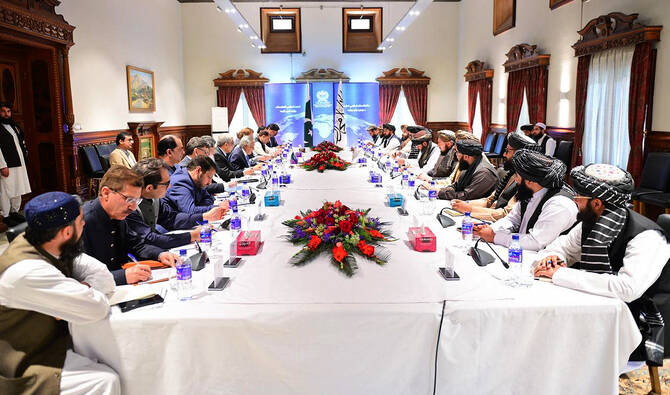


This handout photograph taken on April 19, 2025 and released by the Pakistan’s Ministry of Foreign Affairs shows the country’s Foreign Minister and Deputy Prime Minister Ishaq Dar (9L) speaks during a meeting with Acting Afghan Foreign Minister Amir Khan Muttaqi (8R) and other Taliban government officials in Kabul. Dar arrived in Afghanistan on April 19 for a one-day visit to meet senior Afghan Taliban officials, including Prime Minister Hasan Akhund, after Pakistan expelled more than 85,000 Afghans in just over two weeks. (Photo courtesy: Handout/MOFA)

“Both sides exchanged views on key issues of mutual interest, including security, trade and transit cooperation, and explored ways to enhance people-to-people contacts,” it added.
The foreign office informed the two leaders reaffirmed their commitment to continued engagement and agreed to maintain high-level exchanges to further strengthen relations between the two “brotherly countries.”
Dar arrived in Kabul earlier on Saturday to hold talks with Afghan leaders amid increasingly tense ties between the neighbors.


This handout photograph taken on April 19, 2025 and released by the Pakistan’s Ministry of Foreign Affairs shows the country’s Foreign Minister and Deputy Prime Minister Ishaq Dar (4R) shaking hands with Afghan government officials upon his arrival in Kabul. (Photo courtesy: Handout/MOFA)

Before departing for Kabul, Dar acknowledged recent “coldness” in ties between the two nations but said security remained a priority.
“I believe the security of Pakistan, its people, their lives and properties, is very important,” he told state-run Pakistan Television. “So one of our concerns is regarding terrorism, which we will discuss.”
Dar said Pakistan saw immense potential for trade and investment with Afghanistan and stressed the importance of regional connectivity.

“Our connection with Central Asian states can be established through rail links but that’s not possible unless Afghanistan becomes a partner in this,” he added.
Dar also met Afghan Deputy Prime Minister Mullah Abdul Salam Hanafi and Foreign Minister Amir Khan Muttaqi upon his arrival in Kabul to discuss security, border management and economic cooperation.
“Both parties reaffirmed their commitment to fostering mutually beneficial relations and agreed on the importance of maintaining high-level engagement,” the foreign office said after that meeting.
Dar’s trip is seen as part of Islamabad’s efforts to re-engage with the Afghan Taliban government despite ongoing tensions and to address its concerns over a surge in militant attacks in Pakistan.
A statement issued by the Afghan government said the Taliban foreign minister voiced “deep concern” over Pakistan’s deportation drive, urging Islamabad to “prevent the suppression of the rights of Afghans.”


Pakistan’s OGDC ramps up unconventional gas plans

Updated 05 December 2025
Follow

Pakistan’s OGDC ramps up unconventional gas plans

  • Pakistan has long been viewed as having potential in tight and shale gas but commercial output has yet to be proved
  • OGDC says has tripled tight-gas study area to 4,500 square km after new seismic, reservoir analysis indicates potential

ISLAMABAD: Pakistan’s state-run Oil & Gas Development Company is planning a major expansion of unconventional gas developments from early next year, aiming to boost production and reduce reliance on imported liquefied natural gas.

Pakistan has long been viewed as having potential in both tight and shale gas, which are trapped in rock and can only be released with specialized drilling, but commercial output has yet to be proved.

Managing Director Ahmed Lak told Reuters that OGDC had tripled its tight-gas study area to 4,500 square kilometers (1,737 square miles) after new seismic and reservoir analysis indicated larger potential. Phase two of a technical evaluation will finish by end-January, followed by full development plans.

The renewed push comes after US President Donald Trump said Pakistan held “massive” oil reserves in July, a statement analysts said lacked credible geological evidence, but which prompted Islamabad to underscore that it is pursuing its own efforts to unlock unconventional resources.

“We started with 85 wells, but the footprint has expanded massively,” Lak said, adding that OGDC’s next five-year plan would look “drastically different.”

Early results point to a “significant” resource across parts of Sindh and Balochistan, where multiple reservoirs show tight-gas characteristics, he said.

SHALE PILOT RAMPS UP

OGDC is also fast-tracking its shale program, shifting from a single test well to a five- to six-well plan in 2026–27, with expected flows of 3–4 million standard cubic feet per day (mmcfd) per well.

If successful, the development could scale to hundreds or even more than 1,000 wells, Lak said.

He said shale alone could eventually add 600 mmcfd to 1 billion standard cubic feet per day of incremental supply, though partners would be needed if the pilot proves viable.

The company is open to partners “on a reciprocal basis,” potentially exchanging acreage abroad for participation in Pakistan, he said.

A 2015 US Energy Information Administration study estimated Pakistan had 9.1 billion barrels of technically recoverable shale oil, the largest such resource outside China and the United States.

A 2022 assessment found parts of the Indus Basin geologically comparable to North American shale plays, though analysts say commercial viability still hinges on better geomechanical data, expanded fracking capacity and water availability.

OGDC plans to begin drilling a deep-water offshore well in the Indus Basin, known as the Deepal prospect, in the fourth quarter of 2026, Lak said. In October, Turkiye’s TPAO with PPL and its consortium partners, including OGDC, were awarded a block for offshore exploration.

A combination of weak gas demand, rising solar uptake and a rigid LNG import schedule has created a surplus of gas that forced OGDC to curb output and pushed Pakistan to divert cargoes from Italy’s ENI and seek revised terms with Qatar.