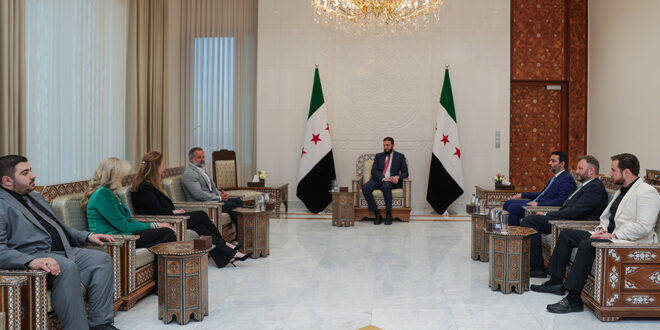
DAMASCUS: Syria’s president on Saturday received a Republican member of Congress in the first visit to the country by American legislators since the ouster of former leader Bashar Assad in December.
State news agency SANA did not give details about the meeting between President Ahmad Al-Sharaa and Rep. Cory Mills of Florida in the capital Damascus. It said the meeting was attended by Syrian Foreign Minister Asaad Al-Shibani, and comes in the wake of calls by Syria’s new rulers for the lifting of sanctions imposed by the US and other Western nations early in the conflict.
Since arriving in Syria on an unofficial visit Friday, Mills and Rep. Marlin Stutzman of Indiana toured parts of Damascus, including the old quarter as well as one of the oldest synagogues in the world that was badly damaged and looted during the country’s 14-year conflict that killed half a million people. The came at the invitation of the Syrian American Alliance for Peace and Prosperity, a US-based nonprofit that describes its mission as fostering “a sustainable political, economic, and social partnership between the people of Syria and the United States.”
On Saturday, Stutzman visited the country’s notorious Saydnaya Prison near Damascus, where tens of thousands of people were subjected to killings and torture during the 54-year rule of the Assad family.
Al-Sharaa’s Islamist Hayat Tahrir Al-Sham group led the offensive that captured Damascus in early December, forcing Assad and his family to flee to his ally Russia, where he was given asylum.
Days after Assad was removed from power, the then-Biden administration decided not to pursue a $10 million reward it had offered for the capture of Al-Sharaa, a former leader of Al-Qaeda’s branch in Syria. The announcement in December followed a meeting between Al-Sharaa and then top US diplomat for the Middle East, Barbara Leaf, who led the first US diplomatic delegation into post-Assad Syria.
The Trump administration has yet to officially recognize the current Syrian government and Washington has not yet lifted harsh sanctions that were imposed during Assad’s rule.
After visiting the prison, Stutzman told reporters that he saw that the people of Syria now have energy and optimism, adding that as the country’s new government makes decisions, “it will be very helpful having the United States understand what the changes are here and that the sanctions lifted would be a huge economic boom.” Any move to lift sanctions “would be President Trump’s decision,” he said.
“As a member of Congress, I can go back home and share with my colleagues, share with the president and others, and tell the story of the changes that are happening in Syria and we want to be here to support that,” Stutzman said. “We would not want to see Syria fall back in the hands of another dictator.”
After the fall of Assad, the US eased some restrictions on Syria to allow the entry of humanitarian aid. The US Treasury issued a general license, lasting six months, that authorizes certain transactions with the Syrian government, including some energy sales and incidental transactions.
Syrian officials have been calling for the lifting of Western sanctions but the US administration has been demanding steps by the country’s new authorities including protecting the rights of religious and ethnic minorities.
“I think lifting the sanctions will be very beneficial and I understand why the people that I’m encountering and traveling with want the sanctions lifted,” Stutzman said.


![]()

President Ahmad Al-Sharaa hosts first US Congress member to visit post-Assad Syria
Short Url
https://arab.news/2zacy
President Ahmad Al-Sharaa hosts first US Congress member to visit post-Assad Syria
- Rep. Cory Mills and Rep. Marlin Stutzman visited Syria at the invitation of the non-profit Syrian American Alliance for Peace and Prosperity
- Washington has already eased some sanctions on Syria affecting essential services


Latest updates


© 2026 SAUDI RESEARCH & PUBLISHING COMPANY, All Rights Reserved And subject to Terms of Use Agreement.