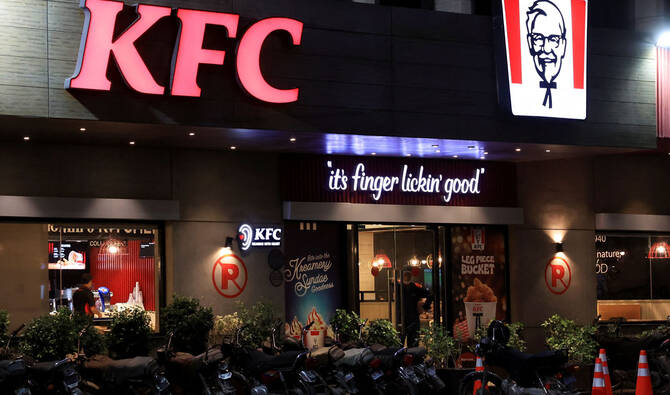
ISLAMABAD: Pakistan’s Minister of State for Interior Tallal Chaudry vowed on Saturday that the government will not show any leniency toward those involved in attacks targeting international food chain Kentucky Fried Chicken’s (KFC) outlets in various parts of the country, vowing to ensure protection for foreign investment.
The minister’s remarks came after charged mobs attacked and vandalized KFC outlets in various parts of the country this week, angered by growing anti-United States sentiment in Pakistan and in opposition to Israel for its military campaign in Gaza.
In videos shared widely on the Internet, men carrying sticks can be seen hurling abuses at customers and staff at various KFC outlets, forcing them to leave the eatery while they vandalize the outlets’ property.
Speaking to reporters at a news conference, Chaudry said around 20 such incidents across the country have taken place this month in which one KFC employee lost his life. He said 12 complaints have been registered for such incidents in Punjab, where 142 people have been arrested for their involvement in the attacks. In Islamabad, he said 15 people were arrested for their involvement in attacks on KFC outlets.
“It cannot happen that someone brings investment into Pakistan, gives its people employment, pays 100 percent tax, and also spends on welfare, education and health activities, and then someone attacks it,” Chaudry said.
“We will not let this happen. I am just not issuing a warning but practically it is being implemented in all four provinces. They are not being shown leniency anywhere and neither will we show them leniency,” he added.
The minister said those arrested for attacking KFC outlets across the country were ashamed of their actions. He said Pakistan’s religious and political parties had distanced themselves from these incidents.
Chaudry said since Friday, no attacks have been reported on any KFC outlets across the country after the prime minister took notice of the incident.
He reiterated Pakistan’s support for Palestine, saying that Prime Minister Shehbaz Sharif had raised his voice for the people of Gaza repeatedly.
However, he said the government would ensure protection for foreign investment in the country whether it be in the mines and minerals sector or international food chains.
The minister said such attacks would be “unacceptable,” adding that Pakistan’s government and interior ministry were available 24 hours to respond to such incidents.
“Any such attack will be unacceptable and it will be treated similar to when a terrorist attacks an unarmed man,” Chaudry said.
Western brands have been hit by boycotts and other forms of protests in Pakistan and other Muslim-majority countries in recent months over Israel’s military offensive in the Gaza Strip.
The war was triggered by the Palestinian group Hamas’ Oct. 7, 2023, attack on southern Israel, in which 1,200 people were killed and 251 taken hostage to Gaza, according to Israeli tallies.
Since then, more than 51,000 Palestinians have been killed in the Israeli offensive, according to Palestinian health authorities.


![]()

Pakistan vows no leniency toward perpetrators of KFC mob attacks
Short Url
https://arab.news/72g7r
Pakistan vows no leniency toward perpetrators of KFC mob attacks
- One person was killed in around 20 attacks targeting KFC outlets this month, says Pakistan’s minister of state for interior
- Charged mobs fueled by anti-US and anti-Israel sentiments attacked KFC outlets in various parts of the country this week


Latest updates




© 2026 SAUDI RESEARCH & PUBLISHING COMPANY, All Rights Reserved And subject to Terms of Use Agreement.