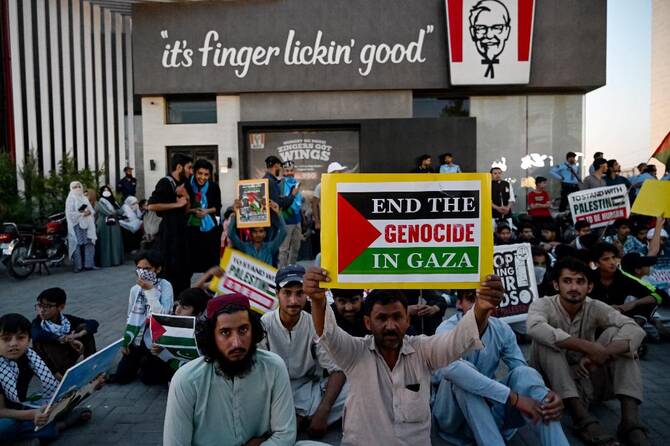
Over 170 arrested for attacks on Pakistan KFC outlets in Gaza war protests

Supporters of Islami Jamiat-e-Talaba, a student wing of Pakistan's Jamaat-e-Islami party, stage a pro-Palestinian protest outside a KFC. (AFP)
Short Url
Updated 18 April 2025
Follow

Over 170 arrested for attacks on Pakistan KFC outlets in Gaza war protests

  • Attacks sparked by anti-US, anti-Israel sentiment
  • Several Western brands face boycotts in Pakistan over Israel-Palestine conflict

KARACHI: Police have arrested scores of people in Pakistan in recent weeks after more than 10 mob attacks on outlets of US fast-food chain KFC, sparked by anti-United States sentiment and opposition to its ally Israel’s war in Gaza, officials said.
Police in major cities in the Islamic nation, including the southern port city of Karachi, the eastern city of Lahore and the capital Islamabad, confirmed at least 11 incidents in which KFC outlets were attacked by protesters armed with sticks and vandalized. At least 178 people were arrested, the officials said this week.
KFC and its parent Yum Brands, both US-based, did not respond to requests for comment.
A police official, who spoke on condition of anonymity, said one KFC employee was shot and killed this week in a store on the outskirts of Lahore by unknown gunmen. The official added there was no protest at the time and they were investigating whether the killing was motivated by political sentiment or some other reason.
In Lahore, police said they were ramping up security at 27 KFC outlets around the city after two attacks took place and five others were prevented.
“We are investigating the role of different individuals and groups in these attacks,” said Faisal Kamran, a senior Lahore police officer, adding that 11 people, including a member of the Islamist religious party Tehreek-e-Labbaik Pakistan (TLP), were arrested in the city. He added the protests were not officially organized by TLP.
TLP spokesman Rehan Mohsin Khan said the group “has urged Muslims to boycott Israeli products, but it has not given any call for protest outside KFC.”
“If any other person claiming to be a TLP leader or activist has indulged in such activity, it should be taken as his personal act which has nothing to do with the party’s policy,” said Khan.
KFC has long been viewed as a symbol of the United States in Pakistan and borne the brunt of anti-American sentiment in recent decades with protests and attacks.
Western brands have been hit by boycotts and other forms of protests in Pakistan and other Muslim-majority countries in recent months over Israel’s military offensive in the Gaza Strip.
The war was triggered by the Palestinian militant group Hamas’ October 7, 2023, attack on southern Israel, in which 1,200 people were killed and 251 taken hostage to Gaza, according to Israeli tallies.
Since then, more than 51,000 Palestinians have been killed in the Israeli offensive, according to local health authorities.
Yum Brands has said one of its other brands, Pizza Hut, has faced a protracted impact from boycotts related to Israel’s war in Gaza.
In Pakistan, local brands have made inroads into its fast-growing cola market as some consumers avoid US brands. In 2023, Coca-Cola’s market share in the consumer sector in Pakistan fell to 5.7 percent from 6.3 percent in 2022, according to GlobalData, while PepsiCo’s fell to 10.4 percent from 10.8 percent.
Earlier this month, religious clerics in Pakistan called for a boycott of any products or brands that they say support Israel or the American economy, but asked people to stay peaceful and not destroy property. 


US will respond to Rwanda’s violation of peace pact, says Rubio

Secretary of State Marco Rubio. (AP file photo)
Updated 58 min 34 sec ago
Follow

US will respond to Rwanda’s violation of peace pact, says Rubio

  • Waltz told the Security Council meeting that the US “is deeply concerned and increasingly disappointed” by this resurgence of violence

WASHINGTON: Top US diplomat Marco Rubio said on Saturday that Rwanda had clearly violated the peace agreement it signed with the Democratic Republic of Congo in Washington last week and vowed unspecified “action” in response.
The Rwandan-backed M23 armed group advanced in eastern DRC and seized the key border city of Uvira, just days after the leaders signed the “Washington Accords” on Dec. 4.

Mike Waltz, US ambassador to the UN. (REUTERS)

“Rwanda’s actions in eastern DRC are a clear violation of the Washington Accords, and the US will take action to ensure promises made to the President are kept,” Secretary of State Rubio wrote on X.

FASTFACT

UN peacekeeping chief Jean-Pierre Lacroix warned the new offensive ‘has revived the specter of a regional conflagration with incalculable consequences.’

The capture of Uvira, along the border with Burundi, has raised fears that the conflict could escalate into a regional war.
As part of an offensive launched at the beginning of December in South Kivu province, the armed group’s takeover follows its earlier this year capture of Goma and Bukavu, other major cities in the DRC’s mineral-rich east.

On Friday, US Ambassador to the UN Mike Waltz accused Rwanda of “leading the region toward more instability and toward war.”
“The Rwandan defense forces have provided materiel, logistics, and training support to M23 as well as fighting alongside M23 in DRC with roughly 5,000 to 7,000 troops,” not including possible reinforcements during the latest offensive, Waltz told the UN Security Council.
The Rwandan firepower has included surface-to-air missiles, drones, and artillery, he added.
Since taking up arms again in 2021, the M23 has seized swaths of territory, displacing tens of thousands and leading to a spiraling humanitarian crisis.
Earlier this month, UN experts said Rwanda’s army and the M23 had carried out summary executions and forced mass displacements of people in the region.
Waltz told the Security Council meeting that the US “is deeply concerned and increasingly disappointed” by this resurgence of violence. 
The envoy denounced “the scale and sophistication” of Rwanda’s involvement in eastern DRC.
UN peacekeeping chief Jean-Pierre Lacroix warned the new offensive “has revived the specter of a regional conflagration with incalculable consequences.”
“Recent developments pose a serious risk of the progressive fragmentation of the Democratic Republic of Congo, particularly its eastern part,” he said.
Burundi on Friday accused Rwanda of bombing its territory, and its ambassador, Zephyrin Maniratanga, told the council it “reserves the right to use self-defense.”
He warned that if the attacks continue, it would be extremely difficult to avoid an escalation between the two African countries.
“Rwanda is not waging war against the Republic of Burundi and has no intention of doing that,” Ambassador Martin Ngoga said.
Meanwhile, Congolese Foreign Minister Therese Kayikwamba Wagner criticized the Security Council for its “lack of action” and called for sanctions against Rwanda.

Despite a resolution adopted in February demanding the withdrawal of Rwandan troops and a ceasefire, “the situation is undeniable: another city has fallen, a parallel administration has consolidated itself, thousands more families have fled, and others have been killed, raped, and terrorized,” she said.