

Pakistan deputy PM discusses security, trade cooperation with Afghan FM in Kabul

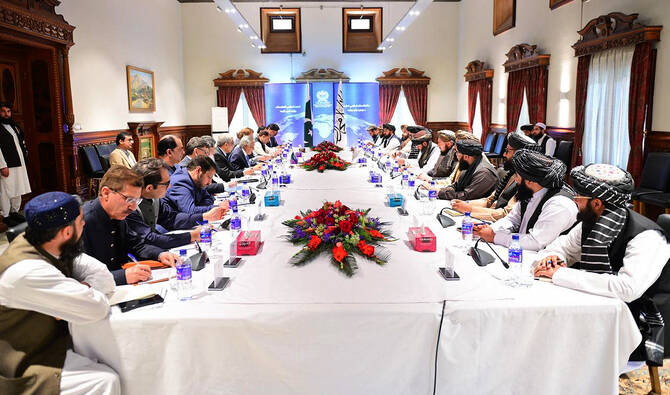
This handout photograph taken on April 19, 2025 and released by the Pakistan’s Ministry of Foreign Affairs shows the country’s Foreign Minister and Deputy Prime Minister Ishaq Dar (9L) speaks during a meeting with Acting Afghan Foreign Minister Amir Khan Muttaqi (8R) and other Taliban government officials in Kabul. Dar arrived in Afghanistan on April 19 for a one-day visit to meet senior Afghan Taliban officials, including Prime Minister Hasan Akhund, after Pakistan expelled more than 85,000 Afghans in just over two weeks. (Photo courtesy: Handout/MOFA)
Short Url
Updated 19 April 2025
Follow

Pakistan deputy PM discusses security, trade cooperation with Afghan FM in Kabul

  • Ishaq Dar’s visit comes at a time when Pakistan has blamed Afghan officials for ‘facilitating’ cross-border militancy
  • Dar stresses importance of resolving issues such as security, border management between both countries, says FO

ISLAMABAD: Pakistan’s Deputy Prime Minister and Foreign Minister Ishaq Dar on Saturday held discussions involving security, border management and regional trade with Afghanistan’s Foreign Minister Amir Khan Muttaqi, Pakistan’s foreign office said.
Dar arrived in Kabul on Saturday morning for a day-long visit to discuss Islamabad’s security concerns, trade and investment opportunities with Afghanistan amid strained ties between the neighbors. 
His visit takes place amid surging militancy in Pakistan, which Islamabad blames on the Tehreek-e-Taliban Pakistan (TTP) militant outfit. Pakistan accuses the Afghan Taliban of providing them sanctuaries, allegations that Kabul has repeatedly denied. 
Dar’s visit to Kabul also takes place as Pakistan intensifies its campaign to deport what it says are “illegal immigrants,” mostly Afghan nationals, which it has blamed without evidence for being involved in suicide attacks and militancy in the country. Pakistan’s deportation drive has further soured ties between the two nations. 
“The discussions encompassed a comprehensive range of topics pertaining to bilateral relations, underscoring the need to devise strategies for enhancing cooperation across diverse areas of mutual interest, including security, trade, transit, connectivity, and people-to-people contacts,” the foreign office said. 
Dar stressed the importance of addressing all issues between the two countries, particularly those related to security and border management to fully realize the potential for regional trade and connectivity, the foreign office said. 
“Both parties reaffirmed their commitment to fostering mutually beneficial relations and agreed on the importance of maintaining high-level engagement,” the statement said. 
The deputy prime minister will meet Afghanistan’s Prime Minister Mullah Muhammad Hassan Akhund, the foreign office said in an earlier statement. 


This handout photograph taken on April 19, 2025 and released by the Pakistan’s Ministry of Foreign Affairs shows the country’s Foreign Minister and Deputy Prime Minister Ishaq Dar (4R) shaking hands with Afghan government officials upon his arrival in Kabul. (Photo courtesy: Handout/MOFA)

Speaking to the state-run Pakistan Television before leaving for Kabul, Dar acknowledged there has been “coldness” in Pakistan’s and Afghanistan’s ties in recent years. 
“I believe the security of Pakistan, its people, their lives and properties, is very important,” Dar said. “So one of our concerns is regarding terrorism, which we will discuss.”
He said there is also immense potential for economic, trade and investment opportunities between Pakistan and Afghanistan. 
“Our connection with Central Asian states can be established through rail links but that’s not possible unless Afghanistan becomes a partner in this,” he said. 
Dar’s visit is seen as a continuation of Pakistan’s efforts to engage with Afghanistan despite frosty ties, and its aim to address mutual concerns and explore avenues for cooperation with the country. 


Pakistan terms climate change, demographic pressures as ‘pressing existential risks’

Updated 4 sec ago
Follow

Pakistan terms climate change, demographic pressures as ‘pressing existential risks’

  • Pakistan has suffered frequent climate change-induced disasters, including floods this year that killed over 1,000
  • Pakistan finmin highlights stabilization measures at Doha Forum, discusses economic cooperation with Qatar 

ISLAMABAD: Pakistan’s Finance Minister Muhammad Aurangzeb on Saturday described climate change and demographic pressures as “pressing existential risks” facing the country, calling for urgent climate financing. 

The finance minister was speaking as a member of a high-level panel at the 23rd edition of the Doha Forum, which is being held from Dec. 6–7 in the Qatari capital. Aurangzeb was invited as a speaker on the discussion titled: ‘Global Trade Tensions: Economic Impact and Policy Responses in MENA.’

“He reaffirmed that while Pakistan remained vigilant in the face of geopolitical uncertainty, the more pressing existential risks were climate change and demographic pressures,” the Finance Division said. 

Pakistan has suffered repeated climate disasters in recent years, most notably the 2022 super-floods that submerged one-third of the country, displaced millions and caused an estimated $30 billion in losses. 

This year’s floods killed over 1,000 people and caused at least $2.9 billion in damages to agriculture and infrastructure. Scientists say Pakistan remains among the world’s most climate-vulnerable nations despite contributing less than 1 percent of global greenhouse-gas emissions.

Aurangzeb has previously said climate change and Pakistan’s fast-rising population are the only two factors that can hinder the South Asian country’s efforts to become a $3 trillion economy in the future. 

The finance minister noted that this year’s floods in Pakistan had shaved at least 0.5 percent off GDP growth, calling for urgent climate financing and investment in resilient infrastructure. 

When asked about Pakistan’s fiscal resilience and capability to absorb external shocks, Aurangzeb said Islamabad had rebuilt fiscal buffers. He pointed out that both the primary fiscal balance and current account had returned to surplus, supported significantly by strong remittance inflows of $18–20 billion annually from the Middle East and North Africa (MENA) and Gulf Cooperation Council (GCC) regions. 

Separately, Aurangzeb met his Qatari counterpart Ali Bin Ahmed Al Kuwari to discuss bilateral cooperation. 

“Both sides reaffirmed their commitment to strengthening economic ties, particularly by maximizing opportunities created through the newly concluded GCC–Pakistan Free Trade Agreement, expanding trade flows, and deepening energy cooperation, including long-term LNG collaboration,” the finance ministry said. 

The two also discussed collaboration on digital infrastructure, skills development and regulatory reform. They agreed to establish structured mechanisms to continue joint work in trade diversification, technology, climate resilience, and investment facilitation, the finance ministry said.