

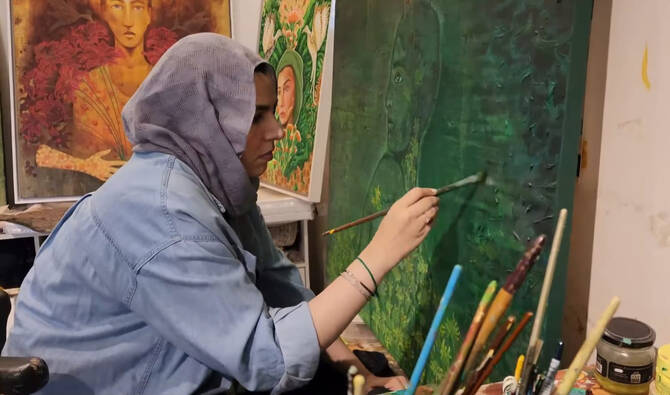

KARACHI: Pakistani artists have been receiving increasing international recognition, but many still grapple with limited opportunities and visibility at home, a participant at a major Gulf art fair said this week.
Her comments coincided with Art Dubai 2025, the Middle East’s leading contemporary art fair, where 10 Pakistani artists are exhibiting their work this year.
The event, running since 2007, draws galleries and collectors from across the globe and has become a vital platform for people with creative abilities in places like Pakistan.
“It’s wonderful that we as artists who have been invisible because of the greater struggles of [our] country are visible through this platform in the Gulf,” said Faiza Butt, a London-based Pakistani artist currently attending the fair, told Arab News over the phone.
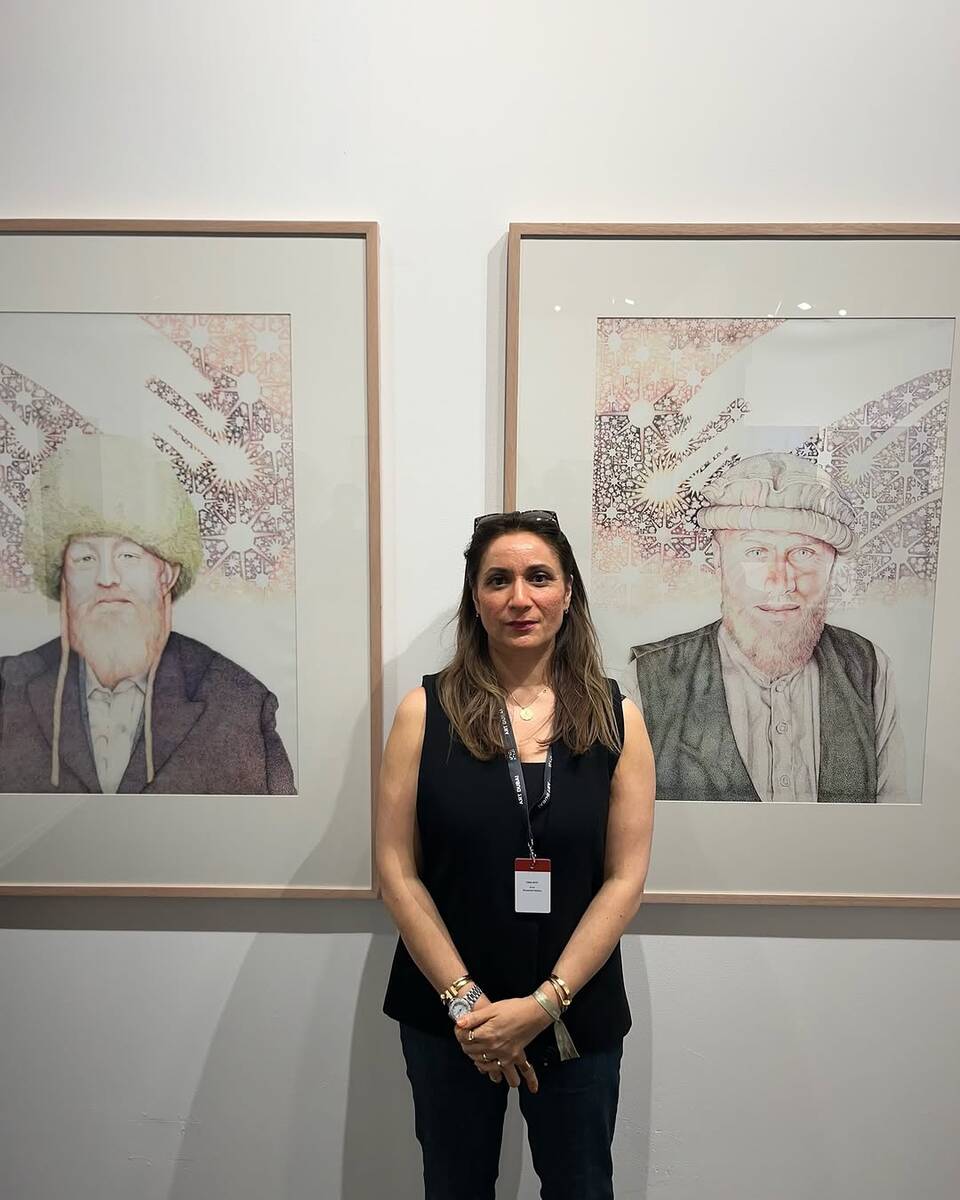
Artist Faiza Butt poses against the backdrop of her artwork ‘The Male Figure’ during the Art Dubai 2025 preview at Madinat Jumeirah in Dubai on April 17, 2025. (Photo courtesy: Handout/Grosvenor Gallery)
“It’s really a matter of pride that despite all the odds, Pakistani artists continue to appear, and work and make themselves visible, especially female artists.”
Butt maintained Pakistani artists are shaped by the country’s complex realities, adding that is what gives their work its depth.
“Our social and political struggles really feed the artists’ imagination,” she said. “Art doesn’t come from a happy place. So one of the reasons our artists are so strong is because our country has gone through a great deal of strife.”
She also credited the country’s mature art education institutions, such as the National College of Arts in Lahore and the Indus Valley School of Arts in Karachi, for nurturing generations of artists despite systemic challenges.

Artwork ‘The Male Figure’ by Pakistani artists Anwar Saeed and Faiza Butt on display by Grosvenor Gallery during the Art Dubai 2025 at Madinat Jumeirah in Dubai. (Photo courtesy: Handout/Grosvenor Gallery)
Karachi-based visual artist Sana Arjumand, who is also exhibiting at the fair, echoed similar views.
“There is now more and more interest coming into Pakistani art because we are really making very good art,” she said.
“Because of so many different experiences here [in Pakistan], we have that informed kind of making of art. It’s more vibrant and alive. It stands out as well — that is why more and more interest is coming here.”
Arjumand, who studied painting at NCA, said her early work focused on self-reflection but has since evolved to include themes of Sufism, mysticism and human interconnectedness with nature.
Her new work, presented at the fair, explores the idea that human behavior mirrors elements in the natural world.
“It’s for everyone,” she said. “It has a storyline that anybody can relate to.”
A total of ten Pakistani artists, including one posthumously, are featured in the fair’s Contemporary Art section. Among them is the late Sadequain, whose pioneering calligraphy and figurative works helped define Pakistan’s post-Partition art movement and continue to influence generations of artists.

Sana Arjumand’s painting ‘The Perfect Mirror’ on display by Aicon Gallery at Booth E5 as they set up for the Art Dubai 2025 preview at Madinat Jumeirah in Dubai on April 16, 2025. (Photo courtesy: Handout/Sana Arjumand Studio)
Also exhibiting are Rasheed Araeen, a Karachi-born conceptualist known internationally for his contributions to British minimalist and postcolonial art, and Imran Qureshi, whose fusion of classical Mughal miniature techniques with contemporary themes has earned him acclaim worldwide.
Other featured names include Anwar Saeed, celebrated for his explorations of identity and sexuality, and Shezad Dawood, a London-based multidisciplinary artist with Pakistani and Indian heritage.
Butt is being represented by Grosvenor Gallery in London, which is exhibiting her work alongside that of Anwar Saeed under a shared curatorial concept focused on representations of the male form.
“The female figure is represented enough in the arts,” said Butt. “Anwar and I both discuss the male form but with our own unique politics based on our unique ethnography. But we are both Pakistanis, and there are overlaps in our concerns.”
She will also deliver a talk on behalf of Saeed, reflecting on his practice and political engagement through art.
Despite global attention, Butt stressed that Pakistan lacks the institutional and financial infrastructure to support a thriving art scene.
“Art is a very priced project, and Pakistan cannot afford having art fairs or a very established art market,” she said. “Pakistani artists get absorbed by galleries from other countries.”
She described Art Dubai as a great opportunity for artists in her country.
“Dubai is a very stable financial hub of the Gulf region,” she continued. “It has welcomed a great deal of migration from India and Pakistan. You get a diverse audience. It’s a beautiful coming together, in a positive way, of ideas, culture and exchange of thought.”


