

In Bihar, 19th-century library holds India’s treasure trove of Arabic manuscripts

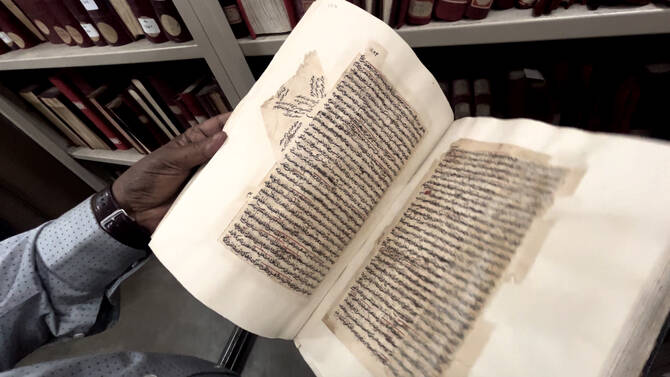
An Arabic manuscript from the collection of Khuda Bakhsh Oriental Library in Patna, India. (AN Photo)
Short Url
Updated 18 April 2025
Follow

In Bihar, 19th-century library holds India’s treasure trove of Arabic manuscripts

  • Collection includes ‘Kitab Al-Tasrif’ by 10th-century Arab physician Al-Zahrawi, father of operative surgery
  • Khuda Bakhsh Oriental Library has more than 21,000 rare and old manuscripts — half of them in Arabic

PATNA: When Khan Bahadur Khuda Bakhsh opened his book collection to the public in the late-19th century, he was fulfilling his father’s wish. Little did he know that, over the decades, their private library would grow into one of India’s richest repositories of the intellectual heritage of South Asia and the Middle East.

The Bakhsh family was a family of jurists and scholars, who migrated from Delhi in the early-19th century and established themselves in Patna — the capital of the eastern Indian state of Bihar.

Khuda Bakhsh’s father, Mohammed Bakhsh, was a lawyer and bibliophile, who collected 1,400 Arabic and Persian manuscripts. His son increased the collection to 4,000.

“He was spending all his money, all his assets, on developing this library, acquiring the manuscripts from all over the world,” Dr. Shayesta Bedar, the library’s former director, told Arab News.

“His father desired that Khuda Baksh should make a library for the use of the public, and it should also specialize in manuscripts. He kept the word.”

The Khuda Bakhsh Oriental Library opened in Patna in 1891, in a two-story building near the banks of the Ganges, where it still stands today.
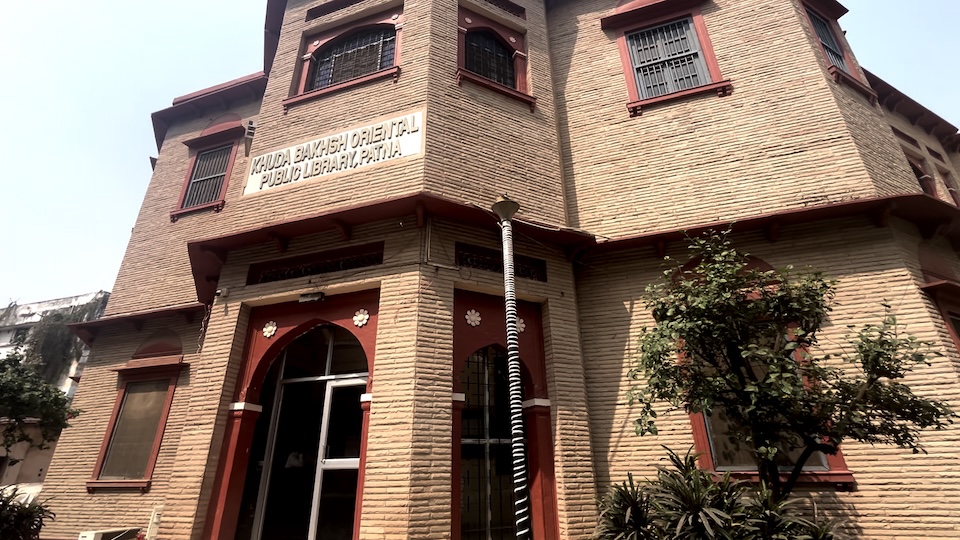


The building of Khuda Bakhsh Oriental Library in Patna, India, March 2025. (AN Photo)

It now holds more than 2 million items, including books, calligraphy, paintings and 21,136 manuscripts — half of them in Arabic and another few thousand in Persian.

The library’s founder had an employee named Makki, whose sole duties were to search for and buy centuries-old works on science, history and Islamic studies.

“Makki used to roam all over the world ... and he was acquiring them from different places,” Bedar said.

“(Khuda Bakhsh) was a rich man. He was an advocate, he has his own lands, and he had no other passion except to develop this library.”

Among the rarest manuscripts in the library’s holdings is the “Kitab Al-Tasrif.” Known in English as “The Method of Medicine,” it is an Arabic encyclopedia of medical procedures written near the year 1000 by Abu Al-Qasim Al-Zahrawi, a famed Arab physician from Andalusia.


This collage of photos shows pages from medieval Arabic manuscripts, “Kitab Al-Hashaish,” left, and “Kitab Al-Tasrif,” center and right, from the collection of Khuda Bakhsh Oriental Library in Patna, India. (Khuda Bakhsh Oriental Library)

Al-Zahrawi is considered the father of operative surgery and is credited with performing the first thyroidectomy and introducing more than 200 surgical tools.

Another rare work is the “Kitab Al-Hashaish,” known as the “Book of Herbs,” which is the Arabic translation of the famous Greek botanical and medical text by Dioscorides, a 1st-century physician and pharmacologist.

“These are 11th-century works ... Today’s medical science has been based on this ‘Kitab Al-Tasrif.’ And ‘Kitab Al-Hashaish’ is a collection of works that deal with medicinal plants and animals. These are some of the rarest manuscripts,” Bedar said.

Among the most prominent Persian works in the collection is the original manuscript of “Tarikh-e Khandan-e Timuriyah” (“Chronicle of the Descendants of Timur”), a 16th-century work commissioned by Mughal Emperor Akbar, which describes the descendants of the 14th-century ruler Timur in Iran and India, including Babur, Humayun and Akbar himself.

Another one is the “Divan of Hafez,” a collection of works by the 14th-century Persian Sufi poet Hafez.

“This (volume) was used by Mughal emperors to take out the omens and the writing of these Mughal kings, notes, are on the margins of the manuscript,” Bedar said.

“These (manuscripts) are a few to be named — just a glimpse ... These are the rarest ones, which are not available anywhere else in the world.”

The library has been administrated by the Indian government since the 1950s. In 1969, Parliament declared it an Institution of National Importance, which is fully funded by the Ministry of Culture.

Since 2023, works have been underway to digitalize the library’s collection and many texts are already available online — expanding the reach of Khuda Bakhsh’s library far beyond the Patna community it was intended for.

But most of the research work still happens offline, in the library’s reading rooms.

“We are connected with the libraries of Saudi Arabia, like the library of the Prophet’s Mosque in Madinah ... People from the Arab world come here for research,” Shakeel Ahmad Shamsi, the library’s information officer, told Arab News.

“We have about 10,000 Arabic manuscripts in this collection, about 8,000 or 9,000 in Persian, and in other languages also like Urdu, Hindi, Sanskrit, Pashto, Turkish ... This library is famous for its manuscripts ... it is famous in the whole world.”


Sarkozy describes his prison stay and advises on appealing to the far right in his new book

Updated 2 sec ago
Follow

Sarkozy describes his prison stay and advises on appealing to the far right in his new book

PARIS: Former French President Nicolas Sarkozy described the prison where he spent 20 days as a noisy, harsh “all-grey” world of “inhuman violence” in a book released Wednesday that also offered political advice about how his conservative party should appeal to far-right voters.
In “Diary of a Prisoner,” the 70-year-old says his own tough-on-crime stance has taken on a new perspective as he recounts the uncommon turn in his life after being found guilty of criminal association in financing his winning 2007 campaign with funds from Libya.
The court sentenced him in September to five years in prison, a ruling he appealed. He was granted release under judicial supervision after 20 days behind bars.
The book provides a rare look inside Paris’ La Santé prison, where Sarkozy was held in solitary confinement and kept strictly away from other inmates for security reasons. His loneliness was broken only by regular visits from his wife, supermodel-turned-singer Carla Bruni-Sarkozy, and his lawyers.
Sarkozy wrote that his cell looked like a “cheap hotel, except for the armored door and the bars,” with a hard mattress, a plastic-like pillow and a shower that produced only a thin stream of water. He described the “deafening noise” of the prison, much of it at night.
Opening the window on his first day behind bars, he heard an inmate who “was relentlessly striking the bars of his cell with a metal object.”
“The atmosphere was threatening. Welcome to hell!”
Sarkozy said he declined the meals served in small plastic trays along with a “mushy, soggy baguette” — their smell, he wrote, made him nauseous. Instead, he ate dairy products and cereal bars. He was allowed one hour a day in a small gym room, where he mostly used a basic treadmill.
Sarkozy says he was informed of several violent incidents that took place during his time behind bars, which he called “a nightmare.”
“The most inhumane violence was the daily reality of this place,” he wrote, raising questions about the prison system’s ability to reintegrate people once their sentences are served.
Sarkozy, known for his touch rhetoric on punishing criminals, said he promised himself that “upon my release, my comments would be more elaborate and nuanced than what I had previously expressed on all these topics.”
Political reflections
Beyond recounting prison life, Sarkozy used the book to offer strategic political advice for his conservative Republicans party and revealed he spoke by phone from prison with far-right leader Marine Le Pen, once a fierce rival.
Le Pen’s National Rally is “not a danger for the Republic,” he wrote. “We do not share the same ideas when it comes to economic policy, we do not share the same history … and I note that there may still be some problematic figures among them. But they represent so many French people, respect the results of the elections and participate in the functioning of our democracy.”
Sarkozy argued that the reconstruction of his weakened Republicans party “can only be achieved through the broadest possible spirit of unity.”
The Republicans party has in recent years been moving away from a position held among parties for decades that any electoral strategy must be aimed at containing the far right, even if it means losing a district to another competitor.
Still, political analyst Roland Cayrol said Sarkozy’s comments came like “a thunderclap” in the decades-long position of French conservatives that the National Rally doesn’t “share the same values” and “no electoral alliance is possible” with the far right.
The former president from 2007 to 2012 has been retired from active politics for years but remains very influential, especially in conservative circles.
In the wake of Sarkozy’s comments, the Republicans’ top officials have stopped short of calling for any actual cooperation deal with the National Rally, but instead indicated they want to focus on ways to get far-right voters to choose conservative candidates.
Strained ties with Macron
Sarkozy also mentioned his former friendship with centrist President Emmanuel Macron. The two men met at the Élysée presidential palace just days before Sarkozy entered prison.
According to Sarkozy, Macron raised security concerns at La Santé prison and offered to transfer him to another facility, which he declined. Instead, two police officers were assigned to the neighboring cell to protect him around the clock.
Sarkozy said he lost trust in Macron after the president did not intervene to prevent him from being stripped of the Legion of Honor, France’s highest distinction, in June.
Last month, Sarkozy was convicted of illegal campaign financing of his 2012 reelection bid, in a major blow to his legacy and reputation. He was sentenced to a year in prison, half of it suspended, which he now will be able to serve at home, monitored with an electronic bracelet or other requirements to be set by a judge.
Last year, France’s top court upheld an appeals court decision that had found Sarkozy guilty of trying to bribe a magistrate in exchange for information about legal proceedings in which he was involved.