

Training of 89,000 Pakistani Hajj pilgrims under government scheme in ‘final stages’ — minister

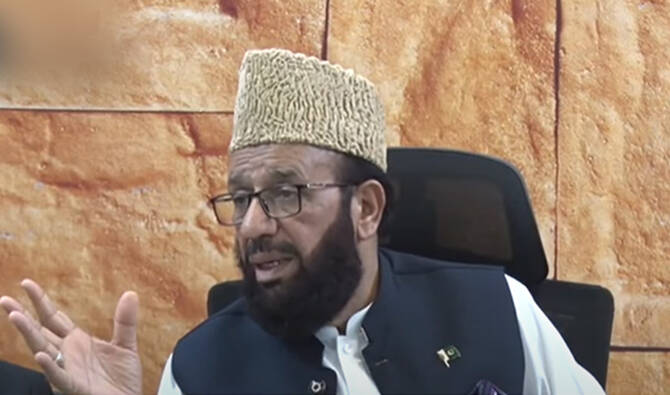
Pakistan's Religious Affairs Minister Sardar Muhammad Yousaf speaks at a press conference in Karachi, Pakistan, on April 18-2025. (Screengrap/PTV)
Short Url
Updated 18 April 2025
Follow

Training of 89,000 Pakistani Hajj pilgrims under government scheme in ‘final stages’ — minister

  • Pakistan holds nationwide camps to ensure pilgrims are well-informed and prepared for the spiritual and physical journey
  • This year, 89,000 Pakistanis will perform Hajj under the government scheme and 23,620 with private tour operators

ISLAMABAD: Pakistan’s Religious Affairs Minister Sardar Muhammad Yousaf said on Friday the training of 89,000 pilgrims performing Hajj under the government scheme was in the “final stages” to ensure they were fully aware of the rituals, logistics, and regulations associated with the annual pilgrimage.

Hajj is expected to take place in June this year.

Pakistan and Saudi Arabia signed the Hajj Agreement 2025 in January, under which Pakistan was given a quota of 179,210 pilgrims. This year, 89,000 people will perform Hajj under the government scheme and 23,620 with private tour operators. 

Each year ahead of the pilgrimage, Pakistan holds nationwide training camps to ensure pilgrims are well-informed and prepared for the spiritual and physical journey, as well as to maintain discipline and uniformity during the Hajj.

“Under our government scheme, 89,000 pilgrims will perform Hajj this year and all the formalities and procedures have been completed,” Yousuf told journalists in Islamabad.

“This training is being provided at the final stage to ensure that pilgrims are fully prepared and knowledgeable in line with Saudi guidelines to avoid any difficulties during their journey.”

“Master trainers and religious scholars” had been engaged to ensure that the administrative procedures were properly understood and pilgrims were well-informed about the correct way to perform Hajj, Yousuf said, adding that the religious affairs ministry’s main objective was to ensure pilgrims from Pakistan were “well informed, well prepared and received maximum assistance.”

Mandatory vaccinations for Pakistani Hajj pilgrims, including meningitis and flu shots, would be administered on April 20, while travelers from yellow fever and polio-prone regions must present valid immunization certificates.

The precautions are vital to prevent the spread of infectious diseases among millions of pilgrims converging in the Kingdom from across the globe.

Hajj flight operations are set to begin on Apr. 29, with the first flight departing from Pakistan’s eastern city of Lahore. 

Prime Minister Shehbaz Sharif has also formed a three-member inquiry committee to investigate why Pakistan failed to fully utilize its quota of 179,210 pilgrims for Hajj 2025.


World Bank approves $700 million for Pakistan’s economic stability

Updated 20 December 2025
Follow

World Bank approves $700 million for Pakistan’s economic stability

  • Of this, $600 million will go for federal programs and $100 million will ⁠support a provincial program in Sindh
  • The results-based design ensures that resources are only disbursed once program objectives are achieved

ISLAMABAD: The World Bank has approved $700 million in ​financing for Pakistan under a multi-year initiative aimed at supporting the country’s macroeconomic stability and service delivery, the bank said on Friday.

The funds will be released under the bank’s Public ‌Resources for Inclusive ‌Development — Multiphase ‌Programmatic ⁠Approach (PRID-MPA) that ‌could provide up to $1.35 billion in total financing, according to the lender.

Of this amount, $600 million will go for federal programs and $100 million will ⁠support a provincial program in ‌the southern Sindh province. The results-based design ensures that resources are only disbursed once program objectives are achieved.

“Pakistan’s path to inclusive, sustainable growth requires mobilizing more domestic resources and ensuring they are used efficiently and transparently to deliver results for people,” World Bank country director Bolormaa Amgaabazar said in a statement.

“Through this MPA, we are working with the Federal and Sindh governments to deliver tangible impacts— more predictable funding for schools and clinics, fairer tax systems, and stronger data for decision‑making— while safeguarding priority social and climate investments and strengthening public trust.”

The approval ‍follows a $47.9 ‍million World Bank grant ‍in August to improve primary education in Pakistan’s most populous Punjab province.

In November, an IMF-World Bank ​report, uploaded by Pakistan’s finance ministry, said Pakistan’s fragmented ⁠regulation, opaque budgeting and political capture are curbing investment and weakening revenue.

Regional tensions may surface over international financing for Pakistan. In May, Reuters reported that India would oppose World Bank funding for Pakistan, citing a senior government ‌source in New Delhi.

“Strengthening Pakistan’s fiscal foundations is essential to restoring macroeconomic stability, delivering results and strengthening institutions,” said Tobias Akhtar Haque, Lead Country Economist for the World Bank in Pakistan.

“Through the PRID‑MPA, we are launching a coherent nationwide approach to support reforms that expand fiscal space, bolster investments in human capital and climate resilience, and strengthen revenue administration, budget execution, and statistical systems. These reforms will ensure that resources reach the frontline and deliver better outcomes for people across Pakistan with greater efficiency and accountability.”

In Sindh, the program is expected to increase provincial revenues, enhance the speed and transparency of payments, and broaden the use of data to guide provincial decision making. The program will directly support the increase of public resources for inclusive development, including more equitable and responsive financing for primary health care facilities and more funding for schools.