

Training of 89,000 Pakistani Hajj pilgrims under government scheme in ‘final stages’ — minister

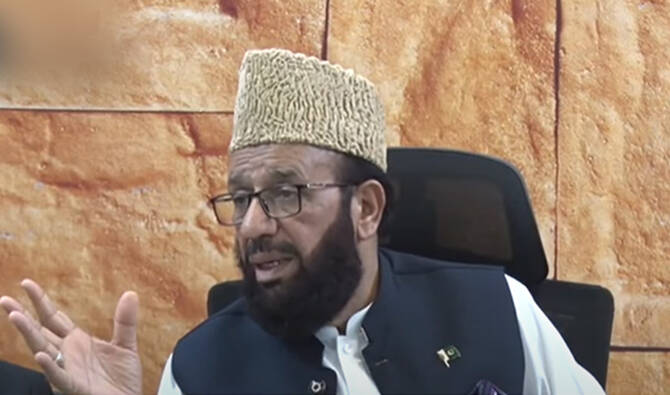
Pakistan's Religious Affairs Minister Sardar Muhammad Yousaf speaks at a press conference in Karachi, Pakistan, on April 18-2025. (Screengrap/PTV)
Short Url
Updated 18 April 2025
Follow

Training of 89,000 Pakistani Hajj pilgrims under government scheme in ‘final stages’ — minister

  • Pakistan holds nationwide camps to ensure pilgrims are well-informed and prepared for the spiritual and physical journey
  • This year, 89,000 Pakistanis will perform Hajj under the government scheme and 23,620 with private tour operators

ISLAMABAD: Pakistan’s Religious Affairs Minister Sardar Muhammad Yousaf said on Friday the training of 89,000 pilgrims performing Hajj under the government scheme was in the “final stages” to ensure they were fully aware of the rituals, logistics, and regulations associated with the annual pilgrimage.

Hajj is expected to take place in June this year.

Pakistan and Saudi Arabia signed the Hajj Agreement 2025 in January, under which Pakistan was given a quota of 179,210 pilgrims. This year, 89,000 people will perform Hajj under the government scheme and 23,620 with private tour operators. 

Each year ahead of the pilgrimage, Pakistan holds nationwide training camps to ensure pilgrims are well-informed and prepared for the spiritual and physical journey, as well as to maintain discipline and uniformity during the Hajj.

“Under our government scheme, 89,000 pilgrims will perform Hajj this year and all the formalities and procedures have been completed,” Yousuf told journalists in Islamabad.

“This training is being provided at the final stage to ensure that pilgrims are fully prepared and knowledgeable in line with Saudi guidelines to avoid any difficulties during their journey.”

“Master trainers and religious scholars” had been engaged to ensure that the administrative procedures were properly understood and pilgrims were well-informed about the correct way to perform Hajj, Yousuf said, adding that the religious affairs ministry’s main objective was to ensure pilgrims from Pakistan were “well informed, well prepared and received maximum assistance.”

Mandatory vaccinations for Pakistani Hajj pilgrims, including meningitis and flu shots, would be administered on April 20, while travelers from yellow fever and polio-prone regions must present valid immunization certificates.

The precautions are vital to prevent the spread of infectious diseases among millions of pilgrims converging in the Kingdom from across the globe.

Hajj flight operations are set to begin on Apr. 29, with the first flight departing from Pakistan’s eastern city of Lahore. 

Prime Minister Shehbaz Sharif has also formed a three-member inquiry committee to investigate why Pakistan failed to fully utilize its quota of 179,210 pilgrims for Hajj 2025.


Pakistan, Saudi Arabia discuss regional situation, upcoming engagements

Updated 14 February 2026
Follow

Pakistan, Saudi Arabia discuss regional situation, upcoming engagements

  • Ishaq Dar and Prince Faisal bin Farhan agree to stay in contact amid Middle East tensions
  • The two officials speak ahead of Trump’s Feb. 19 Board of Peace meeting in Washington, DC

ISLAMABAD: Pakistan’s Deputy Prime Minister and Foreign Minister Ishaq Dar discussed regional developments and upcoming international engagements with Saudi Foreign Minister Prince Faisal bin Farhan in a phone call on Saturday, according to the foreign office in Islamabad.

The conversation took place against the backdrop of deepening strategic ties between Islamabad and Riyadh. In September last year, the two countries signed a bilateral defense agreement that formalized decades of military cooperation and included a commitment to view aggression against one as an attack on both countries.

“Deputy Prime Minister/Foreign Minister Mohammad Ishaq Dar held a telephonic conversation today with the Foreign Minister of Saudi Arabia, Faisal bin Farhan Al Saud,” Pakistan’s foreign ministry said in a statement.

“The two leaders discussed the evolving regional situation, forthcoming international engagements, and agreed to remain in close contact,” it added.

The two officials spoke at a time of heightened tensions in the Middle East, with the conflict in Gaza far from resolution amid ongoing ceasefire violations by Israel.

The region has also been on edge as the United States pursues nuclear negotiations with Iran, prompting regional states to call for diplomacy rather than new military flare-ups.

Both Pakistan and Saudi Arabia are participants in US President Donald Trump’s Board of Peace, which is scheduled to meet on Feb. 19 in Washington.

Islamabad and Riyadh have consistently coordinated positions over regional and global issues.

The foreign ministry did not provide further details of the discussion.