Pakistan says no new polio case reported in over two months

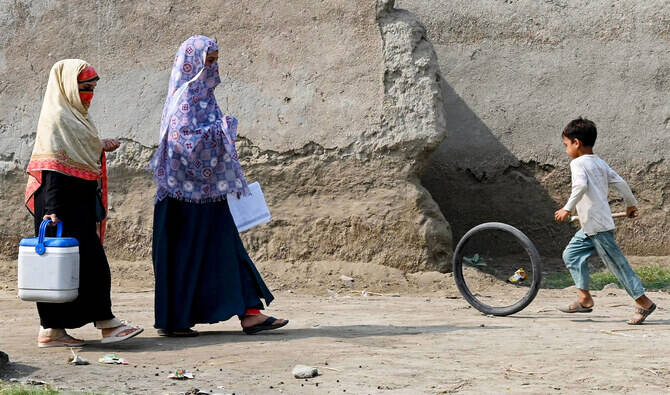
This photograph taken on October 5, 2024 shows health workers walking during a door-to-door poliovirus vaccination campaign for children on the outskirts of Peshawar. (AFP/File)
Short Url
Updated 17 April 2025
Follow

Pakistan says no new polio case reported in over two months

  • Total of 74 cases were reported in 2024, six cases confirmed this year
  • Pakistan and Afghanistan are last polio-endemic countries in the world

ISLAMABAD: Pakistan has not reported a new case of polio since Feb. 10, Radio Pakistan reported on Thursday, after the country confirmed a total of 74 cases of the virus in 2024 and six this year. 
Pakistan and neighboring Afghanistan are the last polio-endemic countries in the world. In the early 1990s, Pakistan reported around 20,000 cases annually but in 2018 the number dropped to eight cases. Six cases were reported in 2023 and only one in 2021.
But Pakistan’s polio program, launched in 1994, has faced persistent challenges including vaccine misinformation and resistance from some religious hard-liners who claim immunization is a foreign conspiracy to sterilize Muslim children or a guise for Western espionage. Militant groups have also repeatedly targeted and killed polio vaccination workers, including earlier this week when gunmen attacked a vehicle and abducted two polio workers in Pakistan’s northwestern Khyber Pakhtunkhwa province.
“It must be ensured that every child under five years of age is administered the polio vaccine during the anti-polio campaign starting from April 21,” Prime Minister Shehbaz Sharif was quoted by Radio Pakistan as saying after he chaired a review meeting on polio eradication in which he was informed that “not a single case of polio had been reported in the country since February 10, 2025.”
Sharif directed authorities to ensure awareness and community mobilization regarding the upcoming nationwide anti-polio campaign from Apr. 21-27, during which the vaccine will be administered to 45 million children by over 415,000 vaccinators.
“Despite challenging conditions, the workers participating in the anti-polio campaign are playing a frontline role in the fight against this disease,” the prime minister added.
Polio is a paralyzing disease with no cure and multiple doses of the oral polio vaccine — along with completing the routine immunization schedule for children under five — are crucial to building immunity against the virus.
Pakistan has planned three major vaccination campaigns in the first half of the year.


Pakistan, global crypto exchange discuss modernizing digital payments, creating job prospects 

Updated 05 December 2025
Follow

Pakistan, global crypto exchange discuss modernizing digital payments, creating job prospects 

  • Pakistani officials, Binance team discuss coordination between Islamabad, local banks and global exchanges
  • Pakistan has attempted to tap into growing crypto market to curb illicit transactions, improve oversight

ISLAMABAD: Pakistan’s finance officials and the team of a global cryptocurrency exchange on Friday held discussions aimed at modernizing the country’s digital payments system and building local talent pipelines to meet rising demand for blockchain and Web3 skills, the finance ministry said.

The development took place during a high-level meeting between Finance Minister Muhammad Aurangzeb, Pakistan Virtual Assets Regulatory Authority (PVARA) Chairman Bilal bin Saqib, domestic bank presidents and a Binance team led by Global CEO Richard Teng. The meeting was held to advance work on Pakistan’s National Digital Asset Framework, a regulatory setup to govern Pakistan’s digital assets.

Pakistan has been moving to regulate its fast-growing crypto and digital assets market by bringing virtual asset service providers (VASPs) under a formal licensing regime. Officials say the push is aimed at curbing illicit transactions, improving oversight, and encouraging innovation in blockchain-based financial services.

“Participants reviewed opportunities to modernize Pakistan’s digital payments landscape, noting that blockchain-based systems could significantly reduce costs from the country’s $38 billion annual remittance flows,” the finance ministry said in a statement. 

“Discussions also emphasized building local talent pipelines to meet rising global demand for blockchain and Web3 skills, creating high-value employment prospects for Pakistani youth.”

Blockchain is a type of digital database that is shared, transparent and tamper-resistant. Instead of being stored on one computer, the data is kept on a distributed network of computers, making it very hard to alter or hack.

Web3 refers to the next generation of the Internet built using blockchain, focusing on giving users more control over their data, identity and digital assets rather than big tech companies controlling it.

Participants of the meeting also discussed sovereign debt tokenization, which is the process of converting a country’s debt such as government bonds, into digital tokens on a blockchain, the ministry said. 

Aurangzeb called for close coordination between the government, domestic banks and global exchanges to modernize Pakistan’s payment landscape.

Participants of the meeting also discussed considering a “time-bound amnesty” to encourage users to move assets onto regulated platforms, stressing the need for stronger verifications and a risk-mitigation system.

Pakistan has attempted in recent months to tap into the country’s growing crypto market, crack down on money laundering and terror financing, and promote responsible innovation — a move analysts say could bring an estimated $25 billion in virtual assets into the tax net.

In September, Islamabad invited international crypto exchanges and other VASPs to apply for licenses to operate in the country, a step aimed at formalizing and regulating its fast-growing digital market.