

Qatari Emir arrives in Moscow for talks with Putin on Ukraine and Middle East

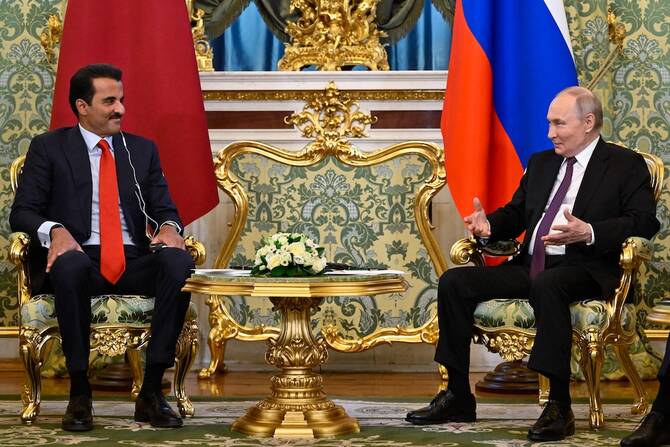
Russian President Vladimir Putin meets with Qatar’s Emir Sheikh Tamim bin Hamad Al-Thani at the Kremlin in Moscow on April 17, 2025. (AFP)
Short Url
Updated 17 April 2025
Follow

Qatari Emir arrives in Moscow for talks with Putin on Ukraine and Middle East

  • Qatar has made a series of attempts to mediate between Russia and Ukraine
  • Russia and Qatar said this week that the leaders would discuss efforts to find a peace deal to end the war in Ukraine

MOSCOW: Qatar’s Emir Sheikh Tamim bin Hamad Al-Thani arrived in Moscow on Thursday for talks with President Vladimir Putin on Ukraine and Middle East issues, on a trip that the Kremlin described as very important.

Kremlin spokesman Dmitry Peskov said the two leaders would have a “serious conversation” on a range of issues and sign various agreements.

“It is difficult to overestimate the role of Qatar as a whole now in many regional and even world affairs. Qatar is our good partner, Russian-Qatari relations are developing very dynamically, contacts between the heads of state are quite frequent,” Peskov told reporters.

Qatar has made a series of attempts to mediate between Russia and Ukraine, and has helped arrange the return of children from both countries who were separated from their parents during the war.

Russia and Qatar said this week that the leaders would discuss efforts to find a peace deal to end the war in Ukraine.

US President Donald Trump has repeatedly said he wants to end the “bloodbath,” but has yet to achieve a breakthrough. Moscow has said it is not easy to agree a settlement.

Qatar’s Minister of State for Foreign Affairs Mohammed Al-Khulaifi told the TASS state news agency that the emir’s talks with Putin would touch on Ukraine, Syria, the Gaza Strip and energy such as liquefied natural gas (LNG).


UN peacekeepers defy South Sudan military’s order to leave opposition-held town

Updated 5 sec ago
Follow

UN peacekeepers defy South Sudan military’s order to leave opposition-held town

JUBA, South Sudan: The United Nations Mission in South Sudan said Monday that it would not comply with a government order to shut down its base in Akobo, an opposition stronghold near the Ethiopian border where tens of thousands of refugees have fled.
On Friday, the South Sudanese army ordered UN peacekeepers as well as NGOs and civilians to vacate the town ahead of a planned assault.
But the mission refused to leave and said it would provide “a protective presence for civilians” in the town, adding that the safety and security of its personnel “must be fully respected at all times.”
The UN Mission said it was engaging “intensively with national, state and local stakeholders” regarding this order. “Any military operations in and around Akobo gravely endanger the safety and security of civilians,” said mission chief Anita Kiki Gbeho.
The South Sudanese government has been fighting opposition forces since a 2018 peace deal broke down about a year ago.
A dramatic escalation took place in December 2025, when opposition forces seized several government outposts in northern Jonglei. A government counter-offensive repelled their forces a month later and displaced over 280,000 people. Tens of thousands have sought refuge in Akobo, where a small contingent of UN peacekeepers is stationed.
Fearing the looming government assault on Akobo, humanitarian workers were evacuated over the weekend, and a mass exodus of the population has also begun.
Local officials contacted by the The Associated Press said fleeing civilians faced danger and widespread shortages of essential supplies. Dual Diew, the Akobo County health director, who has fled to Ethiopia, said there were 84 wounded patients at the hospital. “We have most of them with us here now,” he said, adding that they lack medicine and basic nursing equipment.
Christophe Garnier, the leader of Doctors Without Borders in South Sudan said the organization had to evacuate its staff from Akobo on Saturday and learned of the subsequent looting of its hospital and the ransacking of its office.
“People in Akobo must now either flee without protection or remain at risk of being killed, while losing access to health care and other essential services,” he said.
The three Western governments that have played a major role in the peace process — the U.S, UK, and Norway — sent a letter to President Kiir on Monday urging that the army’s evacuation order be revoked and warning of “further deaths, displacement and suffering for the South Sudanese people” if the offensive on Akobo is implemented.