

Pakistan begins emergency training for Hajj support staff ahead of pilgrimage

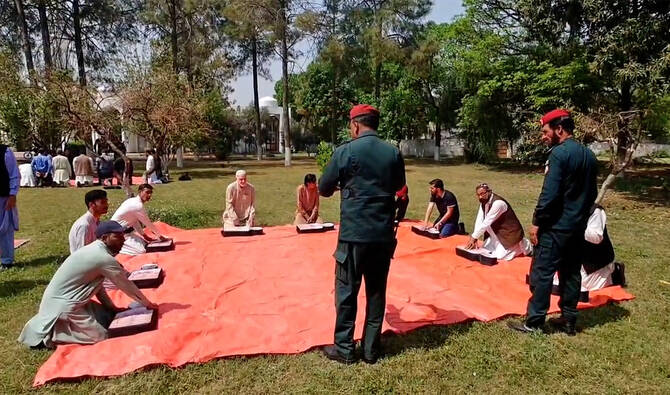
Trainers from Rescue 1122 (center) provide emergency training for Hajj support staff in Islamabad, Pakistan, on April 17, 2025. (Pakistan's Religious Affairs Ministry)
Short Url
Updated 17 April 2025
Follow

Pakistan begins emergency training for Hajj support staff ahead of pilgrimage

  • The training program involves instruction in CPR, crowd management and life-saving techniques
  • Expert trainers from Rescue 1122 are conducting the training sessions at Islamabad’s Haji Camp

ISLAMABAD: Pakistan’s Ministry of Religious Affairs said on Thursday it had launched an emergency response training program for Hajj support staff called Moavineen to equip them with first aid and civil defense skills ahead of this year’s pilgrimage.

The sessions, underway at Islamabad’s Haji Camp, include hands-on instruction in CPR, crowd management and life-saving techniques.

The initiative is part of broader preparations for Hajj 2025, when nearly 90,000 Pakistanis are expected to travel to Saudi Arabia under the government scheme.

“Expert trainers from Rescue 1122 Islamabad are conducting the sessions, providing hands-on instruction and practical demonstrations to the participants,” the ministry said in a statement.

“All selected Moavineen for this year’s Hajj operations are undergoing the training,” it continued. “The program is designed to equip them with essential life-saving skills and emergency response techniques to ensure the safety and well-being of Pakistani pilgrims during their stay in Saudi Arabia.”

The ministry said the training aims to strengthen the capacity of Moavineen to respond to medical emergencies and other challenges that may arise during the annual pilgrimage, including heat-related illness and large crowd movement.

Pakistan has been allocated a quota of 179,210 pilgrims for Hajj 2025, with the first government-arranged flight to Saudi Arabia scheduled to depart on April 29.

The Hajj rituals are expected to take place between June 4 and June 9, subject to moon sighting.

Authorities have also launched mandatory pre-departure workshops across the country to educate pilgrims on health precautions and Saudi laws and customs during their stay.

At ECO meeting, Pakistan proposes ‘Regional Innovation Hub’ to curb natural disasters

Updated 21 January 2026
Follow

At ECO meeting, Pakistan proposes ‘Regional Innovation Hub’ to curb natural disasters

  • Pakistan hosts high-level 10th ECO Ministerial Meeting on Disaster Risk Reduction in Islamabad
  • Innovation hub to focus on early warning technologies, risk informed infrastructure planning

ISLAMABAD: Pakistan has proposed to set up a “Regional Innovation Hub on Disaster Risk Reduction” that focuses on early warning technologies and risk informed infrastructure planning, the Press Information Department (PID) said on Wednesday, as Islamabad hosts a high-level meeting of the Economic Cooperation Organization (ECO).

The ECO’s 10th Ministerial Meeting on Disaster Risk Reduction (DRR) is being held from Jan. 21-22 at the headquarters of the National Disaster Management Authority (NDMA) in Pakistan’s capital. 

The high-level regional forum brings together ministers, and senior officials from ECO member states, representatives of the ECO Secretariat and regional and international partner organizations. The event is aimed to strengthen collective efforts toward enhancing disaster resilience across the ECO region, the PID said. 

“Key agenda items include regional cooperation on early warning systems, disaster risk information management, landslide hazard zoning, inclusive disaster preparedness initiatives, and Pakistan’s proposal to establish a Regional Innovation Hub on Disaster Risk Reduction, focusing on early warning technologies, satellite data utilization, and risk-informed infrastructure planning,” the statement said. 

The meeting was attended by delegations from ECO member states including Pakistan, Türkiye, Azerbaijan, Iran, Kyrgyzstan, Tajikistan, Turkmenistan and Uzbekistan. Representatives of regional and international organizations and development partners were also in attendance.

Discussions focused on enhancing regional coordination, harmonizing disaster risk reduction frameworks, and strengthening collective preparedness against transboundary and climate-induced hazards impacting the ECO region, the PID said. 

ECO members states such as Pakistan, Türkiye, Afghanistan and others have faced natural calamities such as floods and earthquakes in recent years that have killed tens of thousands of people. 

Heavy rains triggered catastrophic floods in Pakistan in 2022 and 2025 that killed thousands of people and caused damages to critical infrastructure, inflicting losses worth billions of dollars. 

Islamabad has since then called on regional countries to join hands to cooperate to avert future climate disasters and promote early warning systems to avoid calamities in future.