

Italian health minister explores key areas of cooperation during Riyadh visit

1 / 5
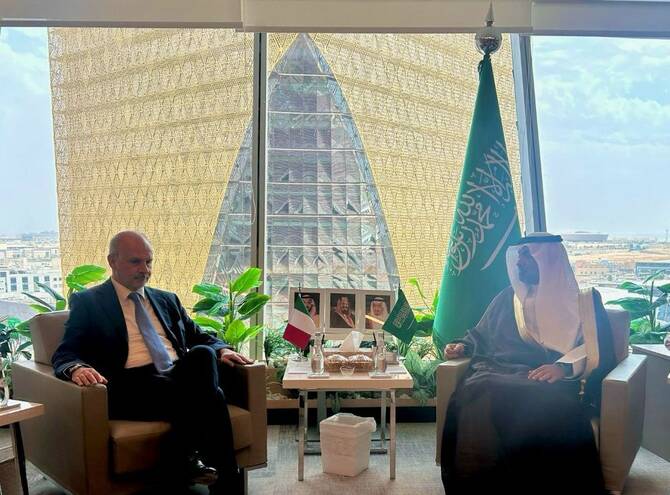
Italian Health Minister Orazio Schillaci met with his Saudi counterpart Fahad Al-Jalajel and senior officials. (Supplied)
2 / 5
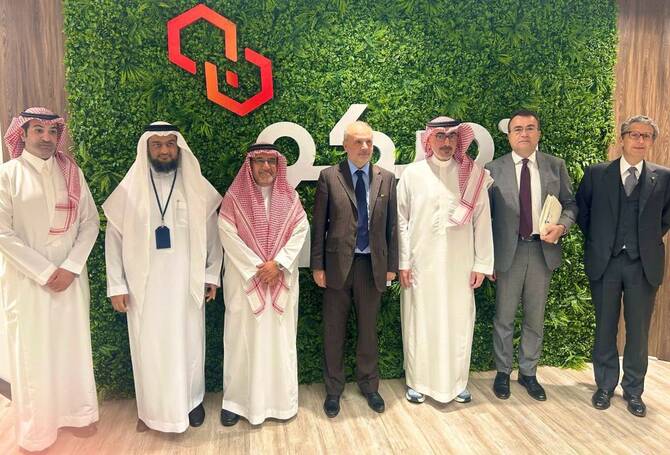
Italian Health Minister Orazio Schillaci met with his Saudi counterpart Fahad Al-Jalajel and senior officials. (Supplied)
3 / 5
Italian Health Minister Orazio Schillaci met with his Saudi counterpart Fahad Al-Jalajel and senior officials. (Supplied)
4 / 5
Italian Health Minister Orazio Schillaci met with his Saudi counterpart Fahad Al-Jalajel and senior officials. (Supplied)
5 / 5
Italian Health Minister Orazio Schillaci met with his Saudi counterpart Fahad Al-Jalajel and senior officials. (Supplied)
Short Url
Updated 16 April 2025
Follow

Italian health minister explores key areas of cooperation during Riyadh visit

  • Collaboration in projects for virtual hospitals and artificial intelligence of particular interest, Schillaci says
  • Orazio Schillaci: During my visit to Riyadh I was able to appreciate the excellence of the Saudi healthcare system

RIYADH: Italian Health Minister Orazio Schillaci met his Saudi counterpart Fahad Al-Jalajel and senior officials to explore key areas of medical excellence and ways to enhance bilateral cooperation, during an official visit to Riyadh on Wednesday.

Schillaci told Arab News that there were prospects for collaboration with Saudi Arabia in the healthcare sector and in advanced medical technologies.

“During my visit to Riyadh I was able to appreciate the excellence of the Saudi healthcare system,” he said. “I also had the opportunity to confirm Italy’s willingness to explore avenues of collaboration in the healthcare sector and advanced medical technologies between our two countries, in the wake of the strategic partnership launched by our prime minister last January.

“Cooperation in projects regarding virtual hospitals and artificial intelligence tools applied to medicine is of particular interest to Italy,” Schillaci said.

Saudi Arabia was known to be committed to developing its healthcare sector through sharing best practices with its main partners, such as Italy, he said, and by promoting the use of modern technologies, particularly in the pharmaceutical field.

Several agreements between Italian and Saudi entities in the health sector had already been announced, he said.

In addition to these existing agreements, Schillaci expressed an intention to further develop interactions between the two countries, including through the development of innovative technologies, telemedicine and antimicrobials.

Schillaci underlined the importance of close collaboration with Saudi Arabia.

“Cooperation also through the exchange of experiences will allow the two countries to benefit from the potential available in terms of innovation and modern technologies, with the aim of offering an ever-improving medical service,” he said.

During his Saudi trip, the minister visited several hospitals, appreciating, among other things, the technologies that were contributing to the medical progress of the country and offering excellent treatment for patients.

Schillaci began his official visit to Riyadh with a meeting with Al-Jalajel on Monday.

This was followed by visits to Seha Virtual Hospital, the National Health Command Center and meetings with the CEOs of the Saudi Food and Drug Authority, National Unified Procurement Company, with Khaled Al-Kattan, dean of Alfaisal University’s College of Medicine, with Dr. Bjorn Zoega, deputy chief executive officer, King Faisal Specialist Hospital and Research Center, and with Dr. Sulaiman Al-Habib, chairman of Sulaiman Al-Habib Group.

Seha Virtual Hospital, using innovative technologies, supports 170 hospitals around the Kingdom, and provides 29 basic specialized health services, in addition to more than 73 sub-specialty services. The virtual hospital is one of the priority initiatives in the health sector transformation program under Saudi Vision 2030.

The visit to KFSHRC aimed to explore key areas of medical excellence and gain insight into Saudi Arabia’s expertise in advancing specialized health care services.

The visit featured a comprehensive briefing on the KFSHRC Heart Center of Excellence and the Organ Transplant Center of Excellence, along with an overview of the latest technologies for treating complex cardiac conditions and performing minimally invasive robotic surgeries.

The visit reflects the growing global interest in KFSHRC’s pioneering model, which integrates clinical expertise with cutting-edge medical technologies, the hospital said in a press release.

The hospital has achieved several milestones, including the world’s first fully robotic heart transplant and the first fully robotic liver transplant, reinforcing its standing as a global reference in advanced specialized care.


Minzal brings Saudi traditions to life in Diriyah

Updated 07 January 2026
Follow

Minzal brings Saudi traditions to life in Diriyah

  • From leather crafts and archery to Saudi coffee, Minzal offers a lesson in ‘Sloum Al-Arab’

RIYADH: This season of Minzal places social norms and traditional etiquette at its center, with tents set up to teach what is locally known as “Sloum Al-Arab” alongside gatherings for coffee, dinner and stargazing around campfires.

“Sloum Al-Arab” refers to the unwritten customers and values that have shaped Arab and Bedouin society for centuries, including generosity, coffee preparation, courage and archery. 

In Saudi Arabia, these traditions are closely ties to cultural identity and religious belief. 

Leather products and the making of leather goods is one of the crafts featured at Minzal this year and is one of the oldest crafts still practiced in the kingdom.

“The most difficult thing I faced to work on was camel leather because it is a little tough,” Nada Samman, a leather trainer and craftsman at Minzal, told Arab News. 

Minzal continues to evolve with each season, offering activities that highlight Bedouin values, traditional skills and sports. (AN photo by Haifa Alshammari)

“The work on leather is wonderful whether it is goat leather, cow leather, Sawakni sheep, and of course, camel leather. At Minzal, we are offering multiple handicraft workshops, most specifically the leather handicrafts. We want visitors to spend time at something useful and fun."

Samman explained the workshops allowed participants to preserve heritage while engaging in meaning, hands on activities. 

Faisal Al-Khaled, a visual artist and craftsman specializing in Saudi designs at Minzal, shared a similar goal: “I want people to have, by the end of this experience, a unique and traditional art piece created by them, and that I know I helped them to preserve this craft.”

Minzal, which has been organized for several years now, continues to evolve with each season, offering activities that highlight Bedouin values, traditional skills and sports. Archery is a key feature, reflecting its deep roots in Arab and Islamic history.

Mohammed Al-Sharif, a certified archery player and coach with the Saudi Archery Federation since 2028, said the sport was closely connected to Saudi culture. It was encouraged by the Prophet Muhammad, which led people to learn and teach it through generations.

“Our traditional bow is considered one of the most important and widely used bows in Arab culture,” Al-Sharif said. “We have several styles, and professional archers specializing in traditional bow shooting … There are various types of archery, such as horseback archery and standing archery, where bow sizes vary according to specific needs, such as types used for hunting and others used during warfare.”

He explained that archery was historically part of daily life, used for protection and hunting. 

Saudi coffee also plays a significant role in the Minzal experience, with live demonstrations. One of the most frequently consumed beverages in the Kingdom, it is a symbol of hospitality and generosity.

Ahmed Al-Shuaibi explained how it was prepared at the Sloum tent, first by roasting the beans and then allowing them to cool. The beans are ground with spices in a Nigr.

“Coffee is passed from our grandparents,” he added. “In significant majlis, you see them offering our local coffee and not other types of coffee. We organized this corner so that young generations can visit and learn this.”