

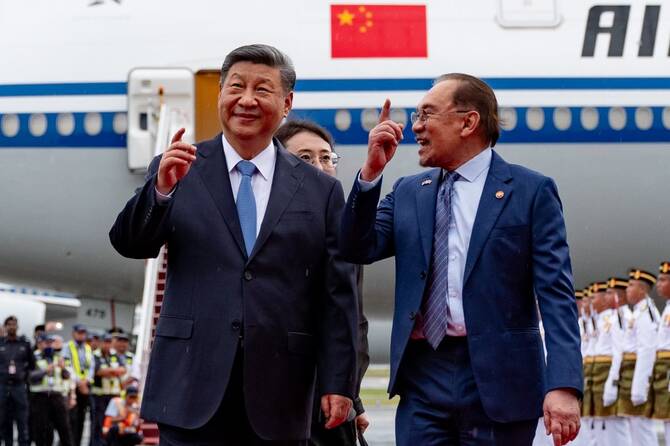

KUALA LUMPUR: Chinese President Xi Jinping met Malaysia’s King Sultan Ibrahim Iskandar and Prime Minister Anwar Ibrahim in Kuala Lumpur on Wednesday, as part of a three-nation tour to advance ties in Southeast Asia as a trade war with the US intensifies.
Xi is in the country for a three-day state visit and was met by Anwar on his arrival at Kuala Lumpur International Airport on Tuesday evening.
On Wednesday he was received by the king at the National Palace before holding talks, along with the rest of the Chinese delegation, with Anwar in the administrative capital Putrajaya.
“China looks forward to building a high-level China-Malaysia shared future,” Xi said during a press conference with Anwar.
“Together we will energize modernization in both our countries, set up a fine example of unity and cooperation for the Global South and make a new and greater contribution for peace, stability and prosperity for our region and beyond.”
The visit comes just days after the US announced a 90-day pause on sweeping “reciprocal” tariffs, while raising tariffs on Chinese imports to an effective rate of 145 percent. Beijing responded with retaliatory hikes on US exports.
The Trump administration also imposed a 24 percent tariff on Malaysian imports, raising concerns about its export-driven economy.
“The rules-based order has been turned on its head — dialogue has yielded to demands, tariffs are imposed without restraint and the language of cooperation is drowned beneath the noise of threats and coercion,” Anwar said.
“China has been a rational, strong and reliable partner. Malaysia values this consistency. Malaysia will remain an unwavering and principled friend to China … When some nations abandon the principle of shared responsibility and others question long-standing commitments, China’s global initiatives offer a new lease on hope.”
During Wednesday’s meetings, Malaysia and China signed 31 memorandums of understanding, Malaysia’s Ministry of Foreign Affairs said. The deals span security, trade, technology — including AI cooperation — and visa exemptions.
Since 2009, China has been Malaysia’s largest trading partner, accounting for 15 percent of Malaysia’s exports and 21 percent of its imports. In the first 10 months of last year, two-way trade totaled about $86.3 billion.
But the US also has a strong economic presence in Malaysia.
“Both the US and China are Malaysia’s main trading partners,” Dr. Lim Kim Hwa, director of the public policy think tank Penang Institute, told Arab News.
“While the 90-day tariff reprieve may mitigate the short-term impact, Malaysia needs to treat the complex relationship with both parties deftly so that both parties will not get the idea that a good relationship is a zero-sum game.”
He said that with Beijing, Malaysia should aim for greater participation in its domestic economy, as China was likely to pivot to domestic consumption to mitigate the impact of loss of direct exports to the US, and while “trade re-routing is inevitable, getting China’s commitment to minimize dumping will mitigate the impact on Malaysian manufacturers.”
Xi arrived in Kuala Lumpur from Vietnam and is also due to visit Cambodia.
Vietnam has been hit by a 46 percent US tariff and Cambodia 49 percent.
While Xi’s visit has been seen as a regional push to shore up Beijing’s ties amid the trade war, Oh Ei Sun, a political analyst at the Pacific Research Centre of Malaysia, said it was unlikely that the members of the Association of Southeast Asian Nations would commit themselves fully to China’s camp.
“This trip is not one which is in immediate response to the latest trade war, but is a long ago planned one which aims to further solidify the already substantial economic ties,” he told Arab News.
“It is highly unlikely that Malaysia or indeed Vietnam will throw its lot with the Chinese. So there is scarcely any significant geopolitical implication, as ASEAN countries, too, largely go their separate ways in engaging the US and China.”


