

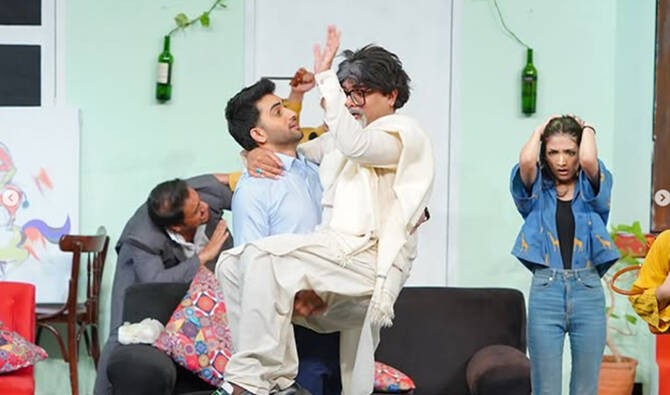

KARACHI: Pakistani actor Yasir Hussain has returned to his theater roots with “Monkey Business,” a farcical comedy currently drawing crowds to the Arts Council of Pakistan in Karachi, though he says it remains nearly impossible for artists to survive on theater alone in the country.
The actor, who rose to prominence through iconic roles in Anwar Maqsood’s plays before moving into television and film, is now back on stage after years. His return comes at a time when Pakistan’s theater scene continues to struggle with limited commercial viability, high production costs and little state support.
“I don’t think an artist should solely rely on theater [in Pakistan]. They should do TV and film too,” Hussain told Arab News on Tuesday.
“Even today if I am offered a project like ‘Badshah Begum,’ ‘Baandi,’ ‘Jhooti’ or ‘Aik Thi Laila,’ which were all great scripts, I’d still do it,” he added, naming some of the television productions.
Hussain stars as Wasim in Monkey Business, a satire about aspiring actors who get involved in phishing scams. The play opened on April 5 and runs through April 21 in Karachi, before heading to Lahore and Islamabad.
“He is a fraud,” he said while describing his character in the play. “It’s all about actors, new actors and they are into some kind of phishing business. It’s a farce comedy.”

Actor Yasir Hussain (right) poses infront of the poster of his theatre play "Monkey Business" in a picture uploaded by himself on April 4, 2025. (Yasr Hussain 131/ Instagram)
Known for his early work in Anwar Maqsood’s “Pawnay 14 August” and “Half Playt,” Hussain transitioned to television and film over the past decade, also producing and directing for screen.
His latest TV drama “Paradise,” which he produced under his banner LO IQ Films, premiered earlier this week, starring Iqra Aziz, his wife, and Shuja Asad.
“I really want to pitch good scripts to my wife,” he said, adding: “In Paradise, if you see the first episode, you’ll see that it’s a custom-made character for Iqra.”
Hussain and Aziz, a renowned actress in her own right, previously appeared together in Jhooti and later in the mini-series Aik Thi Laila. But Hussain said he avoids working opposite her in lead roles post-marriage.
“Marriage is a very personal thing and I don’t want to show that chemistry onscreen in a TV drama at least,” he explained. “I don’t want her screen age to increase for no reason because of me. And I don’t want to share the small screen with her just because she is a famous actress. I have no interest in appearing in dramas nor sharing the small screen with my wife.”
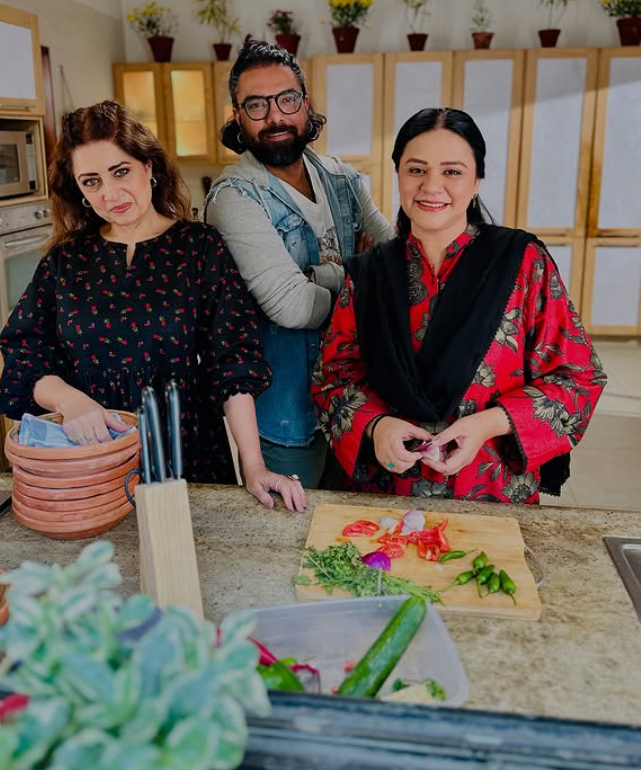
Yasir Hussain (center) poses with actors from the set of drama Paradise directed by him. (Photo courtesy: Instagram/@Yasir Hussain131)
Though he’s focused on stage shows and direction at the moment, Hussain doubts theater can thrive in Pakistan without institutional support.
“How will theater in Pakistan rise? This place where we are performing theater, the rent is 1.5 to 2 lakhs rupees [$357 to $713] in addition to lights, sounds and other expenses. Theater [setup] for a day costs a lot, equal to the amount it generates,” he said.
“Unless the government plays a part in [promoting] theater or film, no one can do it. It cannot flourish.”
Hussain also drew a distinction between commercial theater like Monkey Business and the work staged at institutions like the National Academy of Performing Arts (NAPA).
“It’s good for NAPA but it’s not commercially viable,” he said. “There is no hype around the city for such kind of theater.”
Asked about his future plans, Hussain said he wanted to venture into film production under LO IQ Films.
“I am enjoying production. LO IQ Films is producing theater as well as TV so now I want to produce films,” he said.


