



KARACHI: ‘The River’s Daughter,’ a theater play written by Arieb Azhar, has been highlighting the issue of climate change in Pakistan, with the writer exploring a modern-day narrative of an indigenous community’s struggle for survival in the face of forced urbanization in the country’s south.
Directed by Kulsoom Aftab, the play opened at the National Academy of Performing Arts (NAPA) in Karachi on May 25 and will run for a week. The River’s Daughter is an original script by Azhar.
The play, loosely based around the characters of Umar and Marui from Sindhi poet Shah Abdul Lateef Bhittai’s 18th century classic, highlights traditional methods of permaculture to counter demolition at the hands of those in power.
Pakistan is among ten countries most affected by climate change. Last year, climate-induced floods wreaked havoc in the South Asian country, killing more than 1,700 people. The deluges affected around 33 million people and inundated a third of the country at one point.
“The construction of housing societies on agricultural lands is rapidly increasing. As a result, the productivity of the land is reducing while its value is increasing. This isn’t even good for the country’s economy. It is important to highlight the economic exploitation,” Azhar told Arab News on Friday.
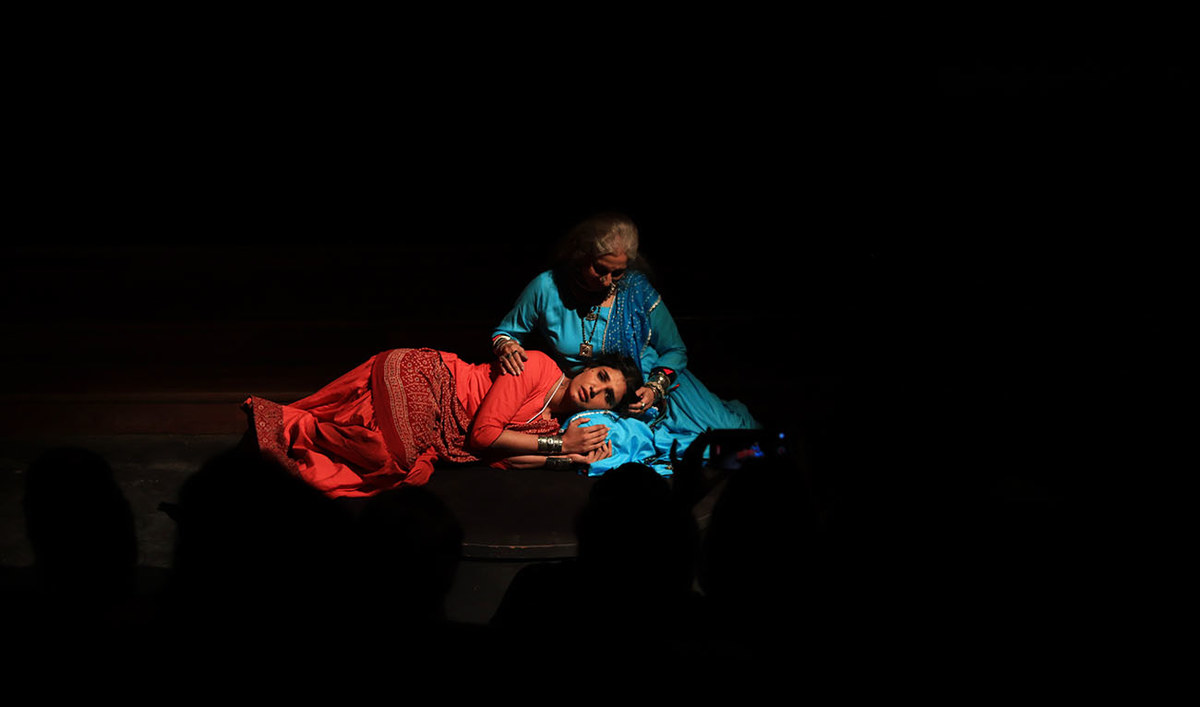
The photo shows a scene from theatre play The River's Daughter performed at NAPA in Karachi, Pakistan on May 26, 2023. (Photo courtesy: ALL4ONE)
The writer said he took inspiration from a folktale for the names of his key characters, Umar and Marui, giving the narrative a modern perspective.
“I wanted to write something about ecology, about the environment. But I wanted to write it in a way that it doesn’t sound preachy and that it has all those aspects that are pertinent to environment,” he said.
The River’s Daughter is the first script written by Azhar, a Pakistani musician known for his renderings of traditional Sufi poetry and folk songs, while he has also acted in the play.
Fawad Khan, who played the role of Umar in the play, said lamented the destruction of villages to build new urban communities in the country.
“Seventy percent of our country’s population is living in villages that are destroyed for construction purposes. Did we ever wonder what the people residing in those villages want for themselves,” he asked.
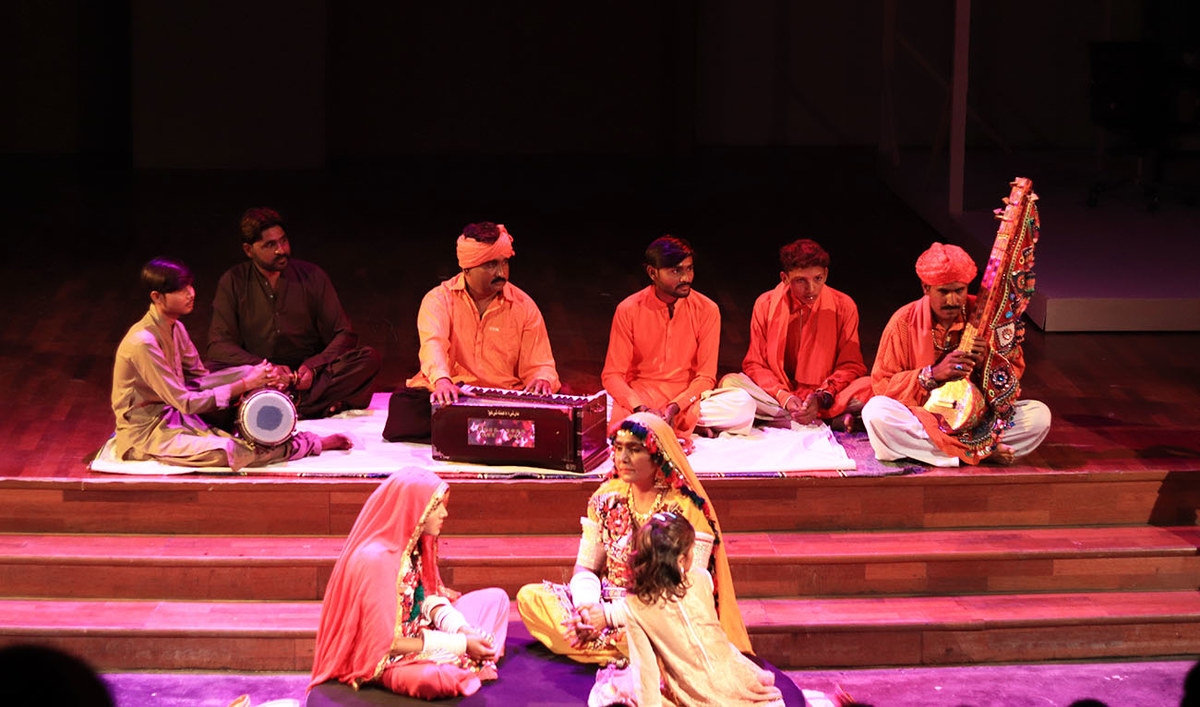
The photo taken on May 26, 2023, shows folk musicians Mai Nimani (with her troupe) and Teekam Das onstage during the performance of The River's Daughter at NAPA in Karachi, Pakistan. (Photo courtesy: ALL4ONE)
“We haven’t made any laws or land reforms to improve their livelihood. We are an agricultural society and we are letting our agriculture suffer the most,” Khan told Arab News.
Sheema Kermani, a renowned artist and activist who played a key role in production, shared the play was not just about the impact of climate change on indigenous communities.
“It is also about land mafia. It’s also about the construction business. It’s also about depriving people of their livelihoods and their homes,” Kermani told Arab News.
“Development is not just about construction of buildings, development is also about people’s right that is mostly ignored in these cases.”
A significant element in the play, according to Azhar, is the folk musicians featured in it, including Mai Nimani, who belongs to the Marwari-speaking Bhatt community and her troupe from Tando Adam in Sindh. In addition, Teekam Das from Rahim Yar Khan represents the culture of Pakistan’s Cholistan desert.
“We need to educate urban youth about folk music and poetry. We need to add these things to our curriculum,” Azhar stressed.
“Our folk culture is very diverse. It has message of humanity and inclusivity. This is the real culture of Pakistan that we’ve been ignoring.”
In addition to Azhar, Kermani and Khan, the two-hour-long play is also featuring television and film actress Amna Ilyas, who is making her theater debut.
“It was an honor to play a part that has so much responsibility as an actor,” Ilyas, who played the role of Marui, told Arab News.
“Climate change is a very relevant issue. The play very well explains that capitalism, concrete stuff, land and agriculture need to go hand in hand in today’s day and age.”


