

Pakistan fails to meet target of 50% Shariah-compliant banking by Jan. 2025 — data

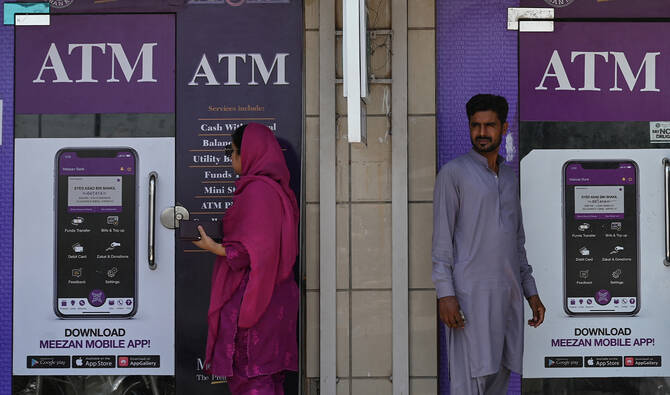
People wait to use an ATM bank machine in Rawalpindi on June 9, 2023. (AFP/File)
Short Url
Updated 16 April 2025
Follow

Pakistan fails to meet target of 50% Shariah-compliant banking by Jan. 2025 — data

  • Pakistan’s central bank set a target to increase Islamic banking deposits’ share to 50% by January 2025
  • Pakistan increased market share of Shariah-compliant banking deposits to only 24.9% by December

KARACHI: Pakistan’s government failed to achieve a target set by the central bank to increase the share of Islamic banking deposits in the country by 50% by January this year, according to official documents seen by Arab News, as Islamabad attempts to rid the country’s banking system of interest. 

Pakistan’s Federal Shariat Court (FSC) directed the government in April 2022 to eliminate interest by 2027, maintaining that Islam prohibited it in all its forms and manifestations. The FSC determines whether Pakistani laws comply with Islamic law or not. 

Following the order, the government and State Bank of Pakistan (SBP) have taken measures ranging from changing laws in October 2024 to issuing Sukuk (Islamic bonds) to replace interest-based treasury bills and investment bonds.

According to a presentation shared by the SBP with bankers in August 2024, a copy of which Arab News has seen, the central bank set an “indicative target” for the government to increase the share of Islamic banking deposits to 50% by January 2025, 65% by January 2026, 80% by January 2027 and 100% by December 2027. 

Pakistan, however, missed this target and was able to increase the market share of its Shariah-compliant banking deposits to only 24.9% by December 2024, the document stated. Noor Ahmed, the chief spokesperson of the SBP, did not respond to Arab News’ request for comments. 

“The SBP and the Securities and Exchange Commission of Pakistan are making a lot of efforts but the government should do more to speed up this process of conversion,” Ahmed Ali Siddiqui, the head of Shariah-compliance at Meezan Bank Ltd., told Arab News.

Meezan Bank is Pakistan’s largest Islamic bank which operates more than 1,000 branches in over 300 cities across the country. Pakistan has six full-fledged Islamic banks and 16 conventional banks that also offer Islamic products. 

INTEREST-FREE BANKING ON THE RISE

The demand for interest-free banking, however, is increasing in the country. 

This increasing demand is reflected in the over 20% growth of annual deposits that Islamic banks have been reporting in recent years, with their total assets swelling beyond Rs10 trillion ($35.6 billion) for the first time, said the SBP’s Quarterly Islamic Banking Bulletin from October to December 2024. 

Total deposits of Islamic banks grew by 17% to Rs 7.91 trillion ($28.2 billion), which accounts for 25% of the total banking industry, the bulletin said. Islamic banks extended Rs 4.04 trillion ($14.4 billion) of financing to borrowers, while their investments totaled Rs 4.99 trillion ($17.8 billion).

“The steady rise in assets, deposits, financing, and investment highlights the sector’s resilience,” the central bank said in the report.

Both conventional and Islamic banks are expanding their branches across Pakistan. This led to a 21% year-on-year growth in the number of branches of Islamic banks to 6,017 and a 17% hike in conventional banks operating Islamic banking windows to 2,253.

“This expansion underpins the increasing accessibility and demand for Islamic banking services across the country,” the SBP said in the bulletin.

Pakistan’s leading banks are converting their branches into Shariah-compliant to align with the legal requirement for all banks to transition to Islamic banking by 2027.

In November, MCB Bank Ltd. converted 39 of its conventional branches into interest-free ones while the United Bank Ltd. has also converted all its branches located in the northwestern Khyber Pakhtunkhwa and southwest Balochistan provinces into interest-free ones.

“The government’s biggest challenge is to convert all its loans and financing into Islamic financing,” Siddiqui said. 

He urged the government to take all its deposits to Islamic banks and convert its treasury bills and investment bonds into Sukuk as a first step.

“You should at least announce the conversion of National Bank Pakistan [into a Shariah-compliant bank], which is the state-owned bank,” Siddiqui said. 

The banker said the government could speed up the process of conversion if all its institutions could carry out their transactions such as salaries and pension funds through Islamic banking. 


Pakistan to play India in T20 World Cup, government says

Updated 09 February 2026
Follow

Pakistan to play India in T20 World Cup, government says

  • Islamabad announced boycotting the Feb. 15 match in Colombo to protest the ICC’s exclusion of Bangladesh from the T20 World Cup
  • Pakistan’s government says the decision to play India is taken to protect ‘spirit of cricket and to support the continuity of global sport’

ISLAMABAD: Pakistan Prime Minister Shehbaz Sharif has cleared the country’s cricket team to play India in the T20 World Cup on Feb. 15, the Pakistani government announced late Monday, ending a week-long standoff.

Islamabad announced boycotting the Feb. 15 match in Colombo to protest the International Cricket Council’s (ICC) exclusion of Bangladesh from the T20 World Cup, following Dhaka’s decision to not play matches in India owing to security fears.

On Sunday, ICC Deputy Chairman Imran Khwaja arrived in Lahore for talks with Pakistan Cricket Board (PCB) officials and Bangladesh Cricket Board (BCB) President Aminul Islam as the sport’s governing body strived to save the high-stakes T20 World Cup encounter.

PCB Chairman Mohsin Naqvi met PM Sharif late Monday and briefed him regarding the outcomes of high-level deliberations held between the PCB, Bangladesh board and ICC representatives, the Pakistani government said on X.

“The Government of Pakistan has reviewed the formal requests extended to the PCB by the Bangladesh Cricket Board, as well as the supporting communications from Sri Lanka, the United Arab Emirates, and other member nations. These correspondences sought Pakistan’s leadership in securing a viable solution to recent challenges,” the Pakistani government said.

“In view of the outcomes achieved in multilateral discussions, as well as the request of friendly countries, the Government of Pakistan hereby directs the Pakistan National Cricket Team to take the field on February 15, 2026, for its scheduled fixture in the ICC Men’s T20 World Cup.”

The BCB earlier thanked the PCB, ICC and all others for their positive roles in trying to “overcome recent challenges,” particularly thanking PCB Chairman Naqvi and Pakistani cricket fans for demonstrating “exemplary sportsmanship and solidarity.”

“We are deeply moved by Pakistan’s efforts to go above and beyond in supporting Bangladesh during this period. Long may our brotherhood flourish,” BCB President Islam said in a statement.

“Following my short visit to Pakistan yesterday and given the forthcoming outcomes of our discussions, I request Pakistan to play the ICC T20 World Cup game on 15 February against India for the benefit of the entire cricket ecosystem.”

The dispute stemmed from the ICC’s decision to replace Bangladesh with Scotland last month after Bangladesh refused to play tournament matches in India. Dhaka’s decision followed the removal of Mustafizur Rahman from the Indian Premier League (IPL). He was bought for $1 million by the IPL’s Kolkata Knight Riders, but on Jan. 3 the Board of Control for Cricket in India (BCCI) ordered Kolkata to release Mustafizur without a public explanation but amid regional tensions.

Pakistani cricket authorities subsequently announced boycotting the match against India at R. Premadasa Stadium in Colombo on Feb. 15. An India-Pakistan fixture is the sport’s most lucrative asset, generating a massive share of global broadcasting and sponsorship revenue.

“This decision [to play India in T20 World Cup] has been taken with the aim of protecting the spirit of cricket, and to support the continuity of this global sport in all participating nations,” the Pakistani government said.

“We remain confident that our team will carry the spirit of sportsmanship and national pride onto the field as they compete for global glory.”