Ant smugglers arrested in Kenya as government warns of changing trafficking trends

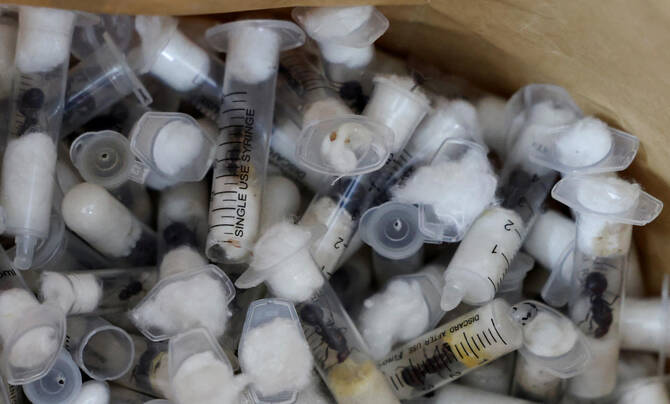
Garden ants concealed in syringes are presented to court as two Belgians, a Vietnamese and a Kenyan appeared for their hearing, after they pleaded guilty to illegal possession and trafficking of garden ants, at the Jomo Kenyatta International Airport Law Courts, in Nairobi, Apr. 15, 2025. (Reuters)
Short Url
Updated 15 April 2025
Follow

Ant smugglers arrested in Kenya as government warns of changing trafficking trends

  • Two 19-year-olds who were arrested on April 5 with 5,000 ants at a guest house, appeared distraught during their appearance before a magistrate in Nairobi
  • Kenya has in the past fought against the trafficking of body parts of larger species of wild animals

NAIROBI: Two Belgian teenagers were charged Tuesday with wildlife piracy after they were found with thousands of ants packed in test tubes in what Kenyan authorities said was part of a trend in trafficking smaller and lesser known species.
Lornoy David and Seppe Lodewijckx, two 19-year-olds who were arrested on April 5 with 5,000 ants at a guest house, appeared distraught during their appearance before a magistrate in Nairobi and were comforted in the courtroom by relatives. They told the magistrate they were collecting the ants for fun and did not know that it was illegal.
In a separate criminal case, Kenyan Dennis Ng’ang’a and Vietnamese Duh Hung Nguyen also were charged with illegal trafficking in the same courtroom, following their arrest while in possession of 400 ants.
The Kenya Wildlife Service, or KWS, said in a statement that the four men were involved in trafficking the ants to markets in Europe and Asia, and that the species included messor cephalotes, a distinctive, large and red-colored harvester ant native to East Africa.
The illegal export of the ants “not only undermines Kenya’s sovereign rights over its biodiversity but also deprives local communities and research institutions of potential ecological and economic benefits,” KWS said.
Kenya has in the past fought against the trafficking of body parts of larger species of wild animals such as elephants, rhinos and pangolins among others. But the cases against the four men represent “a shift in trafficking trends — from iconic large mammals to lesser-known yet ecologically critical species,” KWS said.
The two Belgians were arrested in Kenya’s Nakuru county, which is home to various national parks. The 5,000 ants were found in a guest house where they were staying, and were packed in 2,244 test tubes that had been filled with cotton wool to enable the ants to survive for months.
The other two men were arrested in Nairobi where they were found to have 400 ants in their apartments.
Kenyan authorities valued the ants at 1 million shillings ($7,700). The prices for ants can vary greatly according to the species and the market.
Philip Muruthi, a vice president for conservation at the Africa Wildlife Foundation in Nairobi, said ants play the role of enriching soils, enabling germination and providing food for species such as birds.
“The thing is, when you see a healthy forest, like Ngong forest, you don’t think about what is making it healthy. It is the relationships all the way from the bacteria to the ants to the bigger things,” he said.
Muruthi warned of the risk of trafficking species and exporting diseases to the agricultural industry of the destination countries.
“Even if there is trade, it should be regulated and nobody should be taking our resources just like that,” he said.


Arts festival’s decision to exclude Palestinian author spurs boycott

Randa Abdel Fattah. (Photo/Wikipedia)
Updated 12 January 2026
Follow

Arts festival’s decision to exclude Palestinian author spurs boycott

  • A Macquarie University academic who researches Islamophobia and Palestine, Abdel-Fattah responded saying it was “a blatant and shameless act of anti-Palestinian racism and censorship,” with her lawyers issuing a letter to the festival

SYDENY: A top Australian arts festival has seen ​the withdrawal of dozens of writers in a backlash against its decision to bar an Australian Palestinian author after the Bondi Beach mass shooting, as moves to curb antisemitism spur free speech concerns.
The shooting which killed 15 people at a Jewish Hanukkah celebration at Sydney’s Bondi Beach on Dec. 14 sparked nationwide calls to tackle antisemitism. Police say the alleged gunmen were inspired by Daesh.
The Adelaide Festival board said last Thursday it would disinvite Randa ‌Abdel-Fattah from February’s ‌Writers Week in the state of South Australia because “it ‌would not ​be ‌culturally sensitive to continue to program her at this unprecedented time so soon after Bondi.”

FASTFACTS

• Abdel-Fattah responded, saying it was ‘a blatant and shameless act of anti-Palestinian racism and censorship.’

• Around 50 authors have since withdrawn from the festival in protest, leaving it in doubt, local media reported.

A Macquarie University academic who researches Islamophobia and Palestine, Abdel-Fattah responded saying it was “a blatant and shameless act of anti-Palestinian racism and censorship,” with her lawyers issuing a letter to the festival.
Around 50 authors have since withdrawn from the festival in protest, leaving it in doubt, local media reported.
Among the boycotting authors, Kathy Lette wrote on social media the decision to bar Abdel-Fattah “sends a divisive and plainly discriminatory message that platforming Australian Palestinians is ‘culturally insensitive.'”
The Adelaide Festival ‌said in a statement on Monday that three board ‍members and the chairperson had resigned. The ‍festival’s executive director, Julian Hobba, said the arts body was “navigating a complex moment.”

 a complex and ‍unprecedented moment” after the “significant community response” to the board decision.
In the days after the Bondi Beach attack, Jewish community groups and the Israeli government criticized Prime Minister Anthony Albanese for failing to act on a rise in antisemitic attacks and criticized protest marches against Israel’s war in ​Gaza held since 2023.
Albanese said last week a Royal Commission will consider the events of the shooting as well as antisemitism and ⁠social cohesion in Australia. Albanese said on Monday he would recall parliament next week to pass tougher hate speech laws.
On Monday, New South Wales state premier Chris Minns announced new rules that would allow local councils to cut off power and water to illegally operating prayer halls.
Minns said the new rules were prompted by the difficulty in closing a prayer hall in Sydney linked to a cleric found by a court to have made statements intimidating Jewish Australians.
The mayor of the western Sydney suburb of Fairfield said the rules were ill-considered and councils should not be responsible for determining hate speech.
“Freedom ‌of speech is something that should always be allowed, as long as it is done in a peaceful way,” Mayor Frank Carbone told Reuters.