


WASHINGTON: Limb amputations are performed by surgeons when a traumatic injury such as a wound from war or a vehicle accident causes major tissue destruction or in instances of serious infection or disease. But humans are not alone in doing such procedures.
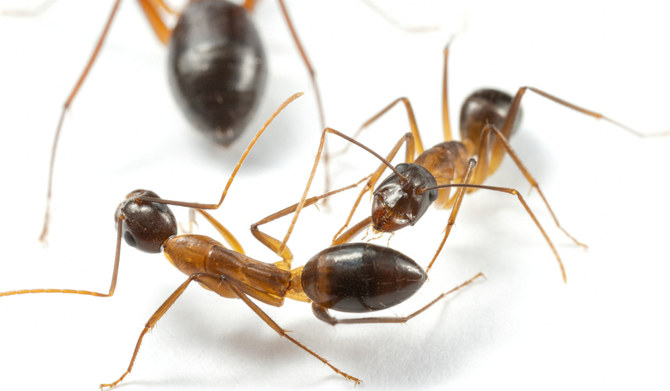
New research shows that some ants perform limb amputations on injured comrades to improve their survival chances. The behavior was documented in Florida carpenter ants — scientific name Camponotus floridanus — a reddish-brown species more than half an inch (1.5 cm) long inhabiting parts of the southeastern United States.
These ants were observed treating injured limbs of nestmates either by cleaning the wound using their mouthparts or by amputation through biting off the damaged limb. The choice of care depended on the injury’s location. When it was further up the leg, they always amputated. When it was further down, they never amputated.

Two carpenter ants, Camponotus fellah, are seen in this undated photograph in a laboratory at the University of Lausanne in Switzerland. (REUTERS)
“In this study, we describe for the first time how a non-human animal uses amputations on another individual to save their life,” said entomologist Erik Frank of the University of Würzburg in Germany, lead author of the research published on Tuesday in the journal Current Biology.
“I am convinced that we can safely say that the ants’ ‘medical system’ to care for the injured is the most sophisticated in the animal kingdom, rivaled only by our own,” Frank added.
This species nests in rotting wood and defends their home vigorously against rival ant colonies.
“If fights break out, there is a risk of injury,” Frank said.

Two carpenter ants, Camponotus fellah, are seen in this undated photograph in a laboratory at the University of Lausanne in Switzerland. (REUTERS)
The researchers studied injuries to the upper part of the leg, the femur, and the lower part, the tibia. Such injuries are commonly found in wild ants of various species, sustained in fights, while hunting or through predation by other animals.
The ants were observed in laboratory conditions.
“They decide between amputating the leg or spending more time caring for the wound. How they decide this, we do not know. But we do know why the treatment differs,” Frank said.
It has to do with the flow of hemolymph, the bluish-greenish fluid equivalent to blood in most invertebrates.
“Injuries further down the leg have an increased hemolymph flow, meaning that pathogens already enter the body after only five minutes, rendering amputations useless by the time they could be performed. Injuries further up the leg have a much slower hemolymph flow, giving enough time for timely and effective amputations,” Frank said.
In either case, the ants first cleaned the wound, likely applying secretions from glands in the mouth while also probably sucking out infected and dirty hemolymph. The amputation process itself takes at least 40 minutes and sometimes more than three hours, with constant biting at the shoulder.
With amputations after an upper leg injury, the survival rate documented was around 90-95 percent, compared to about 40 percent for unattended injuries. For lower leg injuries in which just cleaning was performed, the survival rate was about 75 percent, compared to around 15 percent for unattended injuries.
Wound care has been documented in other ant species that apply an antibiotically effective glandular secretion to injured nestmates. This species lacks that gland.
Ants, which have six legs, are fully functional after losing one.
It was female ants observed doing this behavior.
“All worker ants are female. Males play only a minor role in ant colonies — mate once with the queen and then die,” Frank said.
So why do the ants do these amputations?
“This is an interesting question and it does put into question our current definitions of empathy, at least to some extent. I do not think that the ants are what we would call ‘compassionate,’” Frank said.
“There is a very simple evolutionary reason for caring for the injured. It saves resources. If I can rehabilitate a worker with relatively little effort who will then again become an active productive member of the colony, there is a very high value of doing so. At the same time, if an individual is too heavily injured, the ants will not care for her, but rather leave her behind to die,” Frank added.


