

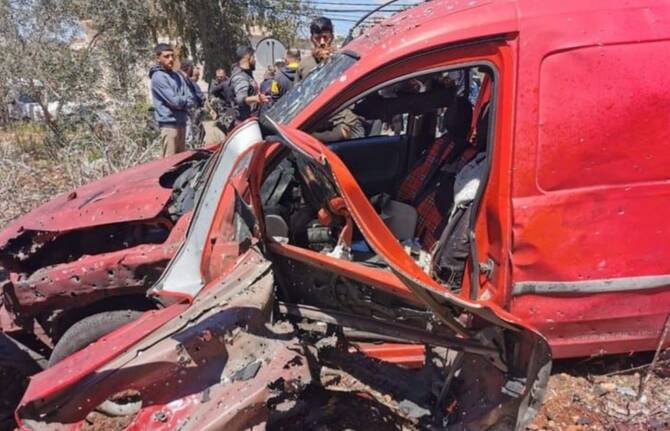

BEIRUT: One person was killed and three others were injured in an airstrike carried out by an Israeli military drone, which targeted a vehicle in Aitaroun, a town in southern Lebanon along the border with Israel.
The Ministry of Health said that the airstrike resulted in one fatality and injuries to three individuals, including a child.
The Israeli army radio confirmed that “the air force targeted a vehicle in the village of Aitaroun in southern Lebanon” and claimed that the raid targeted “a division commander in Hezbollah’s special operations unit.”
Meanwhile, the Israeli army opened fire with machine guns in the town of Mays Al-Jabal in an attempt to intimidate people and prevent them from returning to the front-line towns, thus keeping the area desolate in order to prevent Hezbollah from recapturing its former positions.
Also, an Israeli drone dropped a bomb on tobacco farmers near a vocational school in the town of Aita Al-Shaab, causing panic among the civilian population.
A soldier from a specialized unit in the Lebanese army was killed “during an engineering survey of a site in the Wadi Al-Aziziya area of Tyre,” according to the army command. The explosion also “injured three others with moderate injuries.”
The army command identified the victim as Fadi Mohammed Al-Jassem, born in 1982.
Media reports in Beirut stated that Al-Jassem “was killed in three explosions inside a Hezbollah tunnel.”
As part of his Gulf countries tour, Lebanese President Joseph Aoun traveled to Doha on Tuesday for an official visit.
Prior to his departure from Beirut, he visited the General Directorate of State Security, the Ministry of Defense, and the Army Command to offer condolences following the killing of the Lebanese soldier.
Aoun stressed the need to “restore citizens’ trust in the state.”
He discussed “the operations carried out by the Lebanese army in its deployment areas, particularly in the south and near the border areas.”
Aoun said: “The army has many operational requirements that must be fulfilled, especially in the upcoming stage with the growing responsibilities entrusted to it. Once again, the army is paying a heavy price to safeguard Lebanon’s unity, sovereignty and territorial integrity. The army will remain loyal to its oath. This is our destiny.”
He noted that the army carried out complex and vital duties, “especially during these challenging times …
“We will put the country back on the right track. Just like other institutions, the army plays a key role in the reform process that we have already launched and will continue to pursue.
“I am fully aware of the army’s needs and will ensure they are met. Lebanon has endured great challenges, and it would not have stood firm without the steadfastness of the army command. I call on all leaders, officers, sergeants, and soldiers to continue serving across the country in the interest of all Lebanese citizens.”
Aoun stressed the critical role of the state security apparatus in “combating corruption, bribery, extortion, and blackmail,” promising to “shield this institution from all sorts of pressure and manipulation.”
Earlier, Aoun accepted an invitation from Qatar’s Emir Sheikh Tamim bin Hamad Al-Thani for talks.
Foreign Minister Youssef Rajji is accompanying Aoun on the diplomatic mission, which continues through Wednesday afternoon.
The diplomatic engagement includes a one-on-one meeting between the emir and Aoun, followed by expanded discussions involving official delegations from both countries.
In a separate development, a French military aircraft carrying engineering equipment for explosive ordnance disposal landed at Beirut airport.
“The donation comes from French authorities to support the Lebanese army,” the army command said, noting that “the handover ceremony was attended by officers from both the Lebanese and French armed forces.”
On the reconstruction front, the Council for South Lebanon reported completing 80 percent of damage assessments following the recent Israeli military campaign in the region.
“We have completed the restoration of 125 public schools to enable students to return to their studies,” said Hashem Haidar, the council president, also noting that documentation for another 45 schools had been finalized with repairs imminent.
The recovery effort extends beyond education, with approximately 80 critical infrastructure facilities, including hospitals, government buildings, health clinics, and civil defense centers, currently undergoing restoration in coordination with relevant government departments.

keywords


