

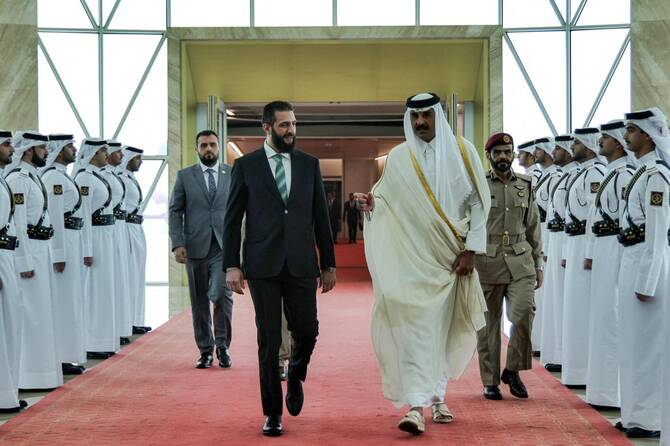

DOHA: Syria’s new president arrived in Qatar on Tuesday, state media said, for his first official visit to the Gulf state, a key backer of the new administration after longtime ruler Bashar Assad’s ouster.
The official Qatar News Agency reported Emir Sheikh Tamim bin Hamad Al-Thani met Syria’s interim President Ahmed Al-Sharaa on his arrival at Doha’s Hamad International Airport.
Earlier, Syria’s foreign minister posted on X that he was accompanying Sharaa on his “first presidential visit to the country that has stood by Syrians from day one and has never abandoned them.”
Sharaa and Shaibani’s Qatar trip comes on the heels of a Sunday visit to the United Arab Emirates, where they met Emirati President Sheikh Mohamed bin Zayed Al-Nahyan, who expressed his country’s support for Syria’s reconstruction.
Sharaa’s Islamist group Hayat Tahrir Al-Sham led the alliance that ousted Assad from power on December 8.
His new administration has received support from several countries including key backers Turkiye and Qatar, as well as multiple Arab states.
Qatar was one of the first Arab countries to back the armed rebellion that erupted after Assad’s government crushed a peaceful uprising in 2011. Unlike other Arab nations, Doha did not restore diplomatic ties with Syria under Assad.
The new authorities have engaged in a flurry of diplomatic activity since taking power, and Sharaa has visited several Arab countries as well as Turkiye.
Meanwhile, Lebanese President Joseph Aoun departed Beirut on Tuesday for Doha, his office said, on his first visit to the Gulf country since his January election.
“The visit will continue until tomorrow afternoon, Wednesday, and will include a bilateral meeting between President Aoun and the Emir of Qatar, as well as expanded talks involving both the Qatari and Lebanese delegations,” Aoun’s presidential office said.
A day earlier, Lebanese Prime Minister Nawaf Salam met with Sharaa in Damascus in an effort to reboot ties between the two neighbors.
Beirut and Damascus have been seeking to improve relations since the overthrow of Assad, whose family dynasty exercised control over Lebanese affairs for decades and has been accused of assassinating numerous officials in Lebanon who expressed opposition to its rule.
Middle East analyst Andreas Krieg said since the fall of the Assad government, Qatar had emerged as “the most important interlocutor with the Al-Sharaa government in the Arab world, at least after Turkiye.”
He said the gas-rich Gulf emirate was a “diplomatic force multiplier to the Al-Sharaa government in Syria” and would be able to connect Syrians back to Lebanon “which is, for both countries, extremely important.”
Sheikh Tamim visited Damascus in January, becoming the first head of state to visit since Assad’s ouster.
Doha has pledged to support the rehabilitation of Syria’s infrastructure, and in January announced an agreement to provide Syria with 200 megawatts of power, gradually increasing production.
Syrian authorities are seeking assistance including from wealthy Gulf states for reconstruction after nearly 14 years of war.
Qatar is one of the providers of financial and in-kind support to the Lebanese army and pledged support for reconstruction in February after the recent confrontation between Hezbollah and Israel.

keywords


