

Muslim Rababis of Lahore struggle to keep alive centuries-old Sikh kirtan musical tradition

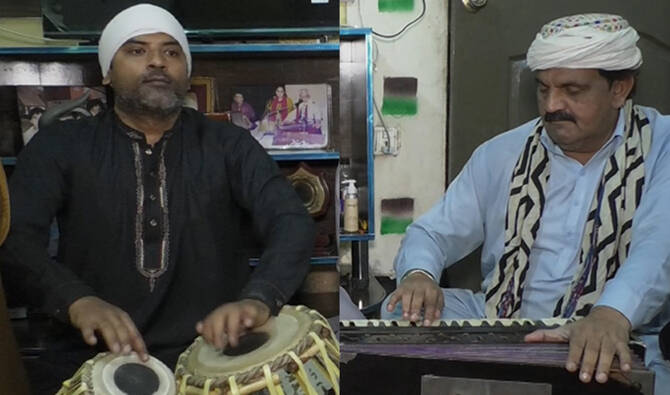
Collage of rababis', Ustad Moeen Ahmed Chand (right) and Mohsin Ali Chand pictured during their rehearsal session in Lahore, Pakistan, on April 13, 2025. (AN Photo)
Short Url
Updated 15 April 2025
Follow

Muslim Rababis of Lahore struggle to keep alive centuries-old Sikh kirtan musical tradition

  • Rababis are Muslims who perform sacred devotional music of Sikhism, passing down the craft from one generation to the next
  • 13th generation Rababi Ustad Moeen Ahmed Chand complains about lack of respect for community, few opportunities to perform

LAHORE: Ustad Moeen Ahmed Chand pumped the external bellows of his harmonium with one hand and pressed the keys on the keyboard with the other as he sat on the floor of his small, run-down house nestled in a narrow street in Pakistan’s eastern city of Lahore.

Chand comes from a long line of Rababis, Muslim singers who were the original custodians of Sikhism’s kirtan tradition, a sacred form of devotional music. 

Rababis trace their origins to Bhai Mardana (1459-1534), a Muslim musician who was one of the closest companions of Sikhism’s founder Baba Guru Nanak (1469-1539). Mardana traveled across South and Central Asia with Nanak, singing songs of divine wisdom and playing the rabab string instrument from where the Rababi community gets its name, awakening diverse audience with Sikhism’s messages of peace, unity, and oneness. 

Over the course of centuries, Rababis have added other instruments such as the tabla and the harmonium to the kirtan tradition, which is passed on from father to son through the generations. Today, it is Chand, 50, who carries forward the art and is fiercely protective of it, struggling to keeping alive the essential but often overlooked part of the history of Sikh and Indian classical music.

Chand, who lives close to Lahore’s iconic Mughal-era Shalimar Gardens, recalled that his love for kirtan took root as a child watching his father laying bricks in the morning and practicing music in the evening. 

“Watching them, I also developed a love for it [kirtan], I also took this path,” Chand, 50, told Arab News at his home on Nadeem Street near Lahore’s Malik Park. “I am the 13th generation [of Rababis in my family] … Next in line is my son.”

Before the partition of India and the birth of Pakistan in 1947, Chand’s grandfather was a renowned Rababi at Amritsar’s Golden Temple, one of the holiest sites in Sikhism. Back then, all Rababis used to get stipends from the Golden Temple.

“The temple would send us money and in those days even 200 rupees [$0.72] would amount to Rs25,000 [$90] to Rs30,000 [$108], even Rs100,000 [$360] of today,” Chand said.

But then the family moved to Lahore after the end of British colonial rule and funds from Sikh temples dried up.

“After partition, our elders faced a lot of hardships, worked as laborers, had to work very hard to survive, but with the blessings of Maharaj [Guru Nanak] they never left kirtan,” Chand said. 

“NOBODY CALLS US TO PLAY”

Despite his family preserving the kirtan for 13 generations, there is little demand for performances by Rababis now, other than at special events like Guru Nanak’s birth anniversary celebrations. This has forced musicians like Chand to diversify their portfolios, taking up the Sufi devotional music form popularly known as the qawwali, which he performs at seasonal melas and annual events such as annual death anniversary celebrations of Sufi saints of the Indian subcontinent. 

“Nobody calls us to play anymore. Once a year tourists come from abroad on Sri Guru Nanak Dev’s birth anniversary, then they call us now and then,” the musician lamented. “All we want is a consistent and reliable source of income.”

Chand’s disciple, his nephew Mohsin Ali Chand, a 32-year-old tabla player, agreed about the lack of respect for the craft and the family that was struggling to carry it forward.

“We are not very respected here [in Pakistan]. In India we are respected,” Mohsin told Arab News as he sat cross-legged at Chand’s house, his fingers softly tapping the top of a pair of tabla drums. 

“There people give us a lot of veneration and love and they respect and value us.”

More than the lack of public appreciation, Chand said the commercialization of music had drained the soul of kirtan, and of the Rababis still practicing it.

“My message for my Rababi brothers is that sing kirtan like we recite our holy books,” he said. “Kirtan should come from the heart.”

Chand also warned against imitators of the craft who had “commercialized kirtan. The only way to become a Rababi was to be mentored by another Rababi, the passing down of the skill from an “ustaad” [teacher] to a “shagird” [student], Chand said. 

“My only request is to stop lying,” the musician added. “Let the rightful Rababis get the work. Be honest, be truthful, the teacher you’ve learned from, take their name.”


Pakistan’s military chief Asim Munir in spotlight over Trump’s Gaza plan

Updated 5 sec ago
Follow

Pakistan’s military chief Asim Munir in spotlight over Trump’s Gaza plan

  • Sources say Munir is expected to visit Washington in the coming weeks for talks with the US president on Gaza
  • Any Pakistani troop role in Gaza could trigger backlash from pro-Palestine, anti-US groups at home, analysts say

ISLAMABAD: Pakistan’s most powerful military chief in decades faces the toughest test of his newly amassed powers as Washington pushes Islamabad to contribute troops to the Gaza stabilization force, a move analysts say could spark domestic backlash.

Field Marshal Asim Munir is expected to fly to Washington to meet President Donald Trump in the coming weeks for a third meeting in six months that will likely focus on the Gaza force, two sources told Reuters, one of them a key player in the general’s economic diplomacy.

Trump’s 20-point Gaza plan calls for a force from Muslim nations to oversee a transition period for reconstruction and economic recovery in the war-torn Palestinian territory, decimated by over two years of Israeli military bombardment.

Many countries are wary of the mission to demilitarize Hamas in Gaza, which could drag them into the conflict and enrage their pro-Palestinian and anti-Israeli populations.

But Munir has built a close relationship with the mercurial Trump to repair years of mistrust between Washington and Islamabad. In June, he was rewarded with a White House lunch — the first time a US president hosted Pakistan’s army chief alone, without civilian officials.

“Not contributing (to the Gaza stabilization force) could annoy Trump, which is no small matter for a Pakistani state that appears quite keen to remain in his good graces — in great part to secure US investment and security aid,” said Michael Kugelman, Senior Fellow, South Asia at Washington-based Atlantic Council.

‘PRESSURE TO DELIVER’

Pakistan, the world’s only Muslim country with nuclear weapons, has a battle-hardened military having gone to war with arch-rival India three times and a brief conflict this summer. It has also tackled insurgencies in its far-flung regions and is currently embroiled in a bruising war with militants who it says are operating from Afghanistan.

Pakistan’s military strength means “there is a greater pressure on Munir to deliver his capacity,” said author and defense analyst Ayesha Siddiqa.

Pakistan’s military, foreign office and information ministry did not respond to questions from Reuters. The White House also did not respond to a request for a comment.

Pakistani Foreign Minister Ishaq Dar said last month that Islamabad could consider contributing troops for peacekeeping but disarming Hamas “is not our job.”

UNPRECEDENTED POWER

Munir was earlier this month anointed chief of the defense forces to head the air force and navy as well, with a job extension until 2030.

He will retain his field marshal title forever, as well as enjoy lifetime immunity from any criminal prosecution under the constitutional amendments that Pakistan’s civilian government pushed through parliament late last month.

“Few people in Pakistan enjoy the luxury of being able to take risks more than Munir. He has unbridled power, now constitutionally protected,” Kugelman added.

“Ultimately, it will be Munir’s rules, and his rules only.”

THE HOME FRONT RISK

Over the past few weeks, Munir has met military and civilian leaders from countries such as Indonesia, Malaysia, Saudi Arabia, Turkiye, Jordan, Egypt and Qatar, according to the military’s statements, which Siddiqa said appeared to be consultations on the Gaza force.

But the big concern at home is that the involvement of Pakistan troops in Gaza under a US-backed plan could re-ignite protests from Pakistan’s religio-political parties that are deeply opposed to the US and Israel.

These parties have street power to mobilize thousands. A powerful and violent anti-Israel party that fights for upholding Pakistan’s ultra-strict blasphemy laws was banned in October.

Authorities arrested its leaders and over 1,500 supporters and seized its assets and bank accounts in an ongoing crackdown, officials said.

While Islamabad has outlawed the group, its ideology is still alive.

The party of former jailed premier, Imran Khan, whose supporters won the most seats in the 2024 national elections and has wide public support, also has an axe to grind against Munir.

Abdul Basit, Senior Associate Fellow, S. Rajaratnam School of International Studies in Singapore, said if things escalated once the Gaza force was on the ground, it would cause problems quickly.

“People will say ‘Asim Munir is doing Israel’s bidding’ — it will be foolhardy of anyone not to see it coming.”