China accuses US of launching ‘advanced’ cyberattacks during the Asian Winter Games

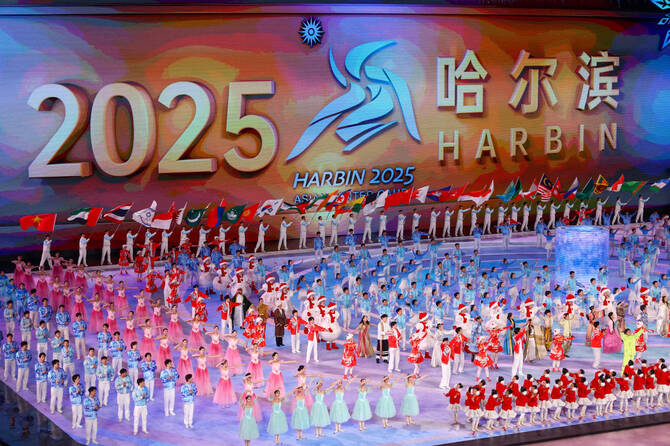
Above, the closing ceremony of Harbin 2025 Asian Winter Games in Harbin, northeast China’s Heilongjiang province on Feb. 14, 2025. The NSA intended to use cyberattacks to steal the personal data of participating athletes. (AFP file photo)
Short Url
Updated 15 April 2025
Follow

China accuses US of launching ‘advanced’ cyberattacks during the Asian Winter Games

  • The attacks had ‘the intention of sabotaging China’s critical information infrastructure, causing social disorder, and stealing important confidential information’

BEIJING: Chinese police in the northeastern city of Harbin have accused the United States National Security Agency (NSA) of launching “advanced” cyberattacks during the Asian Winter Games in February, targeting essential industries.
Police added three alleged NSA agents to a wanted list and also accused the University of California and Virginia Tech of being involved in the attacks after carrying out investigations, according to a report by state news agency Xinhua on Tuesday.
The NSA agents were identified by Xinhua as Katheryn A. Wilson, Robert J. Snelling and Stephen W. Johnson. The three were also found to have “repeatedly carried out cyberattacks on China’s critical information infrastructure and participated in cyberattacks on Huawei and other enterprises.”
It did not specify how the two American universities were involved.
The US Embassy in China did not immediately respond to an emailed request for comment.
The detailed allegations come as the world’s two largest economies spiral deeper into a trade war that has already spurred travel warnings for Chinese tourists going to the US and halted imports of US films into China.
“The US National Security Agency (NSA) launched cyberattacks against important industries such as energy, transportation, water conservancy, communications, and national defense research institutions in Heilongjiang province,” Xinhua said, citing the Harbin city public security bureau.
The attacks had “the intention of sabotaging China’s critical information infrastructure, causing social disorder, and stealing important confidential information,” it added.
Anonymous servers
Xinhua said the NSA operations took place during the Winter Games and were “suspected of activating specific pre-installed backdoors” in Microsoft Windows operating systems on specific devices in Heilongjiang.
In order to cover its tracks, the NSA purchased IP addresses in different countries and “anonymously” rented a large number of network servers including in Europe and Asia,” Xinhua said.
The NSA intended to use cyberattacks to steal the personal data of participating athletes, the news agency said, adding that the cyberattacks reached a peak from the first ice hockey game on February 3. The attacks targeted information systems such as the Asian Winter Games registration system and stored “sensitive information about the identities of relevant personnel of the event,” Xinhua said.
The US routinely accuses Chinese state-backed hackers of launching attacks against its critical infrastructure and government bodies.
Last month, Washington announced indictments against a slew of alleged Chinese hackers who targeted the US Defense Intelligence Agency, the US Department of Commerce, and the foreign ministries of Taiwan, South Korea, India, and Indonesia.
Beijing denies all involvement in overseas cyber espionage.
After years of being accused by Western governments of cyberattacks and industrial espionage, in the past two years several Chinese organizations and government organs have accused the United States and its allies of similar behavior.
In December, China said it found and dealt with two US cyberattacks on Chinese tech firms to “steal trade secrets” since May 2023, but did not name the agency involved.


Belarus frees protest leader Kolesnikova, Nobel winner Bialiatski

Updated 6 sec ago
Follow

Belarus frees protest leader Kolesnikova, Nobel winner Bialiatski

  • The charismatic Kolesnikova was the star of the 2020 movement that presented the most serious challenge to Lukashenko in his 30-year rule
  • Bialiatski — a 63-year-old veteran rights defender and 2022 Nobel Peace Prize winner — is considered by Lukashenko to be a personal enemy

VILNIUS: Belarusian street protest leader Maria Kolesnikova and Nobel Prize winner Ales Bialiatski walked free on Saturday with 121 other political prisoners released in an unprecedented US-brokered deal.
Belarusian President Alexander Lukashenko has locked up thousands of his opponents, critics and protesters since the 2020 election, which rights groups said was rigged and which triggered weeks of protests that almost toppled him.
The charismatic Kolesnikova was the star of the 2020 movement that presented the most serious challenge to Lukashenko in his 30-year rule.
She famously ripped up her passport as the KGB tried to deport her from the country.
Bialiatski — a 63-year-old veteran rights defender and 2022 Nobel Peace Prize winner — is considered by Lukashenko to be a personal enemy. He has documented rights abuses in the country, a close ally of Moscow, for decades.
Bialiatski stressed he would carry on fighting for civil rights and freedom for political prisoners after his surprise release, which he called a “huge emotional shock.”
“Our fight continues, and the Nobel Prize was, I think, a certain acknowledgement of our activity, our aspirations that have not yet come to fruition,” he told media in an interview from Vilnius.
“Therefore the fight continues,” he added.
He was awarded the prize in 2022 while already in jail.
After being taken out of prison, he said he was put on a bus and blindfolded until they reached the border with Lithuania.
His wife, Natalia Pinchuk, told AFP that her first words to him on his release were: “I love you.”

- ‘All be free’ -

Most of those freed, including Kolesnikova, were unexpectedly taken to Ukraine, surprising their allies who had been waiting for all of them in Lithuania.
She called for all political prisoners to be released.
“I’m thinking of those who are not yet free, and I’m very much looking forward to the moment when we can all embrace, when we can all see one another, and when we will all be free,” she said in a video interview with a Ukrainian government agency.
Hailing Bialiatski’s release, the Nobel Committee told AFP there were still more than 1,200 political prisoners inside the country.
“Their continued detention starkly illustrates the ongoing, systemic repression in the country,” said chairman Jorgen Watne Frydnes.
EU chief Ursula von der Leyen said their release should “strengthen our resolve... to keep fighting for all remaining prisoners behind bars in Belarus because they had the courage to speak truth to power.”
Jailed opponents of Lukashenko are often held incommunicado in a prison system notorious for its secrecy and harsh treatment.
There had been fears for the health of both Bialiatski and Kolesnikova while they were behind bars, though in interviews Saturday they both said they felt okay.
The deal was brokered by the United States, which has pushed for prisoners to be freed and offered some sanctions relief in return.

- Potash relief -

An envoy of US President Donald Trump, John Coale, was in Minsk this week for talks with Lukashenko.
He told reporters from state media that Washington would remove sanctions on the country’s potash industry, without providing specific details.
A US official separately told AFP that one American citizen was among the 123 released.
Minsk also freed Viktor Babariko, an ex-banker who tried to run against Lukashenko in the 2020 presidential election but was jailed instead.
Kolesnikova was part of a trio of women, including Svetlana Tikhanovskaya who stood against Lukashenko and now leads the opposition in exile, who headed the 2020 street protests.
She was serving an 11-year sentence in a prison colony.
In 2020, security services had put a sack over her head and drove her to the Ukrainian border. But she ripped up her passport, foiling the deportation plan, and was placed under arrest.
Former prisoners from the Gomel prison where she was held have told AFP she was barred from talking to other political prisoners and regularly thrown into harsh punishment cells.
An image of Kolesnikova making a heart shape with her hands became a symbol of anti-Lukashenko protests.
Bialiatski founded Viasna in the 1990s, two years after Lukashenko became president.