Britain boosts aid for victims of Sudan conflict at conference

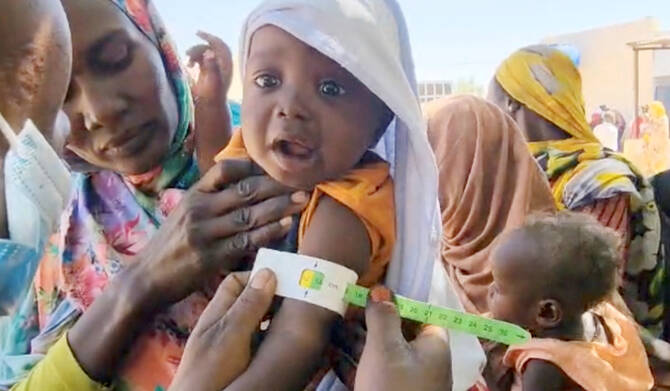
A child gets tested for malnutrition at World Food Program (WFP) camp at El Fasher, in Darfur, Sudan March 27, 2025, in this screengrab obtained from a video. (REUTERS)
Short Url
Updated 15 April 2025
Follow

Britain boosts aid for victims of Sudan conflict at conference

  • British Foreign Secretary David Lammy said the war had been going on for far too long “and yet much of the world continues to look away”

LONDON: Britain said on Tuesday it would provide 120 million pounds ($158 million) more in aid to people in Sudan, which it said faces the worst humanitarian crisis on record, as it hosted a conference marking the two-year anniversary of the conflict.
The war in Sudan erupted in April 2023, sparked by a power struggle between the army and Sudan’s Rapid Support Forces, shattering hopes for a transition to civilian rule.
The conflict has since displaced millions and devastated regions like Darfur, where the RSF is now fighting to maintain its stronghold amid army advances in Khartoum.
Rather than mediating directly in the conflict, Britain said Tuesday’s conference in London would be a chance to improve the coherence of the international response to the crisis, although Sudan criticized the fact its government was not invited for the talks.
British Foreign Secretary David Lammy said the war had been going on for far too long “and yet much of the world continues to look away.”
“We need to act now to stop the crisis from becoming an all-out catastrophe, ensuring aid gets to those who need it the most,” he said in a statement, adding that the combatants had shown “an appalling disregard” for Sudanese civilians.
Britain is co-hosting the London conference with the African Union, the European Union, France and Germany. Egypt, Kenya and the United Arab Emirates are among the other attendees.
Sudan’s foreign minister has written to Lammy to complain, saying Sudan should have been invited, while criticizing the presence of the UAE and Kenya.
Sudan has accused the UAE of arming RSF, a charge the UAE denies but UN experts and US lawmakers have found credible. Sudan has also recalled its envoy to Kenya after it hosted talks between the RSF and its allies to form a parallel government.
Bankole Adeoye, African Union commissioner for political affairs, peace and security, said “achieving peace in Sudan depends on valuing every voice and everyone playing a role in building a prosperous Sudan.”

AID CUT
Britain said 30 million people desperately needed aid and 12 million people were displaced, with famine spreading through Sudan. Lammy announced a separate 113-million-pound aid package in November, and in January he visited Sudan’s border with Chad.
However Britain’s support for victims of the conflict comes as the government has slashed its foreign aid budget to pay for increased defense spending.
Although Prime Minister Keir Starmer vowed to continue aid to civilians in Sudan, one of three priorities along with Gaza and Ukraine, his development minister resigned, saying Britain’s aid priorities would be impossible to maintain and the cuts would ultimately harm Britain’s reputation abroad.
On Tuesday, lawyers acting for Sudanese victims submitted a 141-page dossier outlining alleged war crimes committed by the RSF to the UK police’s special war crimes unit, with a request to pass the file to the International Criminal Court, which has jurisdiction over atrocity crimes in Darfur.
By sending the file via the UK police rather than directly to the ICC, the lawyers said they hoped to provide an impetus for the two jurisdictions to work together more closely on accountability for Darfur.


Thousands in Kosovo march against war crimes trials on 18th anniversary of independence declaration

Updated 2 sec ago
Follow

Thousands in Kosovo march against war crimes trials on 18th anniversary of independence declaration

  • Protesters, many wrapped in red and black Albanian flags, braved cold and snowy weather in the capital, Pristina, to voice their opposition to the proceedings in The Hague
  • PM Albin Kurti added that ‘the KLA-led war was pure, liberation (struggle) and an anti-colonial war ... a just struggle of an occupied and oppressed people under apartheid’
PRISTINA, Kosovo: An air of defiance marked Kosovo’s independence celebrations on Tuesday as thousands of people joined a march in support of former fighters who are facing trial at a Netherlands-based court for alleged war crimes during a 1998-1999 separatist war from Serbia.
Protesters, many wrapped in red and black Albanian flags, braved cold and snowy weather in the capital, Pristina, to voice their opposition to the proceedings in The Hague against former president and rebel leader Hashim Thaci and three others accused of atrocities during and after the conflict that killed some 13,000 people.
Earlier on Tuesday, Kosovo’s security forces paraded in Pristina as part of the independence ceremonies, and Parliament held a special session.
The war started in 1998 when the rebel Kosovo Liberation Army launched its struggle for independence and Serbia responded with a brutal crackdown. The war ended after NATO bombed Serbia for 78 days in 1999, eventually forcing it to pull out its troops from the territory.
Serbia still does not recognize the 2008 declaration of independence of Kosovo and this has been a source of persistent tension in the volatile Balkan region. As both Kosovo and Serbia seek European Union membership, they have been told they must normalize ties before joining.
Prosecutors at the Kosovo Specialist Chambers in The Hague — which formally is part of Kosovo’s judicial system although seated abroad — have asked for a maximum 45-year prison sentence for Thaci and the other defendants. Thaci also faces a separate trial on charges of intimidating witnesses that will begin later this month.
Officials and protesters in Kosovo have criticized the proceedings as political and designed to strike a false balance with Serbia whose political and military leaders previously had been tried and convicted of war crimes in Kosovo by a separate UN court.
Protesters at Tuesday’s march held banners reading “History cannot be rewritten” and “Freedom for the liberators.” They arranged metal fences around a landmark independence monument and placed a sign reading ”Kosovo in Prison” on top of it.
President Vjosa Osmani said in a statement that “truth cannot be changed by attempts to rewrite history or to tarnish and devalue the struggle of Kosovo’s people for freedom.”
Prime Minister Albin Kurti added that “the KLA-led war was pure, liberation (struggle) and an anti-colonial war ... a just struggle of an occupied and oppressed people under apartheid.”
In Belgrade, a Serbian government liaison office for Kosovo described the independence declaration 18 years ago as a “flagrant violation of international law.” The statement alleged “systematic terror” and persecution against minority Serbs in Kosovo.
The United States and most EU countries are among more than 100 nations that have recognized Kosovo’s independence while Russia and China have backed Serbia’s claim on the territory.
Thaci resigned from office in 2020 to defend himself against the 10 charges of crimes against humanity and war crimes.
The court and an associated prosecutor’s office were created after a 2011 report by the Council of Europe, a human rights body, following allegations that KLA fighters trafficked human organs taken from prisoners and killed Serbs and fellow ethnic Albanians. The organ harvesting allegations haven’t been included in indictments issued by the court.