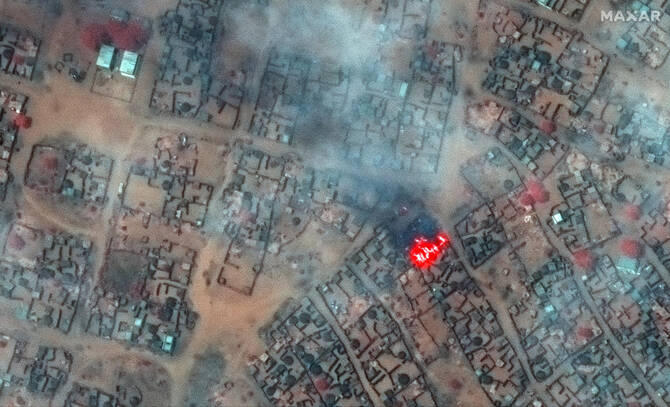
GENEVA: More than 400 people have been killed in recent attacks by Sudan’s paramilitary Rapid Support Forces (RSF) in the western Darfur region, according to sources cited by the United Nations.
The RSF, at war with the regular army since April 2023, has in recent weeks stepped up its attacks on refugee camps around El-Fasher in its effort to seize the last state capital in Darfur not under its control.
And since late last week, the RSF has launched ground and aerial assaults on El-Fasher itself and the nearby Zamzam and Abu Shouk displacement camps.
Just between Thursday and Saturday last week, the UN rights office “has verified 148 killings,” spokeswoman Ravina Shamdasani told AFP.
“But this is very much an underestimate as our verification work is ongoing,” she said, stressing that the number did “not even include yesterday’s violence.”
“Credible sources have reported more than 400 killed,” she said.
Her comments came after UN rights chief Volker Turk decried in a statement that the “large-scale attacks ... made starkly clear the cost of inaction by the international community, despite my repeated warnings of heightened risk for civilians in the area.”
“Hundreds of civilians, including at least nine humanitarian workers, were reportedly killed,” he said, warning that “the attacks have exacerbated an already dire protection and humanitarian crisis in a city that has endured a devastating RSF siege since May last year.”
The UN rights chief insisted that “RSF has an obligation under international humanitarian law to ensure the protection of civilians, including from ethnically motivated attacks, and to enable the safe passage of civilians out of the city.”
With the conflict entering its third year on Tuesday, Turk called on all parties “to take meaningful steps toward resolving the conflict.”

Over 400 killed in Darfur paramilitary attacks: UN
https://arab.news/crdc6
Over 400 killed in Darfur paramilitary attacks: UN
- RSF has in recent weeks stepped up its attacks on refugee camps around El-Fasher in its effort to seize the last state capital in Darfur not under its control
Lebanon PM publishes long-awaited banking law draft
- The law stipulates that each of the state, the central bank, commercial banks and depositors will share the losses accrued as a result of the financial crisis.
- Depositors with a limit of $100,000, over the course of four years
BEIRUT: Lebanese Prime Minister Nawaf Salam published on Friday a long-awaited banking draft bill, which distributes losses from the 2019 economic crisis between banks and the state.
The draft law is a key demand from the international community, which has conditioned economic aid to Lebanon on financial reforms.
In a televised speech, Salam said “this draft law constitutes a roadmap to getting out of the crisis” that still grips Lebanon.
The draft will be discussed by the Lebanese cabinet on Monday before being sent to parliament, where it could be blocked.
The law stipulates that each of the state, the central bank, commercial banks and depositors will share the losses accrued as a result of the financial crisis.
Depositors, who lost access to their funds after the crisis, will be able to retrieve their money, with a limit of $100,000, over the course of four years.
Salam said that 85 percent of depositors had less than $100,000 in their accounts.
The wealthiest depositors will see the remainder of their money compensated by asset-backed securities.
“I know that many of you are listening today with hearts full of anger, anger at a state that abandoned you,” Salam said.
“This bill may not be perfect... but it is a realistic and fair step toward restoring rights, halting the collapse.”
- ‘Banks are angry’ -
The International Monetary Fund, which closely monitored the drafting of the bill, had previously insisted on the need to “restore the viability of the banking sector consistent with international standards” and protect small depositors.
The Associations of Banks in Lebanon criticized the draft law on Monday, saying in a statement that it contains “serious shortcomings” and harms commercial banks.
“Banks are angry because the law opens the door to them sharing any part of the losses,” said Sami Zougheib, researcher at The Policy Initiative, a Beirut-based think tank.
He told AFP that banks would have preferred that the state bear full responsibility.
The text provides for the recapitalization of failing banks, while the government’s debt to the Central Bank will be converted into bonds.
Salam said that the bill aims to “revive the banking sector” which had collapsed, giving free rein to a parallel economy based on cash transactions, which facilitate money laundering and illicit trade.
According to government estimates, the losses resulting from the financial crisis amounted to about $70 billion, a figure that is expected to have increased over the six years that the crisis was left unaddressed.
Since assuming power, Salam and President Joseph Aoun have pledged to implement the necessary reforms and legislation.
In April, Lebanon’s parliament adopted a bank restructuring law, as the previous legislation was believed to have allowed a flight of capital at the outbreak of the 2019 crisis.
The new bill stipulates that politically exposed persons and major shareholders who transferred significant capital outside the country from 2019 onwards — while ordinary depositors were deprived of their savings — must return them within three months or face fines.
The draft law could still be blocked by parliament even if the cabinet approves it.
“Many lawmakers are directly exposed as large depositors or bank shareholders, politically allied with bank owners, and unwilling to pass a law that either angers banks or angers depositors,” Zougheib said.
Politicians and banking officials have repeatedly obstructed the reforms required by the international community for Lebanon to receive financial support.