

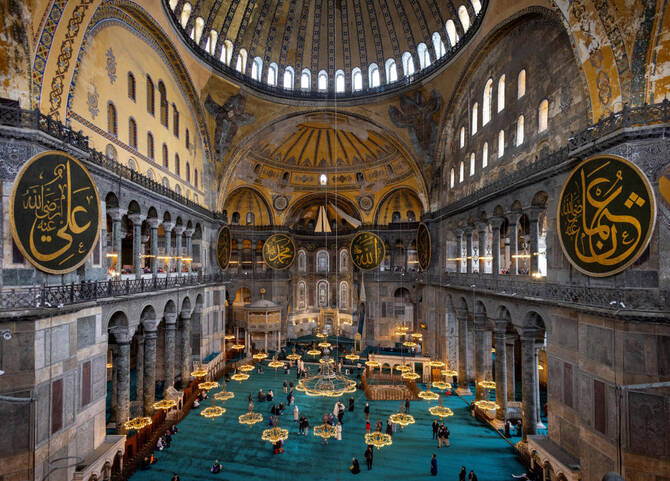
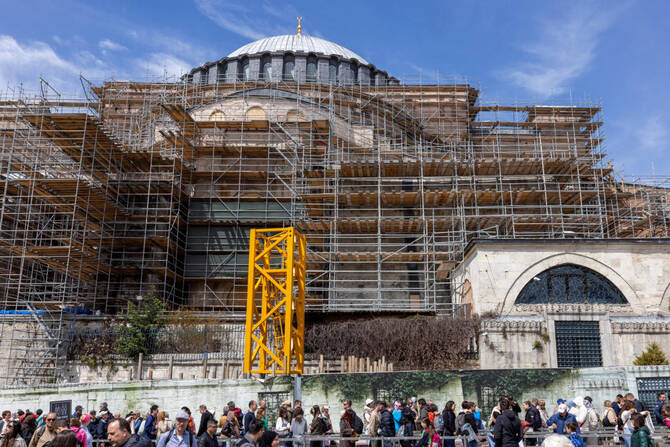


ISTANBUL: Turkiye has begun a new phase in sweeping restorations of the nearly 1,500-year-old Hagia Sophia in Istanbul, focusing on preserving the monument’s historic domes from the threat of earthquakes.
Officials say the project will include reinforcing Hagia Sophia’s main dome and half domes, replacing the worn lead coverings and upgrading the steel framework while worship continues uninterrupted in the mosque.
A newly installed tower crane on the eastern façade is expected to facilitate the efforts by transporting materials, expediting the renovations.
“We have been carrying out intensive restoration efforts on Hagia Sophia and its surrounding structures for three years,” said Dr. Mehmet Selim Okten, a construction engineer, lecturer at Mimar Sinan University and a member of the scientific council overseeing the renovations. “At the end of these three years, we have focused on the seismic safety of Hagia Sophia, the minarets, the main dome and the main arches, especially due to the expected Istanbul earthquake.”
In 2023, a 7.8 magnitude earthquake struck southern Turkiye, destroying or damaging hundreds of thousands of buildings and leaving more than 53,000 people dead. While Istanbul was not impacted, the devastation in southern Turkiye heightened fears of a similar quake with experts citing the city’s proximity to fault lines.
Okten said a “new phase” of work is about to begin, one that he describes as the most significant intervention in over 150 years and in the totality of the structure’s long history.
“A tower crane will be installed on the eastern facade, and then we will cover the top of this unique structure with a protective frame system,” he said. “That way, we can work more safely and examine the building’s layers academically, including damage it suffered from fires and earthquakes in the 10th and 14th centuries.”
Built by the Byzantine Emperor Justinian in 537, Hagia Sophia was turned into a mosque with the 1453 Ottoman conquest of Istanbul. Mustafa Kemal Ataturk, the founding leader of the Turkish republic, converted it into a museum in 1934.
Although an annex to Hagia Sophia, the sultan’s pavilion, has been open to prayers since the 1990s, religious and nationalist groups in Turkiye had long yearned for the nearly 1,500-year-old edifice they regard as the legacy of Ottoman Sultan Mehmet the Conqueror to be reverted into a mosque.
Turkiye’s highest administrative court overturned the 1934 decree in 2020, allowing it to reopen as a mosque.
“We have completed our work on the four minarets and the main structure,” Okten said. “But for this unique cultural heritage (of the domes), we plan to use modern, lightweight materials and keep the building open to the public.”
Visitors to the site expressed approval of the plan.
“Hagia Sophia is amazing, it’s one of the world’s most important monuments,” said Cambridge University lecturer Rupert Wegerif. “It seems really important that they are going to strengthen it in case of earthquakes and preserve it.”
Okten said that while it wasn’t clear when the renovations will be finished, the process would be open to the public to be “monitored transparently.”


