
ISTANBUL: Turkiye has long sought to extend its influence in Africa by mediating in conflicts and building military partnerships with countries on the continent.
Those efforts have picked up speed in recent months with diplomatic successes in resolving local conflicts, and as traditional powers such as France and the United States pull back from the continent, according to analysts and diplomats.
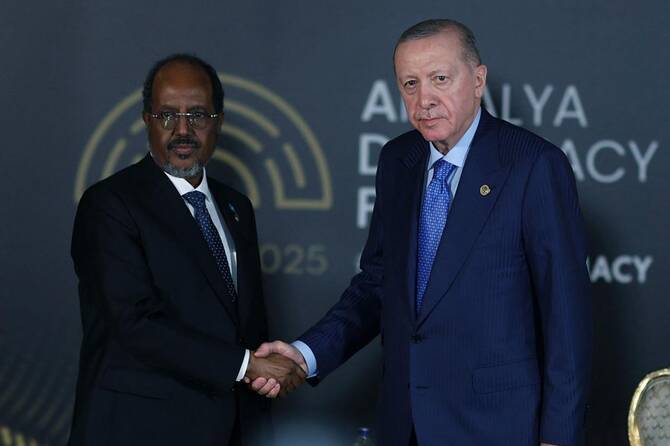
An annual diplomacy forum in the southern Mediterranean resort of Antalya on April 11-13 drew many African officials, including the president of Somalia, as part of Ankara’s efforts to consolidate its foothold in Africa.
“Today African countries are looking for alternatives, and Turkiye represents one of those options, so it has resonated well in Africa,” Professor Eghosa Osaghae, director general of the Nigerian Institute of International Affairs, who attended the forum, told AFP.
Turkish President Recep Tayyip Erdogan has boosted his international standing after backing rebels who overthrew Syrian ruler Bashar Assad and brokering a key Horn of Africa peace deal between Somalia and Ethiopia.
We have relations with France that we are very proud of. But France doesn’t prevent us from having other partnerships
Kacou Leon Adom, Ivory Coast’s foreign minister
Ankara, which also hosted two rounds of talks between Russia and Ukraine at the start of the war, has often said it is ready to support any initiative leading to peace between its two Black Sea neighbors.
The Antalya forum was also attended by Syria’s new leader Ahmed Al-Sharaa, Russian Foreign Minister Sergei Lavrov and Ukraine’s Foreign Minister Andriy Sybiha.
For Osaghae, whether Turkiye can fill the vacuum in Africa left by France, which has seen many of its former colonies turn away from it in recent years, would “depend a great deal on how attractive Turkiye’s offers to African states will be.”
Speaking to AFP on the sidelines of the forum in Antalya, Ivory Coast’s foreign minister, Kacou Leon Adom, said: “We have relations with France that we are very proud of. But France doesn’t prevent us from having other partnerships.”
The west African nation is keen to work with Turkiye in all sectors, including communications, trade, security, education, or training, he said.
“All of that interests us. And from this perspective, Turkiye is making us offers, and we will consider them.”
Security challenges
Many African countries are faced with challenges to their security, with groups such as Somalia-based Al-Shabab, Boko Haram from Nigeria and the Lord’s Resistance Army, which originated in Uganda, wreaking havoc.
“If it is possible for Turkiye to give assistance in these areas, why not?” Osaghae said.
“The good thing is that many African countries already have military cooperation with Turkiye. And that can be the building block for Turkish influence.”
Turkiye has signed defense agreements with a number of states spanning the breadth of the continent, including Somalia, Libya, Kenya, Rwanda, Ethiopia, Nigeria and Ghana.
Those agreements have opened up contracts for Turkiye’s defense industry, notably for its reputedly reliable and inexpensive drones.
According to Turkish diplomat Alp Ay, Turkiye offers dialogue — he noted its success in getting Somalia and Ethiopia to end a bitter dispute that had sparked fears of conflict in the restive Horn of Africa.
“We are trying to ensure that Africa can find its own solutions to African problems,” said Ay, who works as Ankara’s special representative in negotiations between Somalia and the breakaway Somaliland region.
The good thing is that many African countries already have military cooperation with Turkiye. And that can be the building block for Turkish influence
Eghosa Osaghae, Nigerian Institute of International Affairs
Tension mounted last year after Ethiopia struck a deal with Somaliland — which unilaterally declared independence from Somalia in 1991 in a move not recognized by Mogadishu — to gain access to the sea.
But Ethiopia and Somalia announced a full restoration of diplomatic ties following a December deal mediated by Turkiye.
Ay said the responsibility from now on would be on both sides to uphold the deal but Turkiye would continue to play its facilitator role. “We are hopeful.”
A senior Somali diplomat likewise said Turkiye played “a very assistive role in bringing the two countries together to resolve this issue.”
In a sign of Ankara’s growing influence, Erdogan met his Somali counterpart, Hassan Sheikh Mohamud, on Saturday in Antalya.
“I think Turkiye is playing a key role in Somalia,” the Somali diplomat said.
“And it is a positive role. Turkiye is not only involved in security, it is also involved in other developmental projects in Somalia.”
Nigerian political scientist Osaghae said because there are many conflicts in the region, “Africa desperately needs mediators that are not only credible but are capable of doing the kinds of things that Turkish experience suggests.”