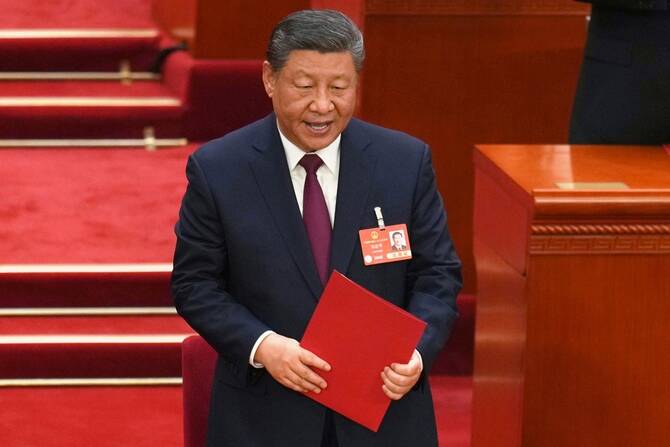
BEIJING: Chinese leader Xi Jinping warned Monday that protectionism “leads nowhere” and that a trade war would have “no winners,” state media said, as he was due to kick off a tour of Southeast Asia with a visit to Vietnam.
Xi’s first overseas trip of the year will see him visit Vietnam, Malaysia and Cambodia as Beijing seeks to tighten regional trade ties and offset the impact of huge tariffs unleashed by his US counterpart Donald Trump.
He will meet his three Southeast Asian counterparts on a tour that “bears major importance” for the broader region, Beijing has said.
Writing in an article published Monday in Vietnam’s major Nhan Dan newspaper, Xi urged the two countries to “resolutely safeguard the multilateral trading system, stable global industrial and supply chains, and open and cooperative international environment,” Beijing’s Xinhua News Agency said.
He also reiterated Beijing’s line that a “trade war and tariff war will produce no winner, and protectionism will lead nowhere,” the agency added.
Beijing is trying to present itself as a stable alternative to an erratic Trump, who announced — and then mostly reversed — sweeping tariffs this month that sent global markets into a tailspin.
Vietnam was Southeast Asia’s biggest buyer of Chinese goods, with a bill of $161.9 billion, followed by Malaysia, which imported $101.5 billion worth in 2024.
Xi will be in Vietnam on Monday and Tuesday, his first trip there since December 2023.
Vietnam has long pursued a “bamboo diplomacy” approach, striving to stay on good terms with both China and the United States.
The two countries have close economic ties, but Hanoi shares US concerns about Beijing’s increasing assertiveness in the contested South China Sea.
China claims almost all of the South China Sea as its own, but this is disputed by the Philippines, Malaysia, Vietnam, Indonesia and Brunei.
The Chinese leader in his Monday article insisted Beijing and Hanoi could resolve those disputes through dialogue.
“We should properly manage differences and safeguard peace and stability in our region,” Xi wrote, according to Xinhua.
“With vision, we are fully capable of properly settling maritime issues through consultation and negotiation.”

Xi warns protectionism ‘leads nowhere’ as he starts Southeast Asia tour
https://arab.news/z9234
Xi warns protectionism ‘leads nowhere’ as he starts Southeast Asia tour
- Beijing is trying to present itself as a stable alternative to an erratic Trump
Venezuela’s furious street forces ready to ‘fight’ after US raid
- As proud defenders of the Venezuelan leadership’s socialist “Bolivarian revolution,” the ousting of Maduro has left them furious and bewildered, convinced that he was betrayed by close allies
CARACAS: When explosions boomed in the night and US warplanes roared in the sky over Caracas, Jorge Suarez and his companions rushed fearfully for their guns.
For these members of the “colectivos” — armed loyalists of the leftist leadership — the US raid that ousted Nicolas Maduro as their president was the most dramatic challenge yet.
“We’re not used to it — it was like a best-seller, like something out of a movie,” said Suarez, in black sunglasses and a cap bearing the slogan: “Doubt is treason.”
“We took to the streets, waiting for instructions from our leaders.”
As proud defenders of the Venezuelan leadership’s socialist “Bolivarian revolution,” the ousting of Maduro has left them furious and bewildered, convinced that he was betrayed by close allies.
“There is frustration, anger and a will to fight,” said a 43-year-old member of one collective the Boina Roja — which translates to Red Beret — who identified himself only as Willians, in a black cap and hooded jacket.
“It’s still not really clear what happened...What is clear is that there were many betrayals,” he added — pointing to implausible failures in Maduro’s defenses.
“We don’t understand how the anti-aircraft system failed. We don’t know what happened with the rocket-launch system.”
- Policing the transition -
Established in their current form under Maduro’s predecessor Hugo Chavez, the colectivos are tasked with keeping social order on the streets — but accused by opponents of beating and intimidating rivals.
They have closed ranks behind Delcy Rodriguez, Maduro’s former deputy who took over as interim president.
She has pledged to cooperate with US President Donald Trump over his demand for access to Venezuela’s huge oil reserves — but has insisted the country is not “subordinate” to Washington.
Willians said the colectivos were resisting certain post-Maduro narratives, which he dismissed as mind games — such as “that Trump might bomb again, or that Delcy Rodriguez is with the United States.”
They respect her ideological pedigree — Rodriguez is the daughter of a far-left militant who died in the custody of the intelligence services in 1976.
“I don’t think anyone would betray her father,” said Alfredo Canchica, leader of another collective, the Fundacion 3 Raíces.
“You can betray the people, but not your father.”
Colectivo members declined to be drawn out on how the post-Maduro phase might play out under Trump and Rodriguez, however.
“We don’t believe the threats that the Americans are going to come, dig in and take us out,” said Canchica.
“They’ll have to kill us first.”
- Maduro ‘betrayed’ -
Feared by opponents as a rifle-wielding, motorbike-mounted shock force, the colectivos are welcomed in some neighborhoods where they are credited with preventing crime — and where authorities hand out subsidized food parcels.
Speaking at the Chato Candela baseball stadium in the working-class 23 de Enero district, Canchica rejected the negative image they have gained.
When opposition demonstrators and some world powers were accusing Maduro of stealing an election in July 2014, “we stopped the shantytowns from rising up,” he said.
The colectivos also claim to run sports programs, coordinate with hospitals and transport networks, and visit traders to keep price speculation in check.
Fiercely committed to the “Chavista” cause, they felt the sting of betrayal in Maduro’s capture.
“The betrayal must have come from someone very close to our commander” Maduro, said Canchica.
“It was so perfect we didn’t notice, and we still don’t know who betrayed us, how they betrayed us — it happened so fast.”
In his office with images of independence hero Simon Bolivar, Chavez and Maduro on the wall, and books, bullets and a sound-wave bomb on the table, Suarez bitterly recalled watching animated reconstructions of Maduro’s capture published online.
“It makes you angry,” he said.
“Despite all the support Commander (Vladimir) Putin, China and North Korea have given us militarily, how can we react in real time when (the US) has more advanced technology than we do?“