Gabon junta chief Oligui Nguema wins presidential election deemed to be fair

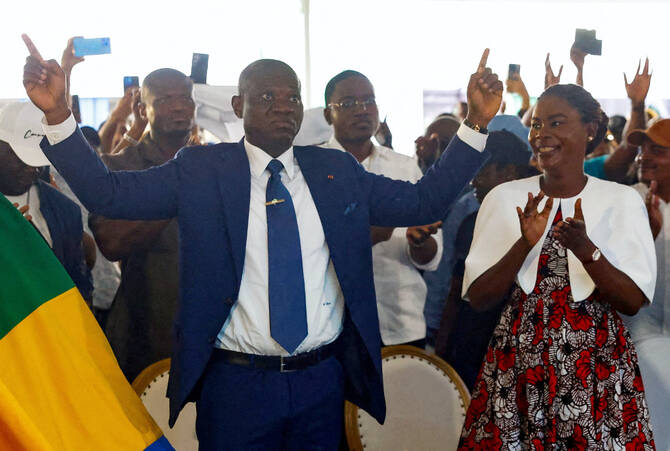
Gabon junta leader Brice Clotaire Oligui Nguema celebrates in Libreville, Gabon, after he was proclaimed winner in the country's presidential election on April 13, 2025. (Reuters)
Short Url
Updated 14 April 2025
Follow

Gabon junta chief Oligui Nguema wins presidential election deemed to be fair

  • Seeking to shed his military strongman image, Oligui allowed foreign and independent media to film the ballot count
  • The new president faces a litany of problems in the oil-rich country, from crumbling infrastructure to widespread poverty

LIBREVILLE: Junta chief Brice Oligui Nguema celebrated a huge victory in Gabon’s presidential election Sunday after provisional results gave him 90.35 percent of the vote.
Oligui, who ended more than five decades of corruption-plagued rule by the Bongo family in August 2023, assuming the role of transitional president, had promised to return the country to democratic rule.
“God does not abandon his people,” Oligui told hundreds of delighted supporters at his campaign headquarters, paying tribute to what he called “the maturity of the Gabonese people.”
Interior Minister Hermann Immongault said earlier that Oligui had won a seven-year mandate with more than 575,200 votes, or 90.3 percent, of the votes counted so far.
His main rival, Alain-Claude Bilie By Nze, took three percent of the vote and six other candidates failed to win more than 1 percent in Saturday’s election.
Even before the count was completed, the official Gabonese media had that announced Mr. Oligui was “far ahead.”
Voters in the nation of 2.3 million people flocked to the ballot boxes on Saturday to take part in an election officially marking the end of military rule. The interior ministry put the participation rate at 70.4 percent.
French President Emmanuel Macron congratulated Oligui on his win and the conduct of the election in a telephone call, his office said.

The day after voting, the streets of the capital Libreville were calm — in contrast with elections in 2016 and 2023 marked by tensions and unrest.
“I hadn’t voted in a long time, but this time, I saw a ray or something that made me go out and vote,” 58-year-old Olivina Migombe told AFP while en route to church on Sunday.
“I believe in change this time,” the professed Oligui voter added.
The new president faces a litany of problems in the oil-rich country, from crumbling infrastructure to widespread poverty, all while laboring under a crushing mountain of debt.
Oligui had sought to shed his military strongman image and even ditched his general’s uniform to run for a seven-year term.
The junta leader dominated the campaign, with his seven challengers, led by ousted leader Ali Bongo’s last prime minister, Alain-Claude Bilie By Nze, largely invisible by comparison.
Critics accuse Oligui of having failed to move on from the years of plunder of the country’s vast mineral wealth under the Bongos, whom he served for years.
For the first time, foreign and independent media were allowed to film the ballot count.
International observers at polling stations across the country did not see major incidents, according to first reports.
In total, some 920,000 voters were eligible to cast ballots at 3,037 polling stations, of which 96 were abroad.
Already, in the first results released by state media on Sunday morning, Oligui was the overwhelming favorite to win in around 30 polling stations, some of them returning results of 100 percent of the vote in his favor.


Belarus frees protest leader Kolesnikova, Nobel winner Bialiatski

Updated 6 sec ago
Follow

Belarus frees protest leader Kolesnikova, Nobel winner Bialiatski

  • The charismatic Kolesnikova was the star of the 2020 movement that presented the most serious challenge to Lukashenko in his 30-year rule
  • Bialiatski — a 63-year-old veteran rights defender and 2022 Nobel Peace Prize winner — is considered by Lukashenko to be a personal enemy

VILNIUS: Belarusian street protest leader Maria Kolesnikova and Nobel Prize winner Ales Bialiatski walked free on Saturday with 121 other political prisoners released in an unprecedented US-brokered deal.
Belarusian President Alexander Lukashenko has locked up thousands of his opponents, critics and protesters since the 2020 election, which rights groups said was rigged and which triggered weeks of protests that almost toppled him.
The charismatic Kolesnikova was the star of the 2020 movement that presented the most serious challenge to Lukashenko in his 30-year rule.
She famously ripped up her passport as the KGB tried to deport her from the country.
Bialiatski — a 63-year-old veteran rights defender and 2022 Nobel Peace Prize winner — is considered by Lukashenko to be a personal enemy. He has documented rights abuses in the country, a close ally of Moscow, for decades.
Bialiatski stressed he would carry on fighting for civil rights and freedom for political prisoners after his surprise release, which he called a “huge emotional shock.”
“Our fight continues, and the Nobel Prize was, I think, a certain acknowledgement of our activity, our aspirations that have not yet come to fruition,” he told media in an interview from Vilnius.
“Therefore the fight continues,” he added.
He was awarded the prize in 2022 while already in jail.
After being taken out of prison, he said he was put on a bus and blindfolded until they reached the border with Lithuania.
His wife, Natalia Pinchuk, told AFP that her first words to him on his release were: “I love you.”

- ‘All be free’ -

Most of those freed, including Kolesnikova, were unexpectedly taken to Ukraine, surprising their allies who had been waiting for all of them in Lithuania.
She called for all political prisoners to be released.
“I’m thinking of those who are not yet free, and I’m very much looking forward to the moment when we can all embrace, when we can all see one another, and when we will all be free,” she said in a video interview with a Ukrainian government agency.
Hailing Bialiatski’s release, the Nobel Committee told AFP there were still more than 1,200 political prisoners inside the country.
“Their continued detention starkly illustrates the ongoing, systemic repression in the country,” said chairman Jorgen Watne Frydnes.
EU chief Ursula von der Leyen said their release should “strengthen our resolve... to keep fighting for all remaining prisoners behind bars in Belarus because they had the courage to speak truth to power.”
Jailed opponents of Lukashenko are often held incommunicado in a prison system notorious for its secrecy and harsh treatment.
There had been fears for the health of both Bialiatski and Kolesnikova while they were behind bars, though in interviews Saturday they both said they felt okay.
The deal was brokered by the United States, which has pushed for prisoners to be freed and offered some sanctions relief in return.

- Potash relief -

An envoy of US President Donald Trump, John Coale, was in Minsk this week for talks with Lukashenko.
He told reporters from state media that Washington would remove sanctions on the country’s potash industry, without providing specific details.
A US official separately told AFP that one American citizen was among the 123 released.
Minsk also freed Viktor Babariko, an ex-banker who tried to run against Lukashenko in the 2020 presidential election but was jailed instead.
Kolesnikova was part of a trio of women, including Svetlana Tikhanovskaya who stood against Lukashenko and now leads the opposition in exile, who headed the 2020 street protests.
She was serving an 11-year sentence in a prison colony.
In 2020, security services had put a sack over her head and drove her to the Ukrainian border. But she ripped up her passport, foiling the deportation plan, and was placed under arrest.
Former prisoners from the Gomel prison where she was held have told AFP she was barred from talking to other political prisoners and regularly thrown into harsh punishment cells.
An image of Kolesnikova making a heart shape with her hands became a symbol of anti-Lukashenko protests.
Bialiatski founded Viasna in the 1990s, two years after Lukashenko became president.