

Japanese leader says he hopes Osaka expo will help reunite a divided world

1 / 3
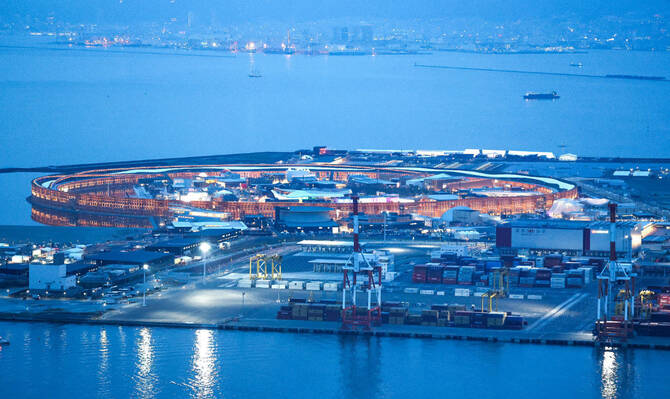
​ This overview image shows the "Grand Ring", made of wood, lit up at dusk on the eve of the opening of the 2025 Osaka Expo in Osaka on April 12, 2025. (JIJI PRESS photo via AFP)
2 / 3
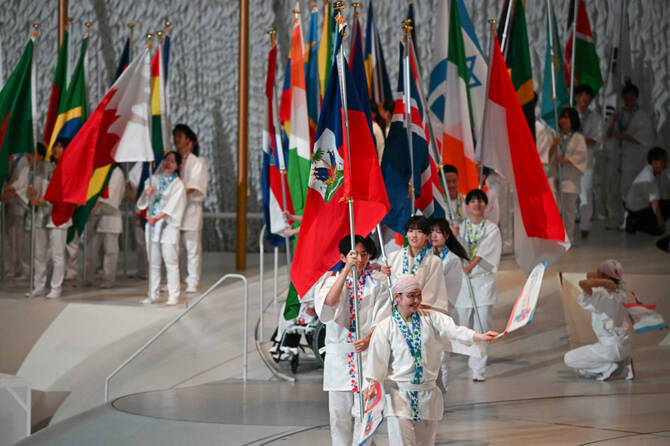
Flag-bearers walk on the stage during the official opening ceremony of the 2025 Osaka Expo in the city of Osaka on April 12, 2025, a day before the event opens to the public for six months. (AFP)
3 / 3
Short Url
Updated 13 April 2025
Follow

Japanese leader says he hopes Osaka expo will help reunite a divided world

  • Expo 2025 Osaka officially opened Sunday, with the theme of life, world and the future
  • It is Osaka’s second world expo after the 1970 event that scored a huge success and attracted 64 million visitors — a record until Shanghai in 2010

OSAKA, Japan: Japanese Prime Minister Shigeru Ishiba, speaking at Saturday’s opening ceremony for the Osaka expo, expressed his hope that the event will help restore global unity in a world plagued by conflicts and trade wars.
“The world, having overcome the coronavirus pandemic, is now threatened by an array of divisions,” Ishiba said. “At a time like this, it is extremely meaningful that people from around the world gather here and discuss the theme of life and experience cutting-edge technology, diverse ideas and culture.”
Expo 2025 Osaka officially opened Sunday, with the theme of life, world and the future, and Japan hopes to bring unity and portray a future society.
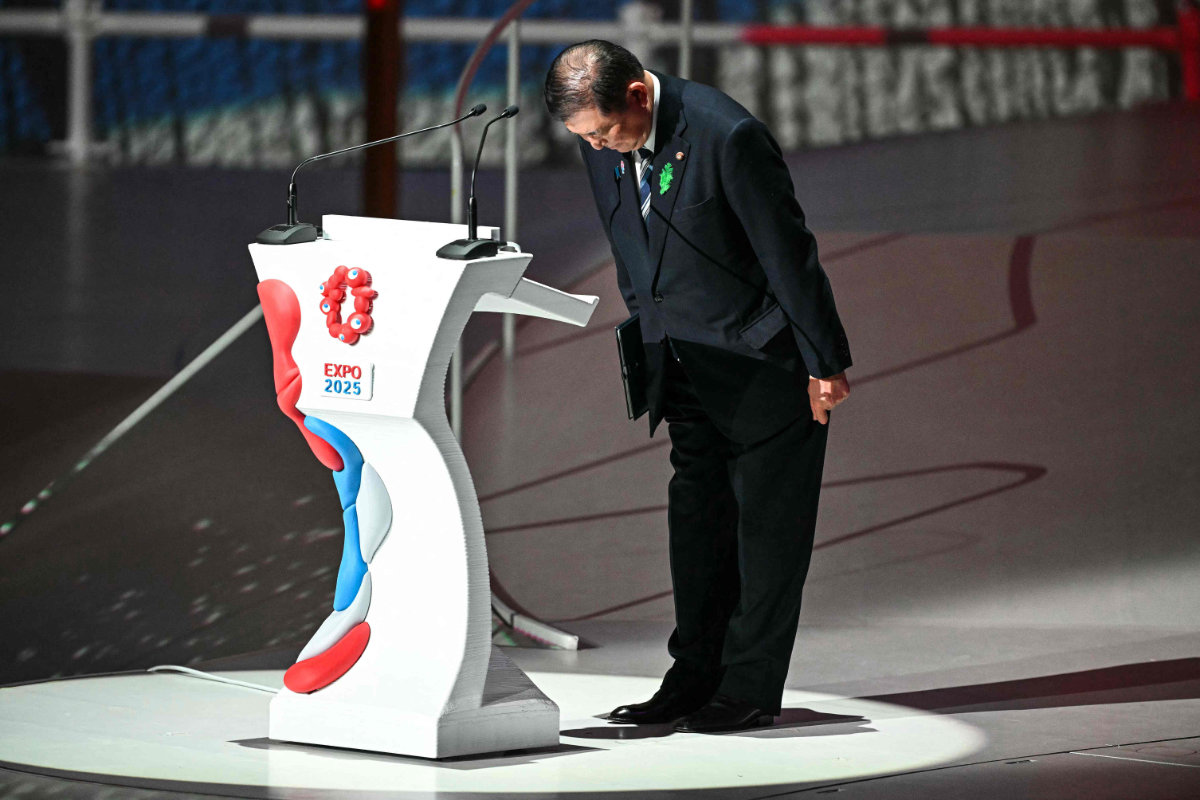


Japan's Prime Minister Shigeru Ishiba takes to the podium to deliver a speech at the official opening ceremony of the 2025 Osaka Expo in the city of Osaka on April 12, 2025, a day before the event opens to the public for six months. (AFP)

But the event’s celebrations have been somewhat dampened by US President Donald Trump’s recent tariff threats, which add to global tension and uncertainty, with Russia’s war in Ukraine and conflict in the Middle East dragging on.
Citing the expo’s iconic lattice-like wooden “Grand Ring,” which symbolizes unity and encircles the venue, Ishiba said: “I sincerely hope the world will unite again through interactions among countries and visitors in and outside of this ring.”
The costly ring, the world’s largest wooden architectural structure, is 20 meters (65 feet) high and has a 2-kilometer (1.2-mile) circumference.

During the six-month event on the reclaimed island and industrial waste burial site of Yumeshima, which means dream island, in the Osaka Bay, the city is hosting some 180 countries, regions and organizations showcasing their futuristic exhibits inside of about 80 pavilions of unique designs.
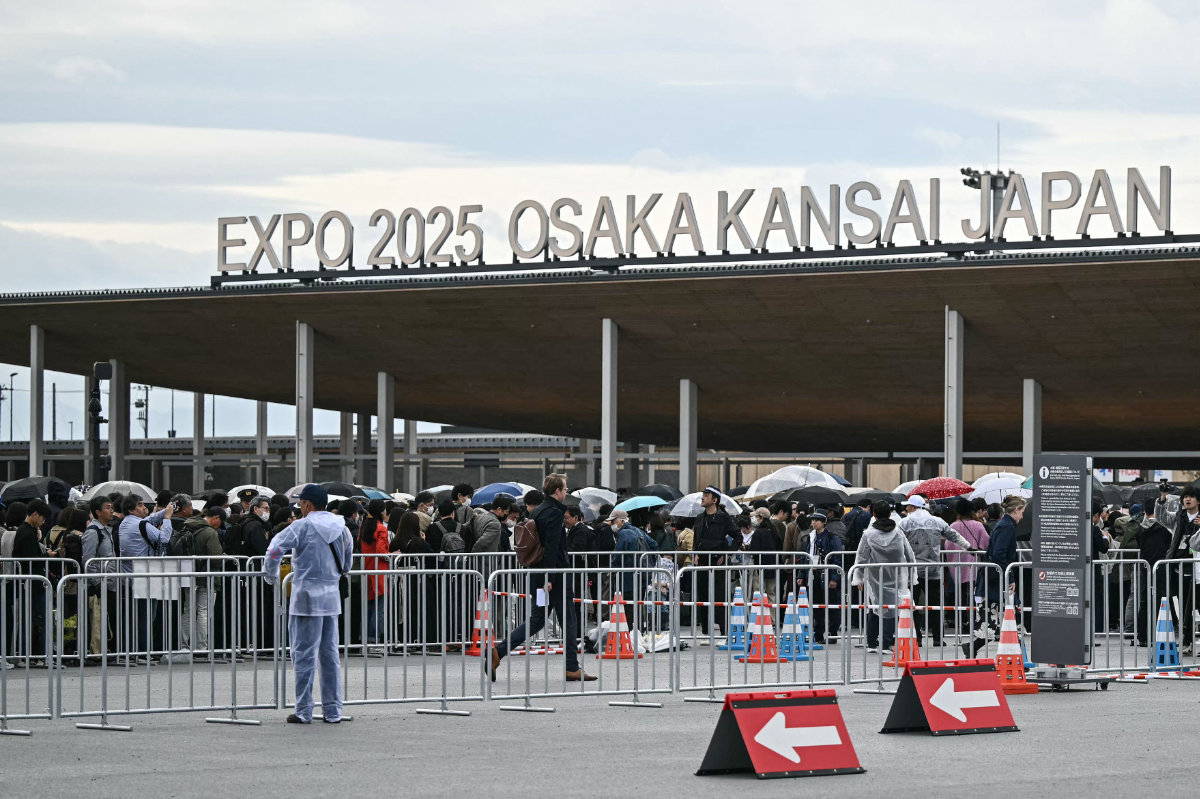


Visitors queue for the gates to open at 9 a.m. on the first day of the 2025 Osaka Expo in the city of Osaka on April 13, 2025. (AFP)

It is Osaka’s second world expo after the 1970 event that scored a huge success and attracted 64 million visitors — a record until Shanghai in 2010.
This time, Japan has faced dwindling public interest, and support and was hit by soaring construction costs due to the weaker yen. The cost nearly doubled from the initial estimate to 235 billion yen ($1.64 billion), about 14 percent of which went to the ring, triggering criticisms from many Japanese over the government’s use of their tax money.
The cost increase also caused construction delays for some countries. Several pavilions, including those of Nepal and India, were not quite ready Saturday. Conflicts also affected preparations for Ukraine and the Palestinians. Russia did not participate.


Signage that reads "not for sale" is seen above the Ukraine pavilion on the first day of the six-month 2025 Osaka Expo in the city of Osaka on April 13, 2025. (AFP)

Ticket sales have been slow. So far, 9 million advance tickets had been sold, far short of the organizers’ target of 14 million. Organizers hope to have more than 28 million visitors at the event that lasts through Oct. 13.

Emperor Naruhito, in his address at Saturday’s opening ceremony, recalled visiting the earlier expo as a fascinating experience for a then 10-year-old prince.
“I vividly remember how excited I was coming across the latest technology, playing with a wireless phone and looking at the moon rock,” brought back by the US Apollo 12 lunar mission, said the emperor, now 65.
Naruhito said he hoped the second Osaka expo would be as successful and expressed hope that children will learn more about people, regions and the world and think about future society by interacting with next-generation technologies and efforts for sustainable future.


Zelensky reaffirms his refusal to cede land to Russia as he rallies European support

Updated 4 sec ago
Follow

Zelensky reaffirms his refusal to cede land to Russia as he rallies European support

  • “Undoubtedly, Russia insists for us to give up territories. We, clearly, don’t want to give up anything. That’s what we are fighting for,” Zelensky says

ROME: Ukrainian President Volodymyr Zelensky has reaffirmed his strong refusal to cede any territory, resisting US pressure for painful concessions to Russia as he moved ahead Tuesday to rally more European support for his country.
“Undoubtedly, Russia insists for us to give up territories. We, clearly, don’t want to give up anything. That’s what we are fighting for,” Zelensky told reporters in a WhatsApp chat late Monday.
“Do we consider ceding any territories? According to the law we don’t have such right,” he said. “According to Ukraine’s law, our constitution, international law, and to be frank, we don’t have a moral right either.”
In an interview with Politico released Tuesday, US President Donald Trump pressed Zelensky to accept the US proposal that Ukraine cede territory to Russia, arguing Moscow has the “upper hand” in its nearly 4-year-old invasion, and that Zelensky’s government must “play ball.”
Zelensky met in Rome with Italian Premier Giorgia Meloni, discussing the progress of the peace process, her office said. They emphasized the importance of US and European unity and of solutions “that will have repercussions on the continent’s security,” the statement said.
They also discussed “developing robust security guarantees to prevent future aggression and maintaining pressure on Russia to join the negotiating table in good faith,” it said.
Earlier, Zelensky met with Pope Leo XIV at Castel Gandolfo, a papal residence outside Rome. The Vatican said Leo reiterated the need for continuing dialogue and “expressed his urgent desire that the current diplomatic initiatives bring about a just and lasting peace.”
The Holy See has tried to stay neutral in the war while offering solidarity and assistance to what it calls the “martyred” people of Ukraine. Leo has met three times with Zelensky and has spoken by telephone at least once with Russian President Vladimir Putin, calling for a ceasefire and urging Moscow to make gestures promoting peace.
On Monday, Zelensky held talks in London with British Prime Minister Keir Starmer, French President Emmanuel Macron and German Chancellor Friedrich Merz to strengthen Ukraine’s hand amid mounting impatience from Trump.
Ukraine faces US pressure
US and Ukrainian negotiators completed three days of talks Saturday aimed at trying to narrow differences on the Trump administration’s peace proposal.
A major sticking point is the suggestion that Kyiv must give up control of the Donbas region of eastern Ukraine to Russia, which occupies most but not all of the territory. Ukraine and its European allies firmly resist the idea of handing over land.
“You know, a lot of people are dying,” Trump told Politico on Monday, claiming that other Ukrainian officials that he identified only as Zelensky’s “lieutenants, his top people” agree with the US administration.
Other than Zelensky’s comments Monday, Ukrainian negotiators have said little in public about the content of the US proposal or their attitude toward it.
Speaking to reporters again Tuesday on WhatsApp, Zelensky said three documents were being discussed with American and European partners — a 20-point framework document that is constantly changing, a document on security guarantees and a document about Ukraine’s recovery.
Zelensky told reporters that Ukraine’s updated version of the proposal would be given to the US on Wednesday.
Russia, Trump said, is too powerful for Ukraine to continue fighting.
“I give the people of Ukraine and the military of Ukraine tremendous credit for the, you know, bravery and for the fighting and all of that,” he said. “But you know, at some point, size will win, generally.”
Trump also repeated his call for Ukraine to hold a presidential election even though martial law doesn’t allow it and Zelensky, elected in 2019, had his five-year term extended because of the war. Trump’s position on Ukraine’s failure to hold an election mirrors frequent statements on the subject by Putin.
Responding to Trump’s remarks, Zelensky asked for help from the US and possibly Europe “to ensure security for the elections” and suggested that Ukraine could be ready to hold balloting in 60 to 90 days.
In past comments, Zelensky has declined to hold elections until a ceasefire is declared and martial law lifted, and Ukrainians have largely supported that decision.
European leaders repeat support for Kyiv
Starmer, Macron and Merz strongly backed Kyiv, with the UK leader saying Monday that the push for peace was at a “critical stage” and stressing the need for “a just and lasting ceasefire.”
Merz, meanwhile, said he was “skeptical” about some details in documents released by the US “We have to talk about it. That’s why we are here,” he said. “The coming days … could be a decisive time for all of us.”
European leaders are working to ensure that any ceasefire is backed by solid security guarantees both from Europe and the US to deter Russia from attacking again. Trump has not given explicit guarantees in public.
Zelensky and his European allies have repeatedly accused Putin of slow-walking the talks to press ahead with the invasion.
Both sides exchange aerial strikes
Ukraine’s air force said Russia fired 110 drones across the country overnight. While air defenses neutralized 84 drones, 24 more struck their targets.
Several regions of Ukraine faced emergency blackouts Tuesday due to Russian attacks on energy infrastructure, according to Ukraine’s national energy operator, Ukrenergo.
UN deputy humanitarian chief Joyce Msuya said Tuesday only 65 percent of the $278 million required to fund a winter response plan in Ukraine has been received, forcing cuts to services like cash assistance, heating support, mental health care and protection for women and girls.
This means families are facing freezing temperatures without heating, women and girls are losing access to “safe spaces” and older people in front-line areas are left without the means to evacuate, she told the UN Security Council.
The UK Defense Ministry said a member of the British military died Tuesday of his injuries from an accident while observing Ukrainian troops test a defensive system away from the front lines — the first UK servicemember to die in Ukraine in the war. It was not immediately clear what role he was serving or where the accident occurred.
The UK military has said a small of number of personnel are in Ukraine to protect British diplomats and support Ukrainian troops.
Ukraine also continued its drone attacks on Russia.
Russia said it destroyed 121 drones in various regions and in the Crimean Peninsula, which Moscow illegally annexed from Ukraine in 2014. In Chuvashia, a region about 900 kilometers (about 560 miles) northeast of the Ukrainian border, an attack damaged residential buildings and injured nine people, Gov. Oleg Nikolayev said.
Ukraine’s Security Service carried out a drone attack on a liquefied gas terminal at the port of Temryuk in Russia’s Krasnodar region on Dec. 5, according to an official with knowledge of the operation who spoke to The Associated Press.
The official, who spoke on condition of anonymity because he was not authorized to comment publicly, said the strike sparked a fire at the facility, with more than 20 storage tanks set ablaze for over three days.