

From Dubai to Osaka to Riyadh: Expos mark decade of global dialogue, says UAE official
From Dubai to Osaka to Riyadh: Expos mark decade of global dialogue, says UAE official/node/2596650/middle-east
From Dubai to Osaka to Riyadh: Expos mark decade of global dialogue, says UAE official
1 / 2
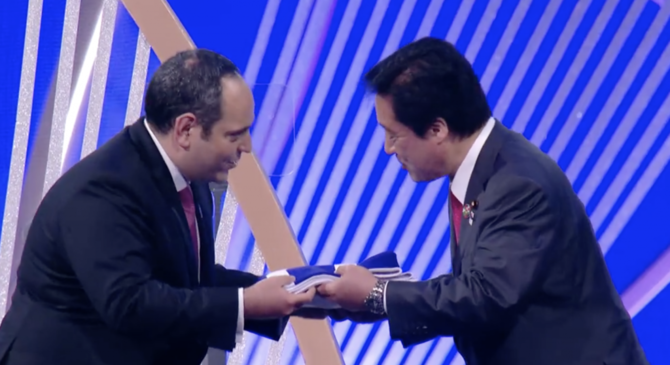
During the Dubai Expo 2020's closing ceremony on March 31, 2022, the BIE flag was handed to Japan’s delegation for the Expo 2025 Osaka, Kansai. (Screenshot)
2 / 2
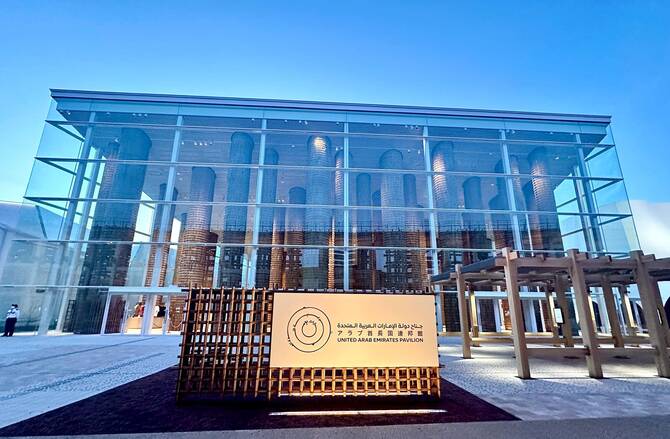
The UAE Pavilion at Expo 2025 Osaka, Kansai. (ANJ)
From Dubai to Osaka to Riyadh: Expos mark decade of global dialogue, says UAE official
UAE, Japan, and Saudi Arabia expos each bring distinct strengths and perspectives, says UAE official
Expo 2025 Osaka, Kansai will run from April 13 to Oct. 13
Updated 11 April 2025
Diana Farah
DUBAI: The move of expos from Dubai to Osaka and soon to Riyadh presents a “unique opportunity to shape a decade of global engagement” in the Middle East and Asia, according to Shihab Al-Faheem, the UAE pavilion commissioner general.
The sequence of the three locations “offers continuity for themes such as innovation, sustainability, and cultural dialogue,” Al-Faheem said in an interview with Arab News Japan.
“It also strengthens connections between our countries. The UAE, Japan, and Saudi Arabia each bring distinct strengths and perspectives,” he added. “By working together through these global platforms, we can create long-term partnerships that deliver meaningful outcomes for people and the planet.”
Al-Faheem, who is also the UAE’s ambassador to Japan, said the Osaka-Kansai Expo this year carries special meaning for the Gulf country.
The UAE’s first expo journey began in Osaka more than five decades ago, and the commissioner-general explained that returning to Japan was “an opportunity to continue engaging with the world and to contribute to shaping a future grounded in cooperation and collective progress.”
As the baton was passed from Dubai Expo 2020 to Osaka, Al-Faheem said the most important insight the UAE valued was that of creating experiences that are immersive, inclusive and people focused.
“We also learned that strong logistical planning and a flexible, responsive approach are essential to hosting a successful expo,” he told Arab News Japan. “We believe these lessons will resonate with Japan as it welcomes the world in 2025.”
When it comes to the UAE’s participation in Osaka this year, the country’s pavilion will continue its “immersive and multi-sensory journey” giving visitors a chance to “engage on an emotional and intellectual level.”
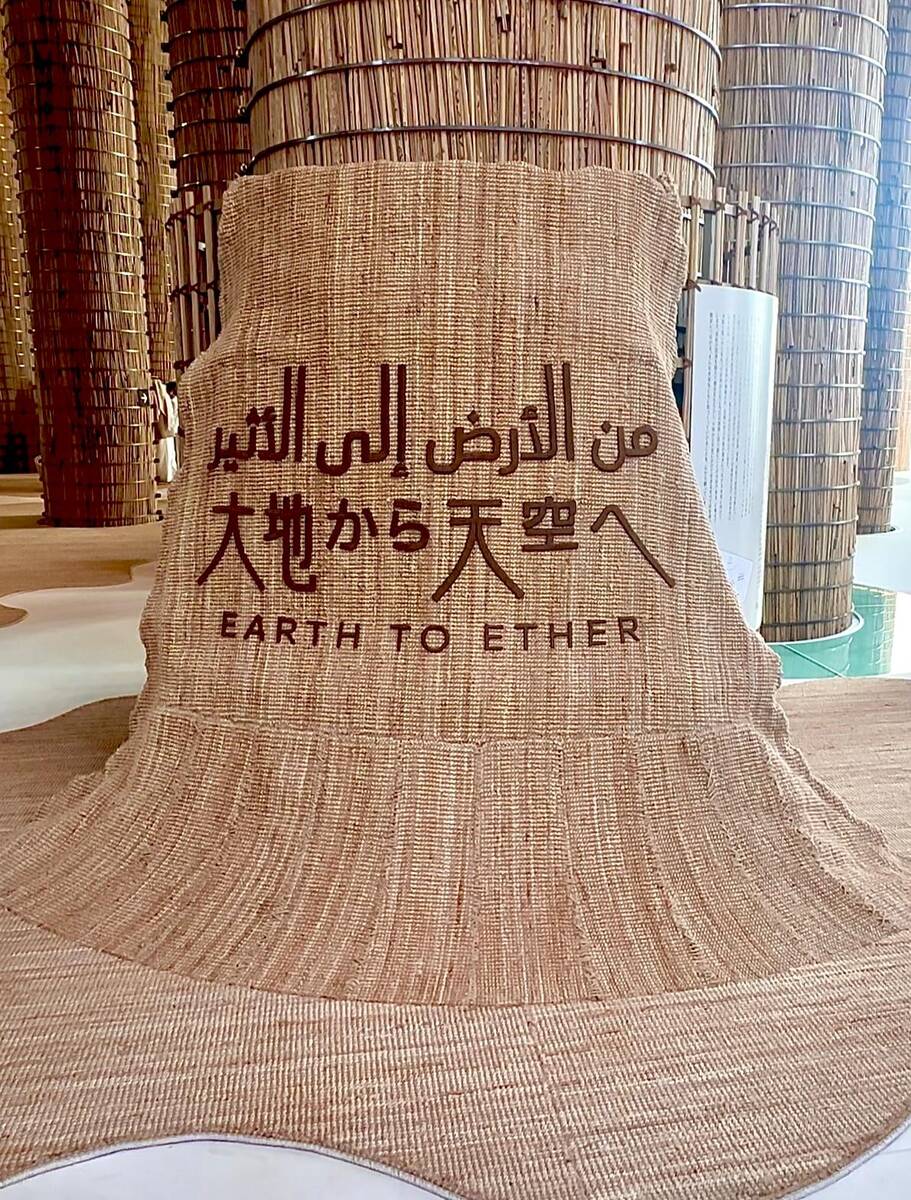
The UAE Pavilion’s theme is “Earth to Ether,” which expresses the Gulf country’s journey from a heritage rooted in the land to a future defined by innovation.
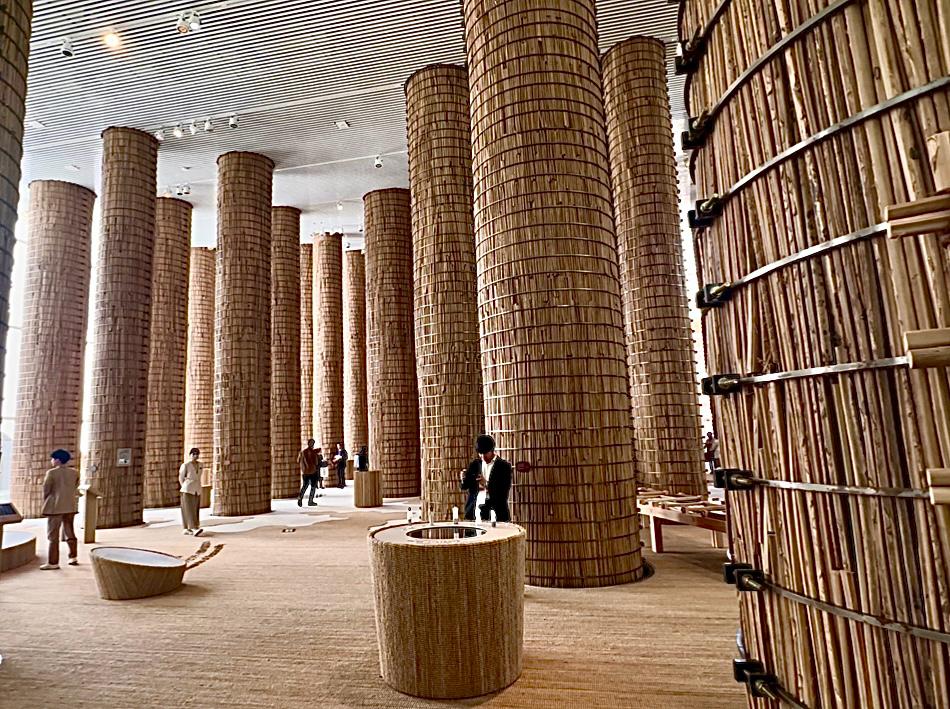
With sustainability and technology in mind, Al-Faheem said the pavilion uses eco-conscious materials such as Datecrete and palm-based architectural elements to reflect environmental values.
“The content of the pavilion also showcases our leadership in clean energy, smart healthcare, and space technologies,” the ambassador said.
The architectural design draws inspiration from traditional Emirati structures and uses materials from the date palm. Inside the pavilion, visitors will be able to experience stories that reflect the UAE’s values and vision for the future.
Given that the UAE and Japan have both hosted World Expos, Al-Faheem said that this has allowed the two countries to strengthen “an already deep and multifaceted relationship. These global events provide a powerful platform to showcase shared values and to develop partnerships across sectors such as energy, education, culture, and technology.”
The UAE Pavilion at Expo 2025 is expected to honor the relationship between the two countries and create new opportunities for joint initiatives.
Al-Faheem said he hopes that through the upcoming expo, the UAE will be able to deepen people-to-people ties with Japan and to create cultural and educational exchanges.
Expo 2025 Osaka, Kansai will run from April 13 to Oct. 13, with an official opening ceremony on April 12.
LONDON: Iran’s supreme leader, Ali Khamenei, was killed on Saturday along with much of the Iranian regime’s senior civilian and military leadership. But, thanks to Iran’s “mosaic” leadership structure, the regime itself is far from dead.
When Iran’s first supreme leader, Ayatollah Ruhollah Khomeini, died of natural causes in 1989, his successor, Khamenei, took office the very next day.
Now Khamenei is dead, killed along with dozens of members of his family and other senior Iranian leaders in a series of US and Israeli attacks on targets across Tehran. Days later, the succession question remains unanswered.
But this, experts suggest, does not mean that Iran is drifting rudderless in a power vacuum — or that cutting off the head will kill the snake.
“The Iranian regime is a system that was built to last,” said Dr Burcu Ozcelik, a senior research fellow at the London-based Royal United Services Institute.
“It has constitutional provisions in place and deep contingency planning, with four or five names for each key role, and so there was a high level of preparedness for a leadership decapitation campaign.”
Contingencies for just such an eventuality, which were first put in place at the end of the Iran-Iraq war in 1988, “were stepped up after Oct. 7, 2023, when the Iranians assessed that there would be a long-lasting confrontation with Israel.
“And although the attacks that followed didn’t lead to a regional confrontation of the sort we are seeing now, the Iranians have been long preparing for this.”
This combination of images shows (clockwise, from top left) smoke rising from a building hit in an Iranian missile and drone attack on March 1, flames and a black plume of smoke rising from a warehouse hit in a drone strike in Sharjah, UAE on March 1, a buildijg burning in Manama Bahrain. after a drone strike, and cars destroyed during a missile barrage in n Bnei Brak, Israel, on March 3, 2026. (REUTERS plhotos)
This is what Robert Pape, a professor of political science at the University of Chicago, specializing in international security affairs, characterized this week as “the mosaic regime.”
“Iran anticipated decapitation long before (the US operation) Epic Fury began,” he wrote on Substack.
“Under its ‘mosaic’ leadership defense doctrine, authority is dispersed into semi-autonomous cells across military, security, and political domains. Redundancy substitutes for hierarchy.”
Pape added: “Airpower kills leaders; it does not easily kill distributed function.”
This was reflected in comments from Mohammad Bagher Ghalibaf, the speaker of Iran’s parliament, who said the regime had “prepared for these moments” and had “planned for all scenarios.”
Indeed, despite multiple attacks by Israel and the US on senior civilian and military leadership, the drones and missiles keep coming across the Arabian Gulf.
The Iranian state “can be best described as polymorphous,” said Dr. Arshin Adib-Moghaddam, professor of global thought and comparative philosophies at the Department of Politics and International Studies at the School of Oriental and African Studies in London.
Western media, he added, “has a skewed understanding of the political dynamics in Iran and there is also a political agenda behind the misrepresentations.
“The tragedy is that this false reality informs decisions. This is why we are facing this horrific war. Bad, ideological knowledge created bad, impulsive decisions.”
Within Iran, he said, “there are several institutions that compete with each other and are anchored quite firmly in networks permeating society.”
At the heart of the system is the supreme leader, who supervises the other branches of government, including elected bodies such as the presidency, the Assembly of Experts and the parliament.
“And then there are the security layers, the military (Artesh), the Islamic Revolutionary Guard Corps and their underbellies — for instance the Basij units with their representation in every university, municipal council, large organizations and even the smallest villages of the country.”
In addition, “there are theological power centers in the Shiite-Islamic seminaries surrounding the holy sites in Mashhad and Qom.
“It is this polymorphic structure that explains why the Israel-US assassination campaign hasn’t disrupted the ability of Iran to govern the country, certainly for now.”
Sooner or later a new supreme leader will have to be appointed. The constitution of the Islamic Republic of Iran lays down a precise process.
In theory, a serving leader designates his preferred successor, whose appointment after his death is subject to approval by the Assembly of Experts — a panel of 88 Islamic jurists.
The Assembly of Experts building in Qom was itself struck on Tuesday as regime clerics were gathering to elect a new supreme leader, according to local media. At the time of writing, it was not immediately clear who was inside. If confirmed, the attack is likely to delay the process further.
“I don’t know that a date has been set,” said RUSI’s Ozcelik. “I think the language being used is that it would be ‘in the near future.’
“But there will be security concerns around a physical meeting of key clerical figures that would certainly be on the radar of American and Israeli intelligence and, given the circumstances, I think the regime can continue to justify not a delay but a considered longer timeline.”
This combination of images taken from a video circulated on social media shows the damaged building of the Assembly of Experts in Qom, Iran, after it was struck. (Social media)
It remains unknown who, if anyone, Khamenei had designated as his successor. If he had not, it might fall to the Assembly of Experts to pick someone.
The field of candidates is larger than it once was. Under the original terms of the constitution, framed after the 1979 revolution, a supreme leader had to be chosen from among the pool of Grand Ayatollahs.
That changed when Ayatollah Khomeini’s original choice to succeed him, Grand Ayatollah Hussein Ali Montazeri, fell out of favor and was dropped from the succession after he began to publicly criticize some of the violent excesses of the regime.
The constitution was then amended, opening up the field of succession beyond the limited cohort of Grand Ayatollahs, which allowed Khomeini to designate Khamenei as his successor. The Assembly of Experts endorsed his choice on June 3, 1989.
In the meantime, Iran is being run, as dictated by the constitution, by a three-man council. The council, which was formed on Sunday, consists of President Masoud Pezeshkian, judiciary chief Gholamhossein Mohseni Ejei, and senior cleric Alireza Arafi.
In theory, these are the men that US President Donald Trump would be talking to should the US decide to reopen negotiations. However, Tuesday’s attack on the Presidential Office suggests no one in the regime is safe.
“I don’t know if these three are actually targets,” said Ozcelik. “Although I think that would be consistent with what we’ve seen from the Israelis’ point of view.
“But I’m not sure how helpful it would be to take out a figure such as President Pezeshkian, who in Iranian terms is a moderate, and a potential point of contact with whom Trump and his administration could have talks going forward.
“And whenever this concludes, there will need to be someone in Tehran who is able to pick up the phone when Trump calls.”
Who that might be right now is as much a question of who remains alive as anything else, said Mona Yacoubian, director and senior adviser of the Middle East Program at the Center for Strategic and International Studies in Washington.
“I’m going to guess that the US would engage with those with whom they’ve engaged in the past, whether it’s Foreign Minister Abbas Araghchi, or possibly Ali Larijani, secretary of the Supreme National Security Council,” she said.
“Those are, I think, the two key people I would highlight, which doesn’t necessarily overlap with that Transitional Council.”
That said, as the death toll among Iranian leaders continues to mount, it could be that no one is now safe.
“And the message that sends is one of regime change,” said Yacoubian. “That’s what the US and Israel in particular have been focused on.
“We have heard President Trump, in one of his many different interactions with various members of the media, note that the US had identified successors, and that those successors had been killed.
“I think that about sums it up, and that’s why I think that any public naming of a supreme leader may not come for some time.”
She added: “In some ways, it’s not clear how important that is at this point. I think the focus in Iran right now is very much on maintaining regime cohesion, such as it exists.
“The military and security circles have long been engaged on these questions and have been thinking through this type of scenario planning.
“So I don’t know how significant it is that we have yet to hear of a new supreme leader being named because these other centers of power, which have long existed in Iran, were likely already planning for a post-Khamenei transition well before this current conflict started, and they are clearly still acting and working, perhaps in a decentralized way.
“So yes, there have been decapitation strikes. But what that actually means in terms of how the system in Iran is operating is unclear.”