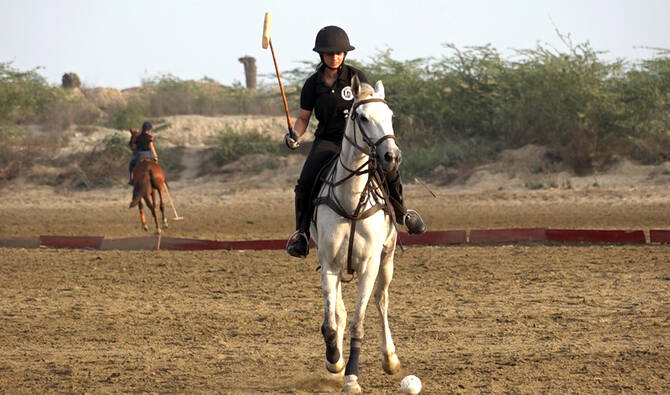
KARACHI: With the Arabian Sea breeze sweeping across the field and the clip-clop of hooves pounding on turf, Naziha Hassan leans low off her saddle, eyes fixed on the white ball, her hammer slicing through the air. In one motion, she sends the ball flying between the goalposts of Karachi’s Clifton Polo Ground, a makeshift arena bordered by high-rises on one side and the beach on the other.
In a city known more for its craze for traditional sports like cricket and football, this unlikely seaside field is home to a rare sight: women competing alongside men in polo.
Once a royal pastime in South and Central Asia, polo was seen as a proving ground for valor and strategy. Traditionally considered a men’s sport, it served not only as recreation but also as a means of training cavalry, developing horsemanship and preparing warriors and noblemen for combat.
“I haven’t felt that they’re going easy on me,” Hassan said of being treated differently by male players.
“I don’t think I was ever treated like a girl in the game... if they have to hit me, ride off, to make me fall, they will make me fall and that is perfectly fine,” she told Arab News.
A doctor by profession, Hassan became passionate about polo when she would go to school in Islamabad and stop by the polo club on her way back home, looking at horses.
After relocating to Karachi, she joined the Gallop Club five years ago to take riding lessons before making her way into polo, a high-speed sport where riders clash mid-play, horses collide and players often fall.
For Hassan and her fellow female players, polo’s appeal goes beyond gender. It’s about the skills, the connection with horses and the strategy. Skill and mental sharpness, they say, often outweigh brute strength.
“I don’t think gender makes a difference in the sport, to be fair,” she said. “Yes, there are some things [like] the physical strength and stuff that sometimes is important, but at the same time, like, polo is a bit different because in polo it depends on the horse a lot also. It also depends on your strategy as well.”
That view is shared by a long-time male player at the club who identified himself as Siavash.
“We absolutely don’t care for them [as female players] here,” he said.
“When you’re playing the game, you only see the other person as a player. And if you start thinking that she’s a female, then basically, they won’t let you play,” he said with a smile.
On the field, players engage fiercely and focus purely on the game. Any suggestion of treating female players differently is brushed aside.
“In polo, we say 70 percent of the game is the horse,” Siavash added. “If a girl plays well and rides a good horse, then she’s a proper player. Some girls even play better than men. It’s about your riding, your swing and your strategy, not just strength.”
Alishba Ahsan, another regular on the field, admits it’s a tough space for women, but she embraces the challenge.
“There are barely three or four girls playing here, including me,” she said. “It’s tough, but it’s also a very good experience. You don’t get any leverage for being a girl. You ride and play just like the boys.”
Ahsan, a law student, said she had fallen five or six times, but instead of backing out, she became more determined.
Off the field, the sport is also inspiring a new generation.
Ayesha Naveed, a stay-at-home mother of a first-grade student, said her journey onto the polo field began with her daughter’s interest in horse riding. She initially accompanied her to practice, but later decided to join in herself.
“I want her to become a good polo player someday,” she said of her daughter. “It makes me really happy to see that this is a sport where everyone plays together … There is no segregation like ‘this is the women’s team’ or ‘this is the men’s team.’ And the women are actually doing even better than the men.”
Her daughter, Alaya Naveed, takes riding lessons twice a week after school. She has already mastered the basics — walk, trot and even how to fall properly.
“I only come here on Tuesdays and Thursdays,” Alaya said, her eyes gleaming. “I would like to play polo because I see the other girls and it looks fun.”
“I think it’ll take me ten more months to be a polo player,” she said after a brief pause, with childlike innocence.


![]()

Chasing goals: Women in Karachi take the reins alongside men in polo
Short Url
https://arab.news/4wh5d
Chasing goals: Women in Karachi take the reins alongside men in polo
- Traditionally considered a men’s sport, polo was seen as a proving ground for valor and strategy
- Female players say skill and mental sharpness often outweigh brute strength while playing polo
Latest updates



© 2026 SAUDI RESEARCH & PUBLISHING COMPANY, All Rights Reserved And subject to Terms of Use Agreement.