

Saudi Foreign Minister says aid entry to Gaza cannot be linked to ceasefire

1 / 4
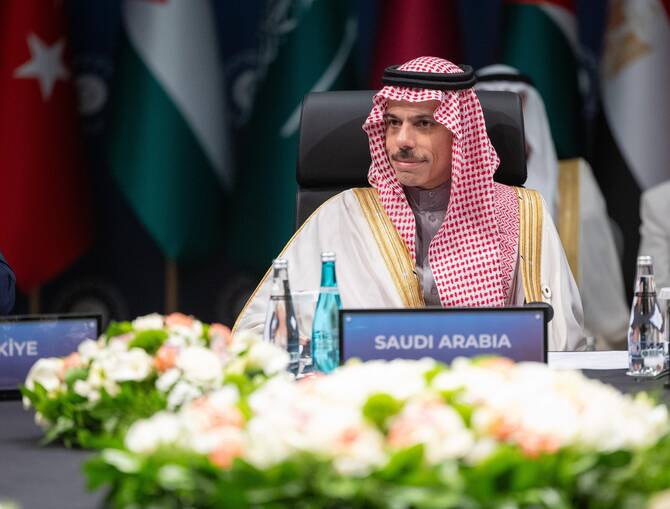
Bin Farhan said the international community must pressure the Israeli government to allow aid deliveries to Gaza. (SPA)
2 / 4
Bin Farhan said the international community must pressure the Israeli government to allow aid deliveries to Gaza. (SPA)
3 / 4
Bin Farhan said the international community must pressure the Israeli government to allow aid deliveries to Gaza. (SPA)
4 / 4
Bin Farhan said the international community must pressure the Israeli government to allow aid deliveries to Gaza. (SPA)
Short Url
Updated 11 April 2025
Follow

Saudi Foreign Minister says aid entry to Gaza cannot be linked to ceasefire

  • Prince Faisal bin Farhan said international community must pressure Israel to allow aid deliveries
  • Rejected any proposal related to the displacement of Palestinians from their land

ANTALYA: Saudi Arabia’s Foreign Minister Faisal bin Farhan said on Friday aid entry to Gaza cannot be linked to a ceasefire.

Prince Faisal also said the international community must pressure the Israeli government to allow aid deliveries to Gaza. 

The Saudi minister was speaking at a joint press conference in Antalya following a meeting of the Arab-Islamic Ministerial Committee on a Gaza ceasefire, which discussed developments in the enclave, as well as efforts to achieve an immediate and sustainable ceasefire.


The meeting also emphasized the need for efforts to continue to enable the Palestinian people to exercise their inherent rights. 

Prince Faisal said any displacement of Palestinians was categorically rejected. He added that the Kingdom appreciated the efforts of Egypt and Qatar in the ceasefire negotiations.

“We categorically reject any proposal related to the displacement of Palestinians from their land, this applies to all forms of displacement, he said.

“There are some who attempt to describe certain types of Palestinian departures as "voluntary," but you cannot speak of voluntary departure while Palestinians in Gaza are being deprived of the most basic necessities of life.

“If aid is not getting in, if people are unable to find food, water, or electricity, and if they are under constant threat of military bombardment — then even if someone is forced to leave, this is not a voluntary departure. This is a form of coercion,” he added.

He also said that any proposal that tried to frame the departure of Palestinians — or what is called “allowing the opportunity” for voluntary departure under these circumstances — was “simply a distortion of the truth.”

He continued: “The reality is that Palestinians in Gaza are being deprived of the most basic requirements for life. That’s why we must continue to clarify this reality, work consistently, and we hope this message is clear to everyone, especially within the framework of the action plan we agreed upon today in the committee.”

The minister also condemned Israeli violations of international law in the West Bank, including settlement expansion, home demolitions, and land seizures.


14 sculptures go on display at public spaces in Riyadh

Updated 11 December 2025
Follow

14 sculptures go on display at public spaces in Riyadh

  • The works were chosen by Riyadh Art from its international Tuwaiq Sculpture symposium to reflect its ‘vision of weaving beauty and intellect into the city’s fabric’
  • Initiative aligns with efforts to make art a key part of city’s identity that improves quality of life and promotes the cultural economy, says Royal Commission for Riyadh City’s Khalid Al-Hazani

RIYADH: Fourteen sculptures selected from the annual international Tuwaiq Sculpture symposium, a Riyadh Art program, went on display on Wednesday at three prominent public spaces across the Saudi capital: ROSHN Front, the SEDRA residential community, and Sports Boulevard.

The project is part of Riyad Art’s efforts to showcase artworks in public spaces, and the addition of more works in other places is expected later.

Khalid Al-Hazani, the executive vice president of the lifestyle sector at the Royal Commission for Riyadh City, said: “This step reflects (Riyadh Art’s) vision of weaving beauty and intellect into the city’s fabric, and creating vibrant and culturally rich public spaces, allowing art to become an integral part of people’s daily lives.”

It is also in line with Riyadh Art’s broader strategy for transforming the city into an open-air art gallery, he added, thereby “turning art into a central element of the city’s identity and a key contributor to improving quality of life and promoting the cultural economy.” 

The Riyadh Art Program installed on Wednesday 14 sculptures selected from the Tuwaiq International Sculpture Symposium at prominent locations in Riyadh, including the ROSHN Front, SEDRA Residential Community, and Sports Boulevard. (Supplied)

The three chosen locations were considered perfect places to host the artworks because of their vibrancy, strong community connections and accessibility, Al-Hazani noted.

“This provides residents and visitors with the opportunity to engage with the sculptures in their everyday lives,” he said.

Seven of the sculptures have been installed at ROSHN Front, considered a key urban hub. The artworks on display there form a thought-provoking artistic landscape that encourages interaction, organizers said, and explores a number of themes including the values of urban transformation, community spirit, and creative curiosity.

Three sculptures are on display at the SEDRA residential community. Chosen to complement its serene character and nature-integrated urban planning, they blend in with their surroundings to reflect the values of environmental harmony, contemplation and renewal, organizers explained.

The remaining four sculptures are at Sports Boulevard, known for its open, green spaces. These works reflect several concepts, in particular ideas of nature, balance and public health.

All of the sculptures are part of Riyadh Art’s permanent collection, which includes works created by local and international artists during the Tuwaiq Sculpture symposium.
