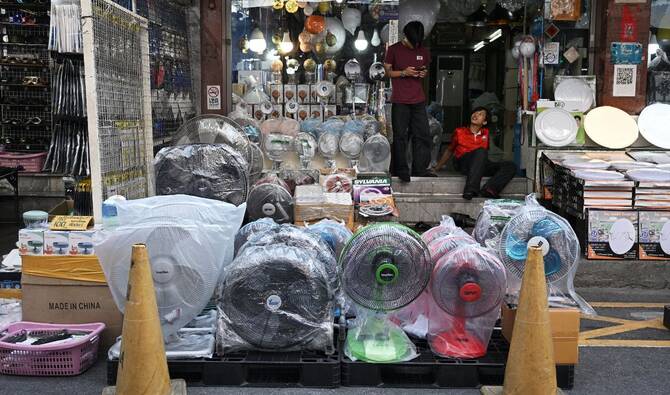
KARACHI: Pakistan’s Finance Minister Muhammad Aurangzeb on Friday hinted at the export of locally produced electric fans with new and improved technology to Gulf and African countries, saying it could potentially boost the country’s export economy.
Pakistan’s fan industry is primarily concentrated in the Punjab cities of Gujranwala and Gujrat, both of which play a key role in domestic production through numerous small and medium enterprises. The country’s leading brands in the sector are all based in these two urban centers, supplying products nationwide.
The finance minister’s statement comes as Pakistan looks to diversify its export base and reduce reliance on traditional sectors like textiles. With energy-efficient appliances such as fans in growing demand globally, particularly in warmer regions like the Gulf and Africa, the government is exploring ways to modernize local manufacturing and align with international standards to reinvigorate industrial output and foreign exchange earnings.
“We are looking forward for these products to not only be used in Pakistan but also have a very good market share in the exports market going forward,” Aurangzeb said while speaking on the sidelines of the “Made in Gujranwala Exhibition” at a local hotel in Islamabad.
“Our efforts now should be to take it to the exports level if we have this much productivity and it is internationally competitiveness as well,” he continued, adding it was important to figure out “how we have to take this initiative ahead to move old fans and the new technology forward.”
According to the Pakistan Bureau of Statistics, Pakistan’s exports rose by 11 percent to $30.7 billion in the last fiscal year ending June 2024. As of March this year, the country has exported $24.7 billion worth of goods, marking an eight percent increase compared to the same period a year earlier.
Aurangzeb said African and Gulf markets were ideal for the export of Pakistani products.
“We have to move toward an export-led growth,” he noted, assuring businesses of the full support of the finance ministry. “Every single sector in this country has to export.”
The government is working to revive Pakistan’s economy with the help of the International Monetary Fund (IMF). The IMF’s executive board is expected to approve a $1 billion tranche for Pakistan under its new loan program in the coming weeks.

Pakistan eyes fan exports to Gulf, Africa in push to boost economy
https://arab.news/ryr65
Pakistan eyes fan exports to Gulf, Africa in push to boost economy
- Muhammad Aurangzeb calls for enhanced productivity to compete in global markets
- Pakistan’s exports rose 8 percent to $24.7 billion in the current fiscal year through March
Tens of thousands flee northwest Pakistan over fears of military operation
- More than 70,000 people, mostly women and children, have fled remote Tirah region bordering Afghanistan
- Government says no military operation underway or planned in Tirah, a town in Khyber Pakhtunkhwa province
BARA, Pakistan: More than 70,000 people, mostly women and children, have fled a remote region in northwestern Pakistan bordering Afghanistan over uncertainty of a military operation against the Pakistani Taliban, residents and officials said Tuesday.
Pakistan’s Defense Minister Khawaja Mohammad Asif has denied the claim by residents and provincial authorities. He said no military operation was underway or planned in Tirah, a town in Khyber Pakhtunkhwa province.
Speaking at a news conference in Islamabad, he said harsh weather, rather than military action, was driving the migration. His comments came weeks after residents started fleeing Tirah over fears of a possible army operation.
The exodus began a month after mosque loudspeakers urged residents to leave Tirah by Jan. 23 to avoid potential fighting. Last August, Pakistan launched a military operation against Pakistani Taliban in the Bajau r district in the northwest, displacing hundreds of thousands of people.
Shafi Jan, a spokesman for the provincial government in Khyber Pakhtunkhwa, posted on X that he held the federal government responsible for the ordeal of the displaced people, saying authorities in Islamabad were retracting their earlier position about the military operation.
Khyber Pakhtunkhwa Chief Minister Suhail Afridi, whose party is led by imprisoned former Prime Minister Imran Khan, has criticized the military and said his government will not allow troops to launch a full-scale operation in Tirah.
The military says it will continue intelligence-based operations against Pakistani Taliban, who are known as Tehrik-e-Taliban Pakistan, or TTP. Though a separate group, it has been emboldened since the Afghan
Taliban returned to power in 2021. Authorities say many TTP leaders and fighters have found sanctuary in Afghanistan and that hundreds of them have crossed into Tirah, often using residents as human shields when militant hideouts are raided.
Caught in the middle are the residents of Tirah, who continued arriving in Bara.
So far, local authorities have registered roughly 10,000 families — about 70,000 people — from Tirah, which has a population of around 150,000, said Talha Rafiq Alam, a local government administrator overseeing the relief effort. He said the registration deadline, originally set for Jan. 23, has been extended to Feb. 5.
He said the displaced would be able to return once the law-and-order situation improves.
Among those arriving in Bara and nearby towns was 35-year-old Zar Badshah, who said he left with his wife and four children after the authorities ordered an evacuation. He said mortar shells had exploded in villages in recent weeks, killing a woman and wounding four children in his village. “Community elders told us to leave. They instructed us to evacuate to safer places,” he said.
At a government school in Bara, hundreds of displaced lined up outside registration centers, waiting to be enrolled to receive government assistance. Many complained the process was slow.
Narendra Singh, 27, said members of the minority Sikh community also fled Tirah after food shortages worsened, exacerbated by heavy snowfall and uncertain security.
“There was a severe shortage of food items in Tirah, and that forced us to leave,” he said.
Tirah gained national attention in September, after an explosion at a compound allegedly used to store bomb-making materials killed at least 24 people. Authorities said most of the dead were militants linked to the TTP, though local leaders disputed that account, saying civilians, including women and children, were among the dead.


