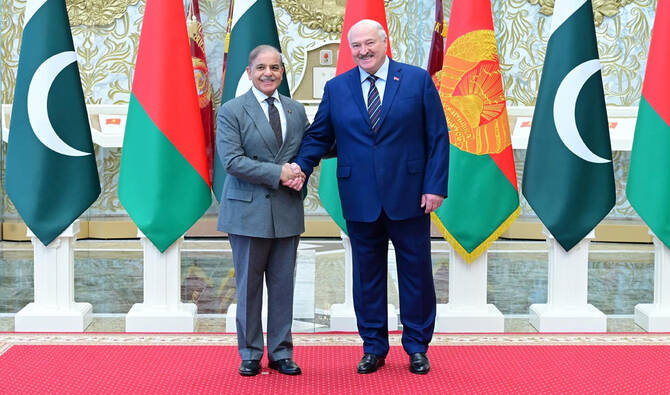

ISLAMABAD: Pakistan and Belarus on Friday signed a series of agreements and memorandums of understanding (MoUs) aimed at enhancing cooperation across sectors such as defense, commerce and environmental protection, state-run APP news agency said.
Pakistani Prime Minister Shehbaz Sharif is on an official visit to the Republic of Belarus during which he held talks with President Aleksandr Lukashenko on Friday to review progress on bilateral cooperation. Delegation-level talks were also held between the two sides encompassing discussions on bilateral cooperation as well as regional and international issues.
Over the past six months, a series of high-level bilateral engagements, including the 8th Session of the Joint Ministerial Commission (JMC) in February 2025 and a subsequent visit by a high-powered mixed ministerial delegation to Belarus in April 2025, have laid the groundwork for Sharif’s visit.
“The governments of Pakistan and Belarus signed a Readmission Agreement as well as an Agreement on Cooperation between the interior ministries of two countries,” APP said, saying another agreement was signed on cooperation between the defense ministries of the two countries.
“The two sides signed a Program (Roadmap) of the Military-Technical Cooperation between the State Authority for Military Industry of the Republic of Belarus and the Ministry of Defense Production for 2025-2027,” APP added.
“Bilateral accords were also signed for cooperation on environmental protection, postal services, business support, trade development and cooperation between trade bodies.”
Pakistan has moved in recent months to increase trade and economic cooperation with landlocked Central Asian republics and other states, hoping to leverage its strategic position as a key trade and transit hub to connect these nations to the global market, while earning much-needed foreign exchange.
Speaking at a ceremony during his visit, Sharif said Belarus was very strong in manufacturing of equipment used in mining, emphasising a closer collaboration between the two countries.
“I think there is no reason why we shouldn’t benefit from your experience because Pakistan, by the grace of God, has mineral deposits to the tune of trillions of dollars,” he said.
The prime minister maintained an air link between the two state could prove pivotal in further strengthening their partnership. He also thanked President Aleksandr Lukashenko for allowing nearly 150,000 young, highly skilled Pakistan laborers to contribute in nation building efforts in Belarus.
Sharif also spoke of strengthening Pakistan’s agriculture sector with mutual cooperation, saying 65 percent of the country’s population lived in rural areas.
“We need your expertise,” he said. “We need to have joint ventures between Belarus and Pakistani companies to manufacture agricultural equipment in Pakistan so we can offer to the farmers at very economical rates, both companies from Belarus and Pakistan, they will have win-win situation.”
Pakistan-Belarus Business Forum
Corresponding with Sharif’s arrival, the second Pakistan-Belarus Business Forum was held on Thursday in Minsk, marking a “significant step toward strengthening bilateral trade and economic cooperation between the two countries,” state-owned Pakistan Television reported.
Senior government officials, business leaders and other key stakeholders from both nations attended.
In recent years, the volume of trade between Belarus and Pakistan has ranged between $50 to 65 million annually, according to foreign office data.
“Our presence here is part of a journey that reflects the evolving and deepening partnership between our two countries,” Pakistani Commerce Minister Jam Kamal Khan said as he addressed the forum.
He said the eighth session of the Pakistan-Belarus Joint Ministerial Commission (JMC), held earlier this year in Minsk, had opened “new avenues of cooperation” in sectors such as trade, agriculture, education, technology, and pharmaceuticals, emphasizing that both governments were committed to removing trade barriers and promoting involvement of the private sector.
Discussing potential trade opportunities, Khan identified key areas for joint ventures including textile machinery, agro-processing, pharmaceuticals, renewable energy, information technology, and e-commerce.
He also announced recent cooperation agreement between the Trade Development Authority of Pakistan (TDAP) and the Belarusian Chamber of Commerce and Industry (BelCCI), describing it as an active platform for trade promotion and partnership development.
Khan invited Belarusian investors to explore opportunities in Pakistan’s Special Economic Zones, saying they offered attractive incentives and access to markets of over three billion people. He also noted the recent reduction in Pakistan’s energy tariffs as an additional facilitative measure for investment.
“Today’s forum is not just a ceremonial gathering but a practical advancement. We are witnessing the signing of a cooperation agreement between TDAP and BelCCI that will provide an institutional foundation. This includes participation in trade exhibitions, B2B events, exchange of market intelligence, and facilitation of sector-specific delegations,” Chief Executive of the Trade Development Authority, Faiz Ahmed, said in his address at the business forum.
“This formal collaboration will ensure that the momentum created today translates into tangible outcomes in the coming months.”