

Pakistan army says ‘high value’ militant among two killed in northwest operation

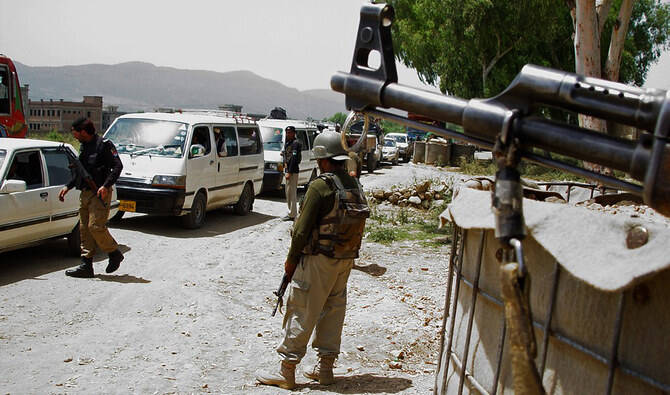
In this file picture, taken on June 17, 2014, Pakistani security personnel keep watch at a checkpoint in Hangu, a town in the Khyber Pakhtunkhwa province. (AFP/File)
Short Url
Updated 11 April 2025
Follow

Pakistan army says ‘high value’ militant among two killed in northwest operation

  • Army conducts frequent operations against militants it claims launch attacks from safe havens in Afghanistan
  • Militants have intensified attacks on army and its bases since breaking ceasefire with government in late 2022

ISLAMABAD: The Pakistan Army said on Friday a “high-value target” was among two militants killed in an intelligence-based operation in the Lower Dir district of the northwestern Khyber Pakhtunkhwa province.

In recent months, the military has launched frequent operations in the restive Khyber Pakhtunkhwa province bordering Afghanistan. The army’s target in the area are militants it says launch attacks inside Pakistan and against the army using safe havens in Afghanistan, a charge Kabul denies. 

Groups like the Pakistani Taliban, commonly known as Tehreek-e-Taliban Pakistan (TTP), have been waging a war against the Pakistani state for nearly two decades in a bid to overthrow the government and replace it with what they consider an Islamic system of governance.

“During the conduct of operation, own troops surrounded and effectively engaged the khwarij (terrorist) location and after an intense fire exchange, two khwarij including high value target Kharji Hafeezullah alias Kochwan were sent to hell,” the military said of the latest operation.

The army said Hafeezullah was involved in numerous militant activities targeting security forces and civilians and was wanted by law enforcement agencies, with a $35,714 (Rs10 million) bounty placed on his head by the government.

Earlier this week, the army said it had killed another “highly wanted” militant among nine others also in an intelligence-based operation in the Khyber Pakhtunkhwa province.

Militants have intensified their attacks since revoking a ceasefire with the government in late 2022, with recent months witnessing significant strikes targeting the military and its bases.


Pakistan urges pilgrims to complete Saudi biometrics as Hajj preparations gain pace

Updated 30 January 2026
Follow

Pakistan urges pilgrims to complete Saudi biometrics as Hajj preparations gain pace

  • Government warns pilgrims biometric verification is required for Hajj visas
  • Step follows tighter oversight after last year’s Hajj travel disruptions

ISLAMABAD: Pakistan’s government on Friday urged aspiring pilgrims to complete mandatory Saudi biometric verification for Hajj visas, as preparations for the 2026 pilgrimage gather pace following stricter oversight of the Hajj process.

The announcement comes only a day after Pakistan’s Religious Affairs Minister Sardar Muhammad Yousuf said regulations for private Hajj operators had been tightened, reducing their quota following widespread complaints last year, when tens of thousands of pilgrims were unable to travel under the private Hajj scheme.

“Saudi biometric verification is mandatory for the issuance of Hajj visas,” the Ministry of Religious Affairs said in a statement, urging pilgrims to complete the process promptly to avoid delays.

“Hajj pilgrims should complete their biometric verification at home using the ‘Saudi Visa Bio’ app as soon as possible,” it added.

The statement said the pilgrims who were unable to complete biometric verification through the mobile application should visit designated Saudi Tasheer centers before Feb. 8, adding that details of the centers were available on Pakistan’s official Hajj mobile application.

Pakistan has been steadily implementing digital and procedural requirements for pilgrims ahead of Hajj 2026, including mandatory training sessions, biometric checks and greater use of mobile applications, as part of efforts to reduce mismanagement.

Saudi Arabia has allocated Pakistan a quota of 179,210 pilgrims for Hajj 2026, with the majority of seats reserved under the government scheme and the remainder allocated to private tour operators.