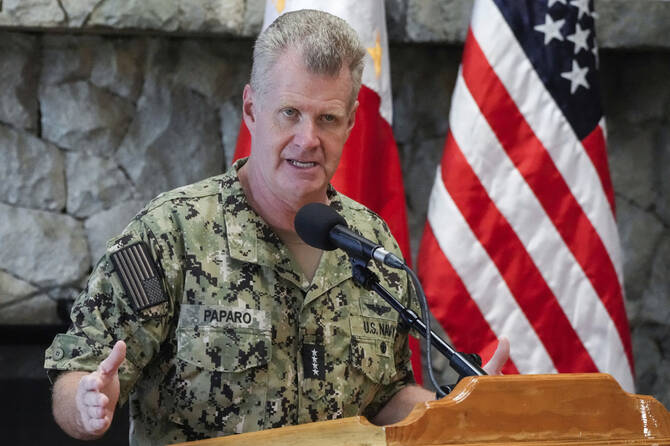
WASHINGTON: The top US commander in the Pacific warned senators Thursday that the military support China and North Korea are giving Russia in its war on Ukraine is creating a security risk in his region as Moscow provides critical military assistance to both in return.
Admiral Samuel Paparo, head of US Indo-Pacific Command, told the Senate Armed Services Committee that China has provided 70 percent of the machine tools and 90 percent of the legacy chips to Russia to help Moscow “rebuild its war machine.”
In exchange, he said, China is potentially getting help in technologies to make its submarines move more quietly, along with other assistance.
Senators pressed Paparo and Gen. Xavier Brunson, commander of US Forces Korea, on China’s advances in the region, including threats to Taiwan. And they also questioned both on the US military presence in South Korea, and whether it should be shielded from personnel cuts..
Both said the current US force there and across the Indo-Pacific is critical for both diplomacy in the region and America’s national security, as ties between Russia and China grow. The US has 28,500 forces in South Korea.
Paparo said North Korea is sending “thousands, maybe hundreds of thousands of artillery shells” and hundreds of short-range missiles to Russia. The expectation, he said, is that Pyongyang will get air defense and surface-to-air missile support.
“It’s a transactional symbiosis where each state fulfills the other state’s weakness to mutual benefit of each state,” Paparo said.
In his opening comments, Sen. Roger Wicker of Mississippi, the Republican committee chairman, said the greater alignment of Russia, China and North Korea “should be of great concern to all in the West. This concern should then lead to action. If we are to maintain global peace and stability, we must continue taking steps now to rebuild our military and reestablish deterrence.”
Brunson said North Korea has shown the ability to send munitions and troops to Russia while advancing development of its own military capabilities, including hypersonics. Pyongyang, he said, “boasts a Russian-equipped, augmented, modernized military force of over 1.3 million personnel.”
North Korea’s efforts to develop advanced nuclear weapons and ballistic missiles ”pose a direct threat to our homeland and our allies,” Paparo added.
North Korea also has sent thousands of soldiers to fight with the Russians against Ukraine. And Ukrainian President Volodymyr Zelensky said Wednesday that Russia is actively recruiting Chinese citizens to fight alongside its forces in the Ukraine war. He said more than 150 such mercenaries are already active in the battle with Beijing’s knowledge.
China has called the accusation “irresponsible.”
In other comments, Sen. Jack Reed of Rhode Island, the ranking Democrat on the panel, said observers fear that President Donald Trump will “shrink the US troop presence in Korea and Japan, reduce our military exercises with both nations, and scale back plans for our Joint Force Headquarters in Japan.” Any such actions, he said, will sow “seeds of doubt” about America’s stability and trustworthiness.
He also questioned whether recent moves by the Pentagon to shift an aircraft carrier and Patriot missile battalion from the Pacific region to the Middle East have hurt military readiness in the Indo-Pacific command.
Paparo said he owes the defense chief and the president “constant vigilance” on that matter, including a persistent awareness on whether those forces could get back to the Pacific if there is suddenly a “higher priority threat” in his region.

China, North Korea and Russia military cooperation raises threats in the Pacific, US official warns
Short Url
https://arab.news/byq35
China, North Korea and Russia military cooperation raises threats in the Pacific, US official warns
- China is providing extensive assistance to Russia to help Moscow “rebuild its war machine”, US Indo-Pacific Command chief tells Senate military committee
- Senator likewise warned that Trump's plan to shrink US troop presence in Korea and Japan will sow “seeds of doubt” about America’s stability and trustworthiness
Portugal fears disruption in first general strike in 12 years
LISBON: Portugal braced on Thursday for its first general strike in 12 years, as unions urge action against the right-wing minority government’s planned workers’ rights reforms.
Widespread disruption is expected for public transport, schools, courts and hospitals, as workers protest against a draft law aiming to simplify firing procedures, extend the length of fixed-term contracts and expand the minimum services required during a strike.
The walk-out is expected to be Portugal’s largest since June 2013, when the country was forced to gut public spending in exchange for international aid after being engulfed by a debt crisis that affected several European nations.
Prime Minister Luis Montenegro insisted that the labor reforms, with more than 100 measures, were intended to “stimulate economic growth and pay better salaries.”
But the communist-leaning CGTP and more moderate UGT unions have lambasted the plans.
The CGTP is organizing about 20 demonstrations across the country. Its secretary general Tiago Oliveira called the reforms “among the biggest attacks on the world of work.” He told AFP the government action would “normalize job insecurity,” “deregulate working hours” and “make dismissals easier.”
Out of a working population of some five million people, around 1.3 million are already in insecure positions, Oliveira said.
- ‘Already a success’ -
Private sector unions are set to join the action.
The TAP Air Portugal national airline expects just a third of its 250 usual flights to get off the ground, while the national railway company has warned the disruption could spill over into Friday.
With Portugal set to elect a new president in early 2026, Oliveira said he considered the strike was “already a success” as it had drawn public attention to the government labor reforms.
“Without a doubt, we’ll have a great general strike,” the union leader added.
Public opinion is largely behind the action, with 61 percent of those polled in favor of the walk-out, according to a survey published in the Portuguese press.
On the eve of the strike, Montenegro said he hoped “that the country will function as normally as possible... because the rights of some must not infringe on the rights of others.”
Although his right-wing party lacks a majority in parliament, Montenegro’s government should be able to force the bill through with the support of the liberals — and the far right, which has become the second-largest political force in Portugal.
The left-wing opposition has accused Montenegro’s camp of not telling voters that workers’ rights roll-backs were on the cards while campaigning for the last parliamentary elections.
Although Portugal has recorded economic growth of around two percent and a historically low unemployment rate of some six percent, the prime minister has argued that the country should take advantage of the favorable climate to push through reforms.
Widespread disruption is expected for public transport, schools, courts and hospitals, as workers protest against a draft law aiming to simplify firing procedures, extend the length of fixed-term contracts and expand the minimum services required during a strike.
The walk-out is expected to be Portugal’s largest since June 2013, when the country was forced to gut public spending in exchange for international aid after being engulfed by a debt crisis that affected several European nations.
Prime Minister Luis Montenegro insisted that the labor reforms, with more than 100 measures, were intended to “stimulate economic growth and pay better salaries.”
But the communist-leaning CGTP and more moderate UGT unions have lambasted the plans.
The CGTP is organizing about 20 demonstrations across the country. Its secretary general Tiago Oliveira called the reforms “among the biggest attacks on the world of work.” He told AFP the government action would “normalize job insecurity,” “deregulate working hours” and “make dismissals easier.”
Out of a working population of some five million people, around 1.3 million are already in insecure positions, Oliveira said.
- ‘Already a success’ -
Private sector unions are set to join the action.
The TAP Air Portugal national airline expects just a third of its 250 usual flights to get off the ground, while the national railway company has warned the disruption could spill over into Friday.
With Portugal set to elect a new president in early 2026, Oliveira said he considered the strike was “already a success” as it had drawn public attention to the government labor reforms.
“Without a doubt, we’ll have a great general strike,” the union leader added.
Public opinion is largely behind the action, with 61 percent of those polled in favor of the walk-out, according to a survey published in the Portuguese press.
On the eve of the strike, Montenegro said he hoped “that the country will function as normally as possible... because the rights of some must not infringe on the rights of others.”
Although his right-wing party lacks a majority in parliament, Montenegro’s government should be able to force the bill through with the support of the liberals — and the far right, which has become the second-largest political force in Portugal.
The left-wing opposition has accused Montenegro’s camp of not telling voters that workers’ rights roll-backs were on the cards while campaigning for the last parliamentary elections.
Although Portugal has recorded economic growth of around two percent and a historically low unemployment rate of some six percent, the prime minister has argued that the country should take advantage of the favorable climate to push through reforms.
© 2025 SAUDI RESEARCH & PUBLISHING COMPANY, All Rights Reserved And subject to Terms of Use Agreement.


